
A toast to our treasures


Play
The Pavilion of Regalia, Royal Decorations and Coins introduces the latest in augmented reality technology to its exhibitions but will that draw Thai visitors?
After suffering sensory deprivation for more than two years, visitors can now once again treat their eyes to a visual feast of more than 1,700 items of rare national treasure at the Pavilion of Regalia, Royal Decorations and Coins.
Located in the Royal Grand Palace, the museum recently opened its doors after extension renovation works that also saw the installation of new interactive technology allowing the facility to also serve as an e-museum.
Established in 1976 as the Thai Coin Pavilion, the museum proved popular with both Thai and foreign visitors, leading to the Treasury Department to request royal permission to use an additional area of the Privy Purse Office to establish an exhibition of royal regalia and decorations. The museum is currently under the supervision of the Finance Ministry’s Bureau of Grand National Treasure.
Augmented reality technologies including 3D and hologram videos have been applied to the museum to improve its displays and provide explanatory information of the exhibit items. This will not just serve to showcase the national treasures, which are exquisite and unique but also help foreign visitors, the public, students and the younger generations learn about and appreciate Thailand’s rich art, history and cultural heritage.
“The national treasure represents the country’s civilisation. Most of the objects are exceptional and have been handmade by royal artists,” says Puthachat Arunaveja, the bureau’s director.
The permanent exhibition is spread over two floors and nine rooms, with the first floor offering a VDO presentation about the overall history of the museum. Also displayed is the registrar table, where Their Majesties the King and Queen and Their Royal Highnesses Princess Maha Chakri Sirindhorn and Princess Chulabhorn presided over the opening ceremony of the Thai Coin Pavilion on April 14, 1976.
The nine exhibition areas are on the second floor and are named: Regalia, Royal regalia used in the ceremony, Insignia of rank, Royal Thai Decorations of the early period, Thai Coins, Other Valuable Treasures, The attire of the Emerald Buddha, and Royal Cradle.
The tradition of Thai regalia dates back to the earliest days of the kingdom. The monarch created regalia for bestowal on members of the royal family, noblemen, and officials for their services to the country as well as to signify their prestige, rank, and status. Regalia are defined as paraphernalia, headgear, clothes, amulets and charms, weapons, vehicles, a group of umbrellas, sunshades and fans.
On show is the gold gown of King Rama V bearing His Majesty’s abbreviation “Jor Por Ror”, in hand-woven pure gold thread. It was created at the order of the King and was to be worn at important royal ceremonies.
Here too are several enamelled-gold charms studded with diamonds, among them the 108 gold rosary. The King presented these amulets to members of the royal family, his commander in chief, and high-ranking officers, in order to protect them and to remind them to perform their duties with caution, thoroughness and honesty.
The auspicious ring with nine gems dates back to the Ayutthaya period and was bestowed by the monarch on high ranking officers to signify that they were acting as his representatives.
The Royal Thai Decorations area displays some important stars, which are today the symbols of particular ministries. The decoration was initiated in 1857, when King Rama IV created the “Dara Irapot” and “Dara Noparat” to be adorned on his attire following the European custom of bestowing decorations upon members of the royal family. The “Kochasi Star” and “Rajasi Star” were bestowed on the ministers of the defence and interior respectively.
The Royal regalia used in the ceremony section features a visual presentation of His Majesty King Bhumibol Adulydej’s coronation in 1950. Among the exhibits is the magnificent gold plate featuring Rajasiha, a mythical creature similar to a lion, regarded as the head of the animals in the Himavanta Forest.
“It symbolises power and bravery and is a metaphoric comparison to the King who is believed to be a descendant of good and who holds the utmost power. The gold plate is placed on the Badarapitha Throne for the King to sit on during the presentation of the Royal regalia, the umbrella of the state and other royal insignia conducted by the Brahman,” explains Chonlatid Chijan, the museum’s curator.
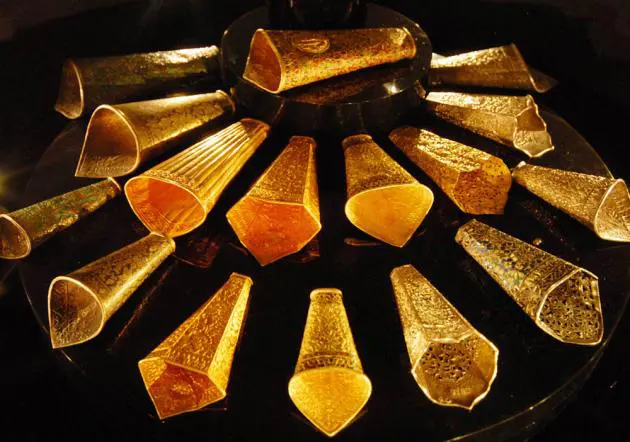
Gold and silver champaks are also used in the coronation ceremony and are hung as decorations on the ceiling of the ceremonial bathing pavilion in and also on the royal nine-tiered umbrella.
“The holy water was collected from 18 sacred rivers in India and Thailand,” Chonlatid adds. “The champak is the flower traditionally used to worship the Buddha.” Other flowers and fruits used in Thai culture during auspicious ceremonies are the pikul, betel nut, and coconut palm, representing abundance.
Other valuable objects include the Chada Phra Kleep, which was created in the reign of King Rama I. It is made of enamelled gold and decorated with diamonds. It is sometimes worn by the members of the royal family with His Majesty’s permission on the occasion of royal ceremonies. The Chada Phra Kleep is similar to the one worn by King Rama V at his first coronation ceremony in 1868.
Also in the custody of the Pavilion are the attires of the Emerald Buddha, gold and silver trees, and different kinds of royal dress and body adornment. These items are carefully conserved and safeguarded.
The last section of the museum exhibits Thai coins, beginning with the flat, round coins of the Funan Kingdom around the first to the sixth century. It was not until 1200s – the Sukhothai era - that Thai money was first introduced. This money, commonly called “Pod Duang”, was the dominant currency in Thai monetary system for more than 600 years. The modern coin came into being in 1904.
After a final look at the Royal Regalia, Chonlatid reveals that the museum sees many more foreign tourists than Thais.
That seems a shame, especially when the admission fee is so very reasonable.
ALL THAT GLITTERS
>>The Pavilion of Regalia, Royal Decorations and Coins is open daily from 9am-4pm every day except Royal ceremonial days. English translation is available. Tickets cost Bt10.
To visit the e-museum, go to http://emuseum.treasury.go.th.
For more information, (02) 226 0251-9 extension 2209.
SYMBOLISING WEALTH
>>The Treasury Department is marking its 80th anniversary by offering members of the public the chance to purchase the Angel of Wealth medal. Proceeds will go to charity.
A statue designed during the reign of King Rama V, the Angel of Wealth is worshipped in his shrine at the office of the Treasury Department, in the Grand Palace. The angel, who holds a lotus in his hand, symbolising wealth, is tasked with protecting the national treasure.
For more information, call (02) 275 5446 or (02) 618 6346..
