
Condo waste-sorting pilot to meet new fees as food and general waste near 80%
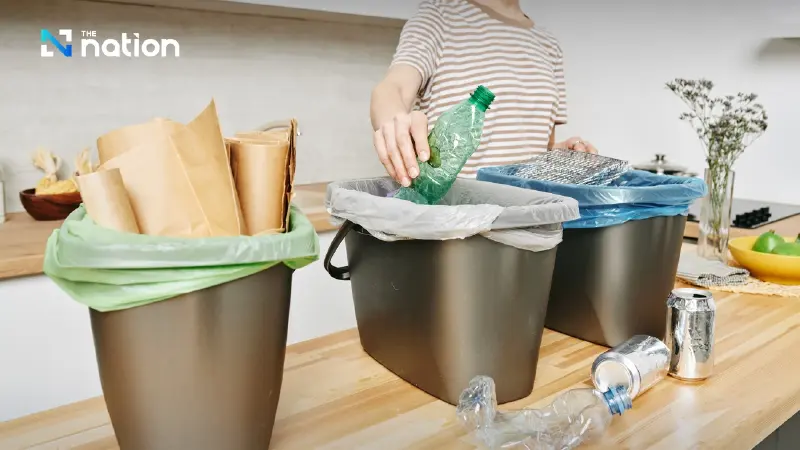


The BMA has launched a “condo waste sorting” pilot in Khlong Toei and Watthana to help buildings prepare for a new waste-management fee ordinance.
The Bangkok Metropolitan Administration (BMA), together with the Thai–Danish network, has launched a pilot project to sort waste in high-rise residential buildings in Khlong Toei and Watthana districts, aiming to create an effective waste-management model in line with the city’s “no mixing” policy.
Survey findings identify food waste and general waste as the main challenges. The pilot will use economic incentives to encourage residents to sort waste and cut fees under the new municipal waste-charge system.

Bangkok’s waste crisis: 9,000 tonnes a day and “pay-as-you-throw”
Pornprom Vikitsreth, Adviser to the Governor of Bangkok, said Bangkok currently shoulders the cost of managing as much as 9,000 tonnes of municipal waste per day. More than 50% of this is food waste, which should be separated at source.
To address the problem, the BMA is preparing to enforce the “New Ordinance on Fees for the Management of Sewage and Solid Waste, BE 2568 (2025)”, which is based on the Polluter Pays Principle.
Under the new measures, pricing will be used as an incentive: condominiums or households that clearly separate waste will pay lower fees, while those that do not will face higher charges.
The pilot project is designed to fill a gap for condo buildings that want to separate waste but lack systems suited to high-rise structures.

Inside condo bins: general and food waste dominate
A field survey by the Thailand Environment Institute (TEI) across 10 pilot condominiums in Khlong Toei and Watthana found the following waste composition:
- General waste: 41% (the largest share)
- Food waste: 35% (second largest)
- Recyclables: 21%
- Hazardous waste: 3%
The study also identified the “top five” items commonly found in mixed bins: food waste, soiled paper, single-use plastics, recyclable plastics, and glass. The data will be used to plan improvements to bin placement and communication to residents, with messaging tailored to the most common problems.

Lessons from Denmark: keep it simple, use pictograms
Danny Annan, Denmark’s Ambassador to Thailand, said Denmark separates household waste into as many as 10 categories, enabling it to recycle nearly half of all waste.
Jens Nytoft Rasmussen of the Danish Environmental Protection Agency (DEPA) added that the key is “simplicity”: bins must be placed close to residents and use standardised pictograms to communicate clearly.
He said the pictogram system has drawn significant attention, with the European Union (EU) moving to adapt it at a regional level.

Scaling up across Bangkok — and beyond
Wijarn Simachaya, Director of the TEI, stressed that effective waste management must go hand-in-hand with public communication, to build awareness and ensure residents understand correct sorting methods.
He said the pilot across 10 condominiums will be an important “jigsaw piece” for extracting lessons and building a flexible model, before expanding to all 50 districts of Bangkok. The longer-term goal is to establish a sustainable waste-management standard that can be adapted for other areas, including across the ASEAN region in the future.
