
Minting the money
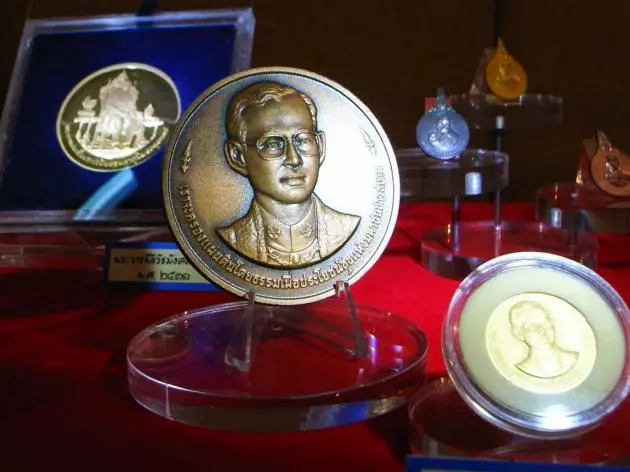


Coins celebrating His Majesty the King's reign and his achievements are the highlight of an exhibition marking the Treasury Department's anniversary
Ever wondered how Bangkok residents of bygone days paid for their daily purchases in the pre-flat coinage era? A rare exhibition, “99 Coins of the King: The Treasury of the Land”, which celebrates the Treasury Department’s 80th anniversary, not only explores how Siam’s first minted money came into being and also takes a look at the evolution of the Siamese monetary system.
Being held at the Queen Sirikit National Convention Centre from November 22 to 25, the exhibition also highlights prominent coins of grand design minted during the reign of the present monarch. These coins display designs and motifs that illustrate the multiple achievements of His Majesty the King.
The exhibition is divided into six themes. “The Ancient Market” examines the use of shells and bullet coins as money in Siam’s previous capitals.
“Savings of the Land” examines the history of King Rama III’s personal savings used in protecting Siam’s sovereignty while “Royal Gift Coinage” looks at the birth of first flat coins in Siam through the introduction of minting machines from Queen Victoria.
The other zones are devoted to “History of the Treasury Department”; “The Making of Modern Coins”; and “99 Coins of the King”.
Various commemorative coins and monetary coins in different denominations will be available to coin collectors.
“The exhibition aims to honour the King’s various achievements captured on different coin designs minted during his reign. My department takes care of not only the manufacturing of the Kingdom’s coins, but also other treasures of the Kingdom. A selection of these will be put on display using various forms of advanced multimedia technology,” says Naris Chaiyasooth, director general of the Treasury Department.
“Viewers will be able to see what life was like during the third to the fifth reigns. That period highlighted Siam’s thriving commerce and its transition to the flat-coin era.”
Thai coinage, along with that of most of Southeast Asia, traces its origins to the Funan Kingdom, which lasted from the first to the sixth century, whose people were Buddhist with a strong Brahmin influence.
Funan was established in the Mekong Delta area and it was here that coinage first appeared. This was based on the Hindu models of silver coins, and throughout the region's history, most coins have been local variations of this early Indian silver coinage.
According to leading Thai coin collector and historian Ronald Jay Cristal, the baht system has been used since the Sukhothai period. King Ramkhamhaeng (1279-1298) is credited with introducing bullet coins. Some experts think they were developed to resemble cowry shells, which had been used as money from ancient times.
Bullet coins were shaped something like a signet ring and made from a short bar of silver, widest at the middle, with its ends bent around to form a complete circle. It was then stamped with various circular decorations, which could indicate certain reigns or places of manufacture. The coins were solid silver, but since their weight varied, their value had to be assessed by weighing before a transaction could take place.
During the Ayutthaya period, many high-quality bullet coins were produced.
The Siamese conceived the idea of flat coins during the reign of King Rama III when one of the king’s ministers visited Singapore in 1835 and reported to the monarch on the use of flat copper coins. Siam’s first flat coins were commissioned by Rama III to be struck in Birmingham, England, through the help by Queen Victoria.
More flat coins continued to be produced in the next reign along with bullet coins, which were too slow to make. In 1857, Queen Victoria sent Rama IV a gift minting machine, which was used to produce the first machine-made Thai flat coins portraying the Chakra and Elephant device on one side and the Crown on the other. Because the machine was a gift, the coins were known as bannakarn, or royal gift coins.
King Rama V introduced the first series of Thai coins with a portrait of the reigning monarch in line with the British mint design, which for the most part influenced Thai coinage.
Coins produced in the present reign are even more elegant and sophisticated, says Putthachat Arunaveja , director of the Bureau of Grand National Treasures.
“Coins that are not ascribed denominations are considered commemorative coins. Making a coin requires a lot of time to think, research and design. You need to choose the right costume for the reigning monarch to be featured on the coin that celebrates a certain occasion.
“Then, you need to choose which throne hall should be featured on the coin. The king’s portrait must always look good and realistic. For example, coins that celebrate the King’s 84th birthday must show a portrait of the King between the ages of 80 and 84. All coins with the King’s portrait must be seen and approved by the King himself. These portraits are based on photos of His Majesty himself,” said Putthachat.
CHA-CHING!
“99 Coins of the King: The Treasury of the Land” is at the Queen Sirikit National Convention Centre from November 22 to 25.
