
THE HOMES WE CALL OUR OWN
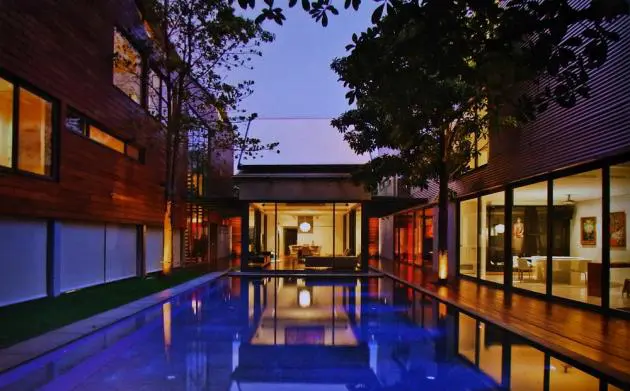


Thai architects' skill at adapting foreign concepts is on display
The 25 houses featured in Robert Powell’s “The Modern Thai House” will likely change your attitude towards Thailand seen through the news media as a country of perpetual traffic congestion, occasional street protests and poor urban planning. These modern houses are sophisticated, sustainable and sensitively designed, as Powell observes. Through these luxury houses, you find a haven of calm, a refuge from urban chaos and even a sanctuary of privacy that the majority of Thais can only dream of.
The point is these houses in 21st-century Thailand are designed by a young generation of Thai architects (in their 30s or early 40s), who were educated either in the US or the UK, and who are producing designs that are not only comparable with but even surpassing the best architecture in the world.
Powell’s positive appraisal is based on a collection modern houses that have emerged over the past decade. Reflecting a long-established trend, these houses are designed by Thai architects who are strongly influenced by Western modernism (because most if not all were educated in the US and the UK), and by their contemporaries in Asia, particularly Japan, China, Singapore and Bali.
So, looking at these houses, one is likely to feel Thailand is always an experiment where foreign ideas are adopted, developed and altered to fit the local climate and culture.
These houses are owned by academics, lawyers, investment analysts, art dealers, a singer, a TV personality, a newspaper editor, an artist, several architects, a financial controller and a banker, most educated overseas. Their homes are their social portraits.
These homeowners have just started a new phenomenon of second homes either out of fear of flooding in Bangkok, or of a personal need to return to nature. They are found mostly in Khao Yai, but there are also vacation homes in Phuket and Chiang Mai.
The designs aim to adhere to the principles of Geoffrey Bawa: tropical houses built in close proximity to the natural world. No substantial trees on the sites are destroyed and there’s a minimal use of glass.
Dr Sumet Jumsai boasts a painting studio by the sea in Sriracha, for instance, which also functions as a Le Corbusier-inspired weekend residence.
Modern houses are a negotiation between the foreign architectural idea and the local context, as noted Thai architect Duangrit Bunnag points out. Regardless of the wealth of the owner, a successful housing design depends on a strong empathy between the client and the designer.
That’s because modern Thai houses still retain their multigenerational profile with complex hierarchies of privacy, an idea that is so deeply ingrained in Thai culture. It’s tricky to find the right balance between intimate and shared spaces. And in these houses, you can’t survive alone without the aid of cooks, cleaners, gardeners, drivers and guards.
Through these pages, it seems size still matters to Thais when it comes to owning a house. But wherever it is, they tend to go for a coherent structure rather than a collision of styles.
THIS JUST OUT
- “The Modern Thai House: Innovative Design in Tropical Asia” by Robert Powell with photography by Albert Lim KS is published by Tuttle Publishing. It’s available at Asia Books and other shops.
-The book is being launched at 7pm tomorrow at the Vue Restaurant of the Hansar Bangkok.
