
Small is beautiful


Play
With its pair of high-quality lenses, Canon's ground-breaking EOS M is a powerful window on the world
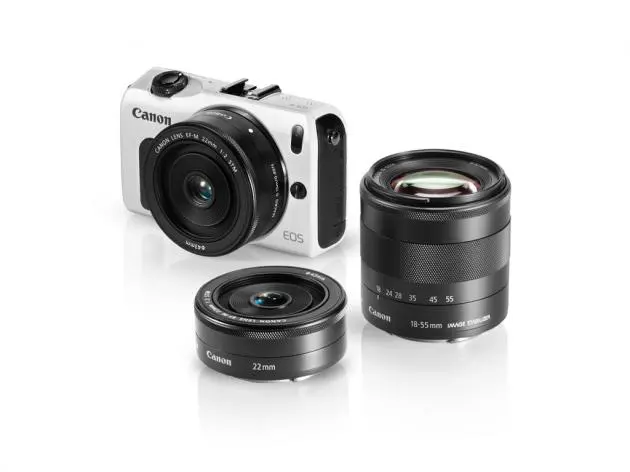
Shooting straight from the research lab comes Canon’s first mirror-less camera with interchangeable lenses. Bottom line: the compact EOS M packs digital SLR quality, capturing photos with sharp detail and eye-pleasing quality via convenient touch-screen controls.
It comes in a light but strong magnesium-alloy body with palm-friendly proportions of 108.6 x 66.5 x 32.3mm, weighing a mere 298 grams with battery and memory card but minus the lens.
The large APS-C CMOS image sensor with 18 megapixel resolution, which is as large as 22.3 x 14.9mm, helps deliver DSLR-quality shots.
Canon has released two lenses for EOS M’s EF-M mount: The EF-M 18-55mm f/3.5-5.6 IS STM zoom, and the EF-M 22mm f/2 STM “pancake”. Both are good matches for the light and compact EOS M body. Also, conventional EF and EF-S Canon lenses can also be used via an adaptor.
The EOS M tested here at the Nation newsroom was the top package, with the two new EF-M lens and a Speedlite 90EX external flash. Tests confirmed that the “pancake” prime lens with fixed focal length of 22mm is very good. Its compact size complements the diminutive EOS M well, while the f/2.0 aperture etches sharp and beautiful portraits against blurred backgrounds.
Both new lenses feature Canon’s STM (stepper motor) for auto-focusing. This makes the EOS M with EF-M lens good for shooting video too, as it allows refocusing during recording. You can shoot in full HD 1920 x 1080 resolution at 30, 25, and 24 fps with stereo sound in MOV format and H.264 compression. But shooting time is limited to 29 minutes 59 seconds per clip.
The EOS M boasts strong performance thanks to its powerful DIGIC5 imaging engine. It took less than two seconds from being switched on for the camera to be ready for the first shot. I detected no shutter lag during the test. And when taking photos in modes that required no post-shooting processing, the camera needed very little downtime between shots.
For the test, I used the high-speed Sony SDHC Class UHS-1 8 GB memory card.
The camera captured images with good details, rich tonal gradation and sharpness in most lighting conditions, thanks to the wide, dynamic range of its 14-bit A/D conversion.
Using the Landscape picture style, we captured green leaves and colourful flowers standing out in well-saturated colours against a bright blue sky.
The touch-screen control includes pinch focusing and makes the EOS M intuitive to use. Most controls can be navigated and selected on the screen, without the need to use the Jog dial and cross-keys control at the back.
The touch screen also provides a “Q”, or Quick Control, button so that shooting parameters can be changed right away on screen. Convenience of use is a strong point of the EOS M.
The Shooting Mode dial offers just three options – Scene Intelligent Auto, Creative Zone and Basic Zone mode – plus Video. Flick to the Creative Zone and you find several more shooting modes for extra control, including Manual exposure, Aperture-priority AE, Shutter-priority, and Program AE.
Meanwhile, the Scene Intelligent Auto mode automatically adjusts the shooting parameters to suit the current lighting conditions, while the Basic Zone mode gives you the responsibility for selecting parameters. The available shooting modes here are Creative Auto, Portrait, Landscape, Close-up, Sports, Night Portrait, Handheld Night Scene, and HDR Backlight Control.
During the test, I especially enjoyed shooting in the Handheld Night Scene mode. This setting automatically brightened the dark scene, allowing me to capture lights at night sharply without the use of a tripod. The EOS M fires four shots in different exposures and combines them into one single image, allowing sharp details to be captured in colourful, brightly lit nightscapes. But the camera apparently used high ISO sensitivity, resulting in night shots that lacked the saturated blackness of scenes captured with equivalent modes of other brands. Despite this, the EOS M night shots were impressive.
I also enjoyed the HDR Backlight mode, which is very useful if you need to shoot in complex lighting conditions, such as capturing a subject against the sun. This mode fires three shots to record highlight, mid-tone and shadows, then combines them into a single image that gathers the details of the different lighting tones.
Using this mode during a test at Samarn Ratana Temple in Chacheongsao, I managed to reproduce the vibrant greens of water hyacinth back-lit by the sun, while retaining the deep blues of the sky.
Then I aimed the same mode at the giant statue of Quan Yin, Goddess of Compassion, and picked out good details against a grey sky.
The Portrait mode was useful for etching beautiful portraits against a blurred background.
To add more fun, you can apply the camera’s Creative filters to your shots. The filters include Soft focus, Fish-eye effect, Art bold effect, Water painting effect, Toy camera effect and Miniature effect. You can also add the filters to previously captured shots.
Key specs:
_ Type: Digital single-lens non-reflex, AF/AE camera
_ Image sensor: 18 megapixels 22.3 x 14.9mm CMOS sensor
_ Compatible lenses: Canon EF-M lenses, Canon EF lenses (including EF-S lenses) With Mount Adapter EF-EOS M.
_ Lens mount: Canon EF-M (1.6 times the lens focal length)
_ AF points: 31 points (Maximum)
_ Metering modes: Real-time metering with the image sensor: Evaluative, Partial, Spot and Centre-weighted average metering
_ Exposure control: Scene Intelligent Auto, Manual exposure, Aperture-priority AE, Shutter-priority, Program AE, Creative Auto, Portrait, Landscape, Close-up, Sports, Night Portrait, Handheld Night Scene, HDR Backlight Control
_ Creative filters: Grainy B/W, Soft focus, Fish-eye effect, Art bold effect, Water painting effect, Toy camera effect, Miniature effect
_ ISO Speed: Basic Zone modes – ISO 100-6400 set automatically; Handheld Night Scene: ISO 100-12800 set automatically; Creative Zone modes: ISO 100-12800 set manually
_ Shutter Speeds: 1/4000 sec to 30 sec, Bulb
_ Video: 1920 x 1080 (Full HD) 30p/25p/24p MPEG-4 AVC/H.264
_ LCD: 3.0-inch TFT capacitive sensing touch screen
_ Recording Media: SD memory card, SDHC memory card, SDXC memory card
_ Battery capacity: 875 mAh, Approx. 230 shots
_ Dimensions (W x H x D): Approx. 108.6 x 66.5 x 32.3mm
_ Weight: Approx. 298g (CIPA Guidelines: Body + Battery Pack + Card)
