
Kiss her gently, then upload


Keyboard taps, bleeps and the pings of instant messages are the soundtrack to life in the logged-in age
As the city with the highest number of Facebook users in the world, Bangkok was the perfect venue for the Southeast Asian premiere of “LOL: Lots of love” by Protein Dance.
Staged as part of the International Dance Festival over three days last week, the audience was transported into the familiar yet bewildering wired and webbed world of friendship requests and status updates right from their seats at Chulalongkorn University’s Sodsai Pantoomkomol Centre for Dramatic Arts.
Appearing before the audience as the lights went on was an empty stage, with three tall screens showing a montage of people in front of invisible computer screens. All of them sported different facial expressions but possessed the same, somewhat unnerving, glazed-over eyes.
Connected through cables, they were physically isolated and deprived of simple human contact. This image became even more distinct when a dancer carried a bundle of tangled wires, almost in the shape of a human body, onto the stage and dumped it on the ground.
Five other dancers joined in and they took turns telling their life events, which sounded far more like a Facebook newsfeed than natural speech, filled as they were with such abbreviations as OMGs, BTWs, and dot-dot-dots. Common emoticons became fascinatingly incomprehensible at first when described as “colon capital D” or “semi-colon closed bracket” even though that is how they’re actually written.
Human relationships were complex enough even before the existence of cyberspace and ultra-fast electronic communication certainly hasn’t solved or even lessened the complications. In fact, the Internet age may well have introduced even more issues to drive us insane.
How many X’s or kisses should one put at the end of a text message to convey the right level of affection? Do dot-dot-dots mean someone has a lot to say or nothing to say at all? How do we know whether someone’s Facebook post “open to new experiences” has a sexual subtext? These are just some of the topics this award-winning dance company explored.
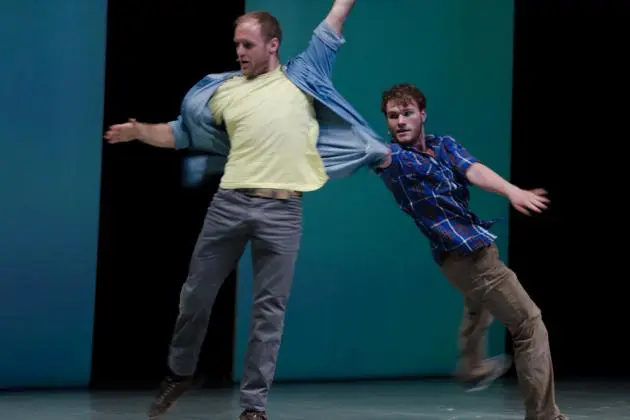
Both the acting and dancing of all six dancers were highly commendable. Even more impressive was how they managed to do both at the same time without being distracted or out of breath. Director Luca Silvestrini’s juxtaposition of the yearning for connection in the dancers’ script and the complete ignorance of the other dancers performing with them also worked extremely well in showing today’s weird world where people seem to be more interested in those they connect with by phone or computer than the people around them.
In a few duets, some dancers were so absorbed in telling their own stories about the “friendships” they’d made online that the failed to recognise the presence of their dancing partners even though they were thrown around, jumped over, or even stood upon throughout. Even when real meetings took place onstage, the parties involved were unable to let go of their screens. A man was desperate to record his kiss on the phone, while others were disappointed by how their dates turned out in reality.
Andy Pink’s inventive original score made excellent use of keyboard tapping, bleeping, and instant messaging pings to enhance as well as direct the movements. One dance number was constructed entirely to these sounds from intricate popping, locking and flowing steps, bringing loud applause from the audience. At the same time, this highly entertaining dance was melancholic in the way it captured how controlled we are by the Internet.
The show ended with the first dancer wandering alone onstage before going back to his confused mass of twisted wires. He gently lowered himself and curled up on the bundle as John Lennon’s “Love” came up. The contrast between the definitions of love as “real”, “feeling” and “touch” in the song and the image before the audience’s eyes made how longingly he embraced the isolation of these online connections even more poignant.
