
This Lamsing doesn't sing
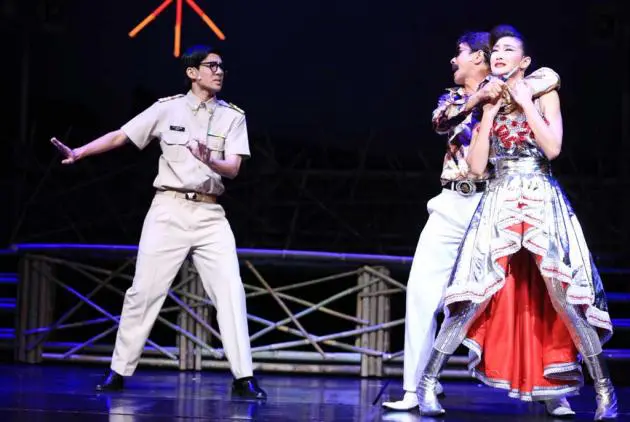


'Lamsing Singer' belongs on campus, not the professional stage
Watching “Lamsing Singer”, a co-production of GMM subsidiaries GTH and Scenario at Muangthai Rachadalai Theatre just before the festive season, reminded me why I had stopped frequenting university student productions of a certain kind several years ago.
Four decades ago, Thai university students were much more active in politics and thus used productions as platforms to voice their opinions as much as to experiment with theatrical styles, often adapting both foreign political and social plays as well as writing new pieces.
Today, most university student theatre productions can be roughly divided into two categories. There are those produced by theatre majors, which are “by the book” and others by non-theatre majors, which are less predictable and, in some cases, remarkably social and political. Examples can be found in the works of communication students attending Thammasat and Bangkok Universities and from time to time I watch them. At other schools, tradition dictates that senior students follow a certain format, making productions predictable in both form and content. Examples are the communication arts and architecture students of Chulalongkorn University, known as “Lakhon Nitade” and “Lakhon Thapad” respectively, and these are the ones I stopped watching several years ago.
In 2007, Toh Klom, a subsidiary of Work Point Entertainment, transformed “Pritsana”, a “Lakhon Thapad”, into “Chaiklang”, a professional production at Muangthai Rachadalai Theatre, and it was not successful.
“Lamsing Singer” has suffered the same fate. It is still a “Lakhon Nitade” with the same title.
Though the script has been edited for this professional restage, there are still many irrelevant jokes that fail to move the story forward. And while the subject matter is good — lamsing is the most popular entertainment form in Northeastern Thailand, the three scriptwriters do not seem to have done enough research. What the audience sees on stage doesn’t look, sound or feel like a lamsing troupe and the final number is not a lamsing performance, but more a parody of how university students have interpreted music videos from YouTube.
Thai movie star Chantavit Dhanasevi and TV comedian and hostess Panisara Phimpru reprise their student roles in this stage show. The former is as charming and engaging as he is on the big screen, proving the producers’ talent for typecasting him. The latter is a true chameleon and her comedic timing is nothing short of genius. Supermodel and TV actress Khemanit Jamikorn makes her professional stage debut and while she can perform on stage, she is not totally believable as a lamsing artist, a role that requires considerable singing skills.
The show’s website says that Nantida Asavahame, who portrays Khemanit’s mother, is ailing and that’s why performances on weekdays and Sunday evening have been cancelled. Audiences suspect that the cancellation is partly due to the staggering ticket sales. When I saw the show, Nanthida was replaced by her understudy Chonlekha La-ngu who, despite her experience in many stage productions, was not really credible as a mother. This was probably due to lack of sufficient rehearsal time, which would have allowed her to develop the character better.
Despite being a stage comedy with a few songs, there is a band in the orchestra pit. This is not a reason why tickets cost Bt 2,500 a pop. I found myself wishing I were in the band just so I could enjoy napping or playing cards in between songs.
ISAAN NIGHTS
“Lamsing Singer” continues until January 13 at Muangthai Rachadalai Theatre (MRT: Thailand Cultural Centre).
Show times are Friday at 7.30pm; Saturday at 2pm and 7.30pm and Sunday at 2pm.
Tickets are from Bt500 to Bt2,500 (students can buy Bt1,500 tickets for Bt800, Friday only), available at ThaiTicketMajor.
For more details, www.GTH.co.th.
