
Getting snippy about iSnap
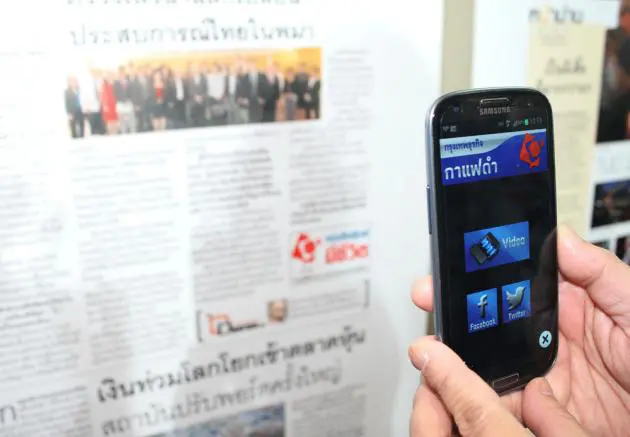


Who really needs a smartphone anyway?
I don’t own a smartphone.
And I don’t plan to, even if there are already 1 billion smartphone users in the world and 84 per cent of them use their gadgets to browse the Internet and 76 per cent to check e-mails.
Not even if the big boss, Suthichai Yoon – a big fan of technology himself – says I’ll be in trouble if I don’t own a smartphone by next week. This, after he demonstrated how The Nation’s newest innovation gives readers added value through a more interactive reading experience.
I’ve always considered owning a smartphone pointless since I am at a desk the whole day connected to the Internet on my Windows PC. If I need to call or SMS someone, I do not need a smartphone. I just need my reliable analog phone.
To the world’s technology-savvy population, this is social suicide and now, may also mean career suicide. Imagine working for a company whose new advancement in delivering the news involves an app, called iSnap, that allows readers to scan stories so they can view videos and photo galleries. I am not just a social pariah, but a multimedia pariah as well.
I first saw iSnap in action when my other boss, Pana Janviroj, was testing it on the way to a meeting a week before the app was launched. He spent his time in Bangkok’s legendary traffic scanning stories on The Nation with his iPhone. It was fascinating to witness an otherwise traditional media platform produce new media content through iSnap. The app does indeed bring stories to life.
Who would have thought that a device that used to be attached to a landline and which you absolutely could not take anywhere, could go mobile then smart. Isnt technology amazing?
Even the big boss’s driver has a smartphone, which he uses to shoot videos for the head honcho’s podcasts. And here I am, a so-called multimedia journalist without a smartphone.
Still, I am not convinced that a smartphone is essential to my life. Shooting HD videos? I have my DSLR. A phone’s function for me is still primarily for voice calls or SMS. I don’t need other add-ons. Or maybe this is what others call the generation gap. Not that I don’t have my share of gadgets. I have an iPod, which I don’t technically need now since I have an iPad (first generation), with which I can also listen to music.
So shall I buy that smartphone to save my career and be a real multimedia journalist in both practice and gizmos?
My colleague, Vichuta Prawittkarnh, whose IT team is in-charge of iSnap, saved the day when she mentioned that the app is also available on iPad. Now, this offers more appeal for non-smartphone fans like me. The app is available for both smartphone and tablet. (iSnap works only for gadgets with cameras.)
Now, let me go online to see if I can buy a new tablet.
Smartphones make things a snap
AVIGAIL OLARTE
ASIA NEWS NETWORK
It’s not every day that a company CEO asks you to check out brassieres. And, no, it was not at some expensive lingerie shop but right in his office, with his smartphone hovering over a Wacoal newspaper ad.
It was unsettling to see a senior, well-respected man checking out scantily clad women in pink undies. But he was not to be denied, and before you think it was merely some prurient ritual, he was directing our attention to a revolutionary idea: the iSnap, a new technology that’s driving mobile commerce, out to save the future of print journalism.
Thailand is one of the first countries in Asean to use iSnap, and in Thailand, The Nation is the first. The idea behind this cool technology is to allow you to have extra, multimedia content as you scroll through the printed daily paper or the e-paper.
Simply hover your phone’s camera over a print ad or a news story marked with that orange, squarish icon and an impressive gallery of videos, photos, and social media links will dazzle you. It’s like circus magic – a phone interacting with printed paper – only there are no tricks, and the possibilities are endless.
Just make sure you have a super-speedy Internet connection. Downloading the app from Google play to my Android phone took a full 10 minutes. Streaming videos was just as difficult. But if you’re at a good hotspot, everything streams through your phone in, well, a snap.
There’s no denying that print journalism is fast becoming a luxury that only few can afford – not only is it expensive to produce it, it is also expensive to buy it. But in newsrooms around the world, revenue from print operations still largely funds online operations. If designed cleverly and promoted well, the iSnap, which is a free app, might just as well bring in the money to help journalists like me keep their jobs.
So do journalism some good, click on that app.
