
Strange creatures come to life


Chiang Mai thrills to the best of Southeast Asian puppetry
If the Asean Enchanting Puppets Festival, staged in Chiang Mai last weekend by the Tourism Authority and Chiang Mai University, made for a dazzling display of puppet virtuosity, there were two festival events in particular that went far beyond mere entertainment, providing refreshment for the soul.
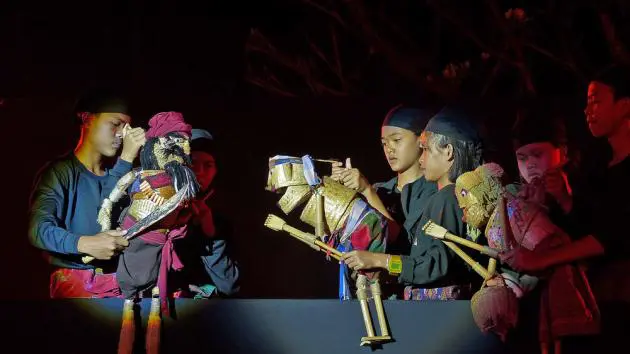
The Issan-based Dek Thevada Troupe astonished the most. Only schoolchildren, their performance conveyed breathtaking professionalism, great wit and spiritual enlightenment.
The troupe’s puppets were made of sticky-rice containers and other everyday objects, but they made so much out of so little. The rough-hewn puppets came to life with a multitude of colours to tell a story that gripped adults and children alike.
Director Preecha Karun sees puppetry as a way of giving people a voice. Believing as a Buddhist that enlightenment is accessible to all, he has worked with children who committed crimes. Locked up in institutions, they were too scared to speak for themselves, but could express themselves through puppets.
The Dek Thevada youngsters are in no trouble at all, but still learn from Preecha that they have a duty to strive for enlightenment, and can do so by combining fun with morality in creative art.
On Saturday night Dek Thevada told tale of “Angulimala”, about the fellow from Buddhist literature who wore a necklace of the fingers of people he’d murdered. He had slaughtered 999 souls, but the Buddha stopped him from taking a 1,000th victim – his own mother.
The puppetry was highly animated to begin with, drawing many laughs, but then tears mixed in as the themes of sin and redemption came forward and we saw the victims in their death throes. Ultimately, of course, joy returned with the recognition that we can always change for the better – and that some of the youngest participants in the festival were capable of such a great performance.
Dek Thevada should be sent round the world as a representative of the spirit and soul of Thailand.
The other outstanding presentation was by the troupe Krabong Laos, whose leader, Leuthmany Insisiengmay, proclaimed that his productions follow no rules, setting them apart from traditional puppetry.
Like their neighbours in Isaan, Krabong also uses sticky-rice containers and other cast-off objects, full of character even if not so pretty. Its most fantastical show had coconut masks on the actors’ arms, knees and faces, with fluorescent material creating an effect at once supernatural, terrifying and sublime. If puppetry is all about making dead materials come to life, Krabong goes further, suggesting the nature of eternal realms. Leuthmany’s avant-garde remake of puppet art is shocking and brilliant.
The Vietnam National Puppetry Theatre offered more surprises – magical, clever and great fun too. The performers came onstage wearing thatch on their heads and linked arms to become strutting ostriches. The choreography, using conventional but beautiful puppets, was enthralling.
Thai troupe Jona’s most effective sketch had a ghostly masked human interacting with a puppet of seemingly inanimate materials. Had the puppet become human or the human puppet?
The delight was in not being able to figure it out.
And the Philippines’ Mulat Theatre showed its trademark adrenaline and playfulness in a production by Amelia Lapena Bonifacio about the King of the Monkey’s dreadful headache.
Hilarious animals popped up everywhere doing ridiculous things in what was simply the most lovely entertainment, bringing peals of laughter from the children.
Htwe Oo Myanmar produced exhilarating effects with puppets controlled by a multitude of strings. The audience was unaware of the many complex mechanical actions, but appreciated the fluidity of the characterisations.
There were terrific shadow-puppet shows from Indonesia and Thailand. The Thai one, with scenes from everyday life – such as children using emotional blackmail to extract pocket money from their dad and then vanishing with it – drew knowing laughs.
The festival included demonstrations and seminars, with a particularly good one from the Joe Louis Theatre that showed why three people are needed to control one giant puppet. They did their routine without the puppet and then with it, showing how their profound dancing skills are made a part of the puppet's larger-than-life identity.
Failures of management marred an otherwise remarkable event. The biggest mistake was scheduling the Vietnam National Puppetry Theatre’s water-puppet show for a sort of grand finale. The huge tank of water waiting at the side of the main stage forced audience members to switch seats quickly, many ending up with obstructed views.
Because of the crowding and discomfort, the finale – a riotous display of fire- and water-breathing dragons – was kept brief, making it all the more absurd after all the trouble of bringing the puppets to Chiang Mai. They should have had a full-length show and at a better location.
There were also frequent programme changes, leading to missed events and late arrivals – and children enduring a dry lecture instead of enjoying a fun puppet show.
The festival deserves to be an annual event, and with better management, it would be even more adorable next time.
