
Neglected for so long


Concurrent exhibitions make amends with Chang Tang, whose recognition came too late
What I created
Was not a kind of product,
In exchange of gold and/or money
But to express human value,
The value of human wisdom!
So wrote the self-taught artist and poet Chang Tang (1934-1990). He was ready to be brave, even revolutionary, for his art. He was prepared to do hard labour, even clean toilets, to feed his wife and seven children and keep making art. He had to – he never sold a single poem or artwork while he was alive.
Yet in three decades Chang produced 200 paintings, nearly 6,000 drawings, more than 9,000 pages of poetry and several sculptures.
The best of them now draw six-figure prices, and much of his output is currently on view at both the g23 gallery and the new Subhashok Arts Centre, lovingly assembled by his son Thip Tang, caretaker of the estate.
It includes, in the show’s catalogue by artist and lecturer Wiroon Tungcharoen, this quote: “I’m hungry. I’m really hungry and have lived in hunger. Only my art and my literature are rich, since I have created them to be intellectual property.”
“One day,” says Thip, “I found among my father’s poetry the line ‘It was my desire to have my very own space’. “That’s what inspired me to mount this show.” And “Tang Chang: ‘It was my desire to have my very own space’” focuses on portraits, landscapes and depictions of the artist’s daily routine.
The first section adheres to another line of poetry: “I never charged for doing portraits of other people’s parents.” The “parents” here include Their Majesties the King and Queen, painted in 1961, as well as Rama V and another of Rama IV as a monk.
“I have never been commissioned to paint landscapes,” Chang also wrote, and yet the watercolours he painted around his home from 1953 to 1959 are lovely, doubly captivating because they capture Bangkok in “the good old days”, when people still lived comparative harmony with nature. His 1959 marketplace painting “Talad Plu” shows the old wooden shophouses that long ago yielded to concrete structures.
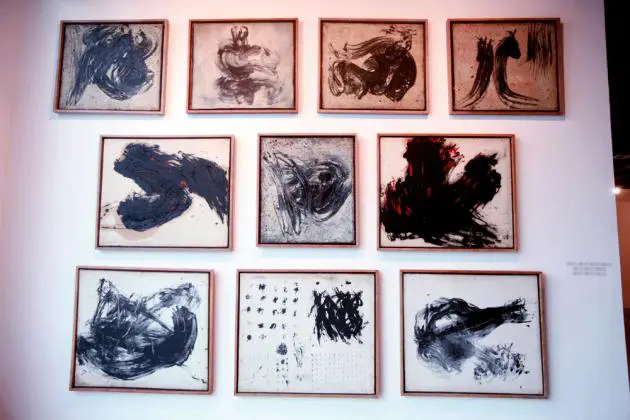
“I was never hired to do any paintings,” Chang wrote as well, and yet his huge abstract-expressionist works, inspired by Zen and Taoism, are daring, suggesting that he was perhaps too experimental for common tastes.
Among the highlights of the show overall is Chang’s final painting, “Withered Plants”, which decorated the visitors’ book in his room at Rajavithi Hospital. It rests in a glass box, poignantly accompanied by a plastic baby doll that Chang had fashioned in 1957.
Having just undergone an operation, Chang was asked by a doctor how he was feeling. In response, Chang drew the basket of flowers a friend had left in his room, deep purple against a yellow background, with one of the blossoms notably withered. He gave the painting its title and signature in shaky handwriting, reflecting his weakness.
A self-taught philosopher, Chang converted his home-studio in Thonburi into “Poet Tang Chang’s Institute of Modern Art” in 1985. It became a meeting place and one of Thailand’s first public art centres.
After Chang died of renal failure on August 26, 1990, at age 56, his family sold about 40 artworks, earning enough to survive on and to build a museum in Nakhon Pathom’s Sampran district. It opened in 1997.
At Srinakharinwirot University’s g23 gallery, Thip has mounted his father’s 1960-1969 abstract paintings and the poetry that Chang wrote in geometric and figurative patterns around the page. The gallery gives the huge abstracts their full due, inviting the viewer to engage in a sort of meditation.
Unlike Western abstract expressionism, Chang’s paintings derived from a mind emptied of trivial things in the best Zen tradition. He shunned brushes and used his fingers and whole hands to spread around the same type of cheap paint used on boat hulls. The result is continuous movement on canvas, with layers of pigment building into three dimensions.
“Oils for painting were really expensive, so my father used the cheaper paint used for coating boats,” Thip explains. “The benefit is that it still looks good now in the shaping and the volume.”
“Black on Black” from 1962 and “White on White 1” and “White on White 2” from 1996 are muscular battles in texture, the light catching the raised surfaces even as it vanishes elsewhere into the absence of colour.
Chang’s poetry is on display in the adjoining room. As in a drawing, the poems are mostly sketches of a few words, about people, the forest, animals and the sun – and about hunger, resistance and dictatorship. They provoke thought by the shapes of the nouns and verbs.
In a 1978 untitled series he uses only two words. The word “people” is repeated to form a human face, while “dictator” forms the ears, eyes and mouth. The clear message is a loss of freedom of expression.
Thip made an award-winning 26-minute film about his father’s life and work that on view in both exhibitions. Presented in animation style using stop-motion, it mingles clips of his father with Thip’s own depictions of Thailand’s pioneers of conceptual art.
REMEMBERED
- “Tang Chang: ‘It was my desire to have my very own space’” is at the Subhashok Arts Centre on Sukhumvit Soi 33 until March 31. Visit www.SACBangkok.com or call (02) 662 0299.
- “Tang Chang: Abstract Paintings – Concrete Poetry” is at Srinakharinwirot University’s g23 gallery on Sukhumvit Soi 23 until April 28. Find out more at G23.swu.ac.th and (02) 649 5000, extension 15306.
- The Tang Chang Private Museum is at 29/5 Moo 2 Sampran, Nakhon Pathom. Call (02) 811 9628 or (081) 839 0212.
