
Japan's new toon tourism


Play
The settings for popular anime and manga series are hot travel destinations
It seems an increasing number of people are visiting the settings of their favourite anime animated productions and manga comic strips. Some rural towns are using this upswing to their advantage as they seek to energise their communities and bring in new visitors.
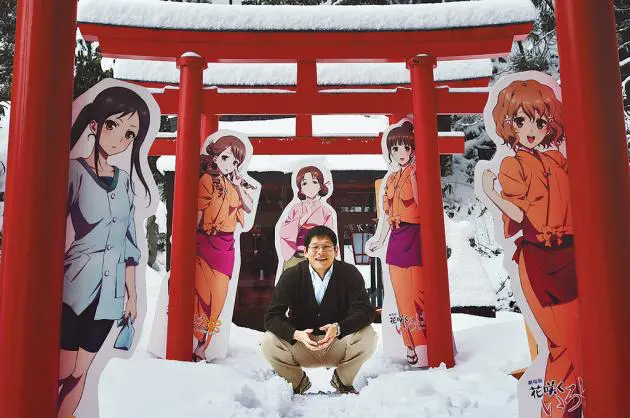
A prime example stems from the anime TV series “Hanasaku Iroha”, which aired in 2011 and features a high-school girl who is a part-time maid at a Japanese hot spring and inn modelled after Yuwaku Onsen in Kanazawa. The film version of the anime, “Hanasaku Iroha: Home Sweet Home”, will be released on March 30.
On October 9, 2011, more than 5,000 people, mostly men in their 20s to 40s, gathered in the small hot-spring town. They had come to participate in the Bonbori Festival. Whereas most festivals are deeply rooted in history, the Bonbori sprang into reality from the fictional world of the “Hanasaku” anime.
In the anime, the festival is held to send a little female god on her way to Izumo Taisha shrine in Izumo, Shimane Prefecture, during Kannazuki, the 10th month of the lunar calendar, when it is believed all gods gather at the shrine.
People around the goddess carry bonbori paper lanterns weighed down by tablets on which their wishes are written.
The Yuwaku Spa Tourist Association brought the festival to life with the help of the anime’s producers to promote the spa. About 7,000 people visited the spa during the second festival last year.
“Those who gathered at the festival came all the way from Tokyo and Okinawa Prefecture. Where does their passion for the festival come from?” asks Kenji Horikawa, one of the event’s key organisers and president of PA Works, which produced the original anime.
“I’m not well versed in anime,” he modestly claims.
Before dropping out of Toyama University, he majored in chemistry in the school’s faculty of science and joined a group that performed puppet and stage plays for children, which later motivated him to enter the entertainment world. “I want to create something, even if it’s a drama or a stage performance,” he says.
He was so impressed by the classic anime “Kaze no Tani no Nausicaa” (“Nausicca of the Valley of the Wind”), produced by Studio Ghibli, that he chose to enter the world of 2D images. “I was surprised that ‘Nausicaa’ had such a clear, strong message for viewers. I wanted to create a work of similar power.”
Immediately after, he dropped out of university and entered a vocational school for animation in Nagoya. After working for several production companies, he moved to Toyama Prefecture, home of his wife’s parents, to found his own production firm.
Word of his firm spread through joint production of popular works, such as “Kokaku Kidotai” (“Ghost in the Shell”): Stand Alone Complex”.
PA Works, which is based in Nanto, Toyama Prefecture, became known in the animation world as one of a few small production houses capable of providing high-quality work.
The firm has another studio in Kodaira, Tokyo, whose works include “Tari Tari”, “Another” and “Layton Kyoju”.
Asked about the disadvantages of being located far from Tokyo, Horikawa says, “We used to have to develop our images on film [and physically send them]. But now we can send the images as data [via the Internet] in many cases, so we don’t really feel there are disadvantages to being located in a rural area.
“However, as we have to record voice actors in and around the Kanto region, we also have a studio in Tokyo. Teleconferencing effectively connects our Toyama headquarters with the Tokyo studio.”
Produced in commemoration of the 10th anniversary of its foundation, “Hanasaku” is the first completely original work by PA. The acronym in the company's name stands for “Progressive Animation”.
Horikawa is often misunderstood as an artist who draws animation, when in fact he is an animation producer. “My work is to put scriptwriters and animators together and continuously challenge them to create animations that I like,” he laughs.
The key to the “Hanasaku” plot is the business log the protagonist finds, which is similar to Horikawa’s blog, in which he records his thoughts and feelings.
“People often say they feel a sense of stagnation. I wonder if people nowadays are so caught up in their affluent lifestyles that they become numb to the sense that something important is missing. As a result, they can’t project, can’t dream about the future,” he wrote in February.
“Therefore, I want to provide stimulus for them through anime. I may feel differently in a few days though. I notice something new every day.”
What does Horikawa think of the dedicated pilgrims who come from far and wide for the Bonbori Festival? “I wonder if they crave a place where they can unleash their energy around something anime-centred. In the end, they are probably seeking to forge bonds with other people.”
He says the fans seldom clearly state what they want, and if they did, it wouldn’t be as interesting.
“I try to take into consideration what’s in their subconscious, and give it shape. This is my basic principle for the next 10 years.”
