
On the right track


Play
Japanese railway company JR Kyushu has made train travel a pleasurable and profitable experience through innovative design and comfort. Can Thailand's future high-speed network follow the same route?
Bangkok’s Skytrain and metro are undoubtedly convenient, but with the sheer number of people packing into the carriages, neither mode of transport offers the traveller a relaxing experience. The commuter trains that run between the city centre and outer suburbs are less crowded but can’t be counted on for punctuality. Hardly surprising then that here in Thailand, where future investment in transportation infrastructure development, including the high-speed train and dual rail tracks, is still under debate, the private car is inevitably the first choice of transportation.
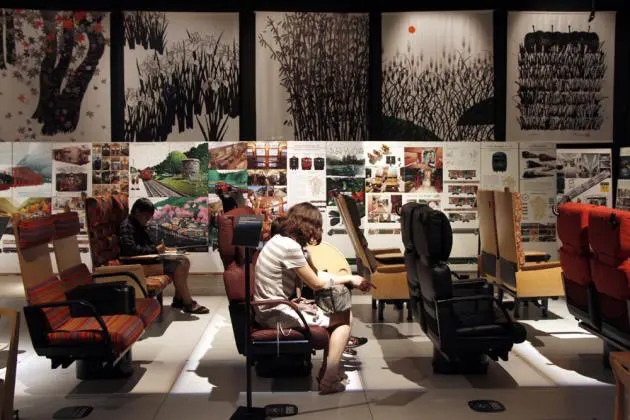
For another take on the train, it’s worth squeezing on to the BTS as far as Phromphong station to visit the Thailand Creative and Design Centre (TCDC) on the sixth floor of the Emporium mall. The current exhibition “Designing a Happy Journey: Reviving Kyushu through Creativity”, is a showcase of rail travel with functional and complete in-carriage service and demonstrates that the train can be a convenient and pleasurable means of transportation, no matter if you are commuting, sightseeing or journeying across country.
The exhibition comes courtesy of Japan’s Kyushu Railway Company, or JR Kyushu as it more familiarly known. When JR Kyushu privatised in 1987, it was suffering a major deficit, the result of the recession in the Japanese steel industry and competition from highways and air flights. Using a creative combination of regional raw materials and regional history in the redesign of its rolling stock and collaboration with local people, JR Kyushu struggled through change and profit losses and today is not only successful but also globally famous.
“This exhibition is the result of a field trip to Japan last year in search of a way to take advantage of value creation in high-speed railway projects that our country can apply,” says TCDC director Apisit Laistrooglai. “Part of the field trip was a visit to an exhibition held by JR Kyushu that featured an exemplary exploitation of creativity in the development of train and related services along the railways and explained how these helped the company to survive losses and become a profitable business with a growing reputation.”
JR Kyushu’s pivotal change of strategy took place when the company recruited Eiji Mitooka, a freelance designer and founder of Don Design Associates, to make the railway unique both in design and service.
“Mitooka has combined design and art to make train travel more than just a mode of transportation, but also a source of pleasure and enjoyment,” says TCDC’s curator Nunnaree Panichkul. “He uses top materials like leather, fabric upholstery and wood to ensure the comfort of passengers because he believes nothing is an unnecessary luxury for public facilities.”
In his effort to build brand image, Mitooka not only designed the train’s exterior and interior, but also developed the stations, employee uniforms and accessories, railway signs and public media. In the exhibition, visitors can examine his rendering illustrations and graphics as well as his interiors, furniture, textiles and uniforms, touching iPad screens to see the images. It’s even possible to flip through his design blueprint for each train. One train features carriages in the front and back with glass observation lounges while another has a common space not unlike an art gallery at the entrance that showcases calligraphy.
“The designer wants to encapsulate the services and amenities you’d find in the finest hotels within the confines of train cars. The 787 Series Express Train that brought him fame makes the 3.45-hour journey from the North to the South of Kyushu enjoyable. Thanks to the spacious area, passengers can move freely around the carriage. There’s a buffet car, a cafe and private salon seating as well as open salon style seating where passengers can gather around a table and chat with other passengers,” says Nunnaree.
Visitors to the exhibition can sit in sample train seats and watch the video to see the inspiration behind the design. Family seating that Mitooka designed for the sightseeing train Aso Boys! allows a parent and a child to see things from the same height. The seat is also designed with a switchable cross seat instead of a rotating one, so that the child is always sitting on the window side. On display too are rotating seats covered with genuine leather and reclining seats with colourful fabric upholstery and a white wooden table below the armrest.
The mock-ups of Mitooka’s interiors clearly demonstrate his attention to local materials and local craftsmanship. The design is based on value creation from existing resources that can lead to the sustainable development of the local tourism industry. The 800 series Shinkansen cabin, for instance, is decorated with gold leaf and lacquer themes that celebrate traditional craftsmanship. Mountain cherry, a species native to Kyushu, is used for wooden furnishings such as the window blinds and frames with ancient lacquer for the doors.
Traditional Japanese materials like clay, cedar and bamboo are adapted for booth walls. The rush grass carpet and Japanese paper inserted inside the glass partitions add a classy touch.
The train exteriors relate regional folklore and geographical areas. The Hayato no Kaze Express train that runs along the Kirishima volcanic belt is painted black because here, visitors can find all things black - from vinegar to pork, beef and sugar.
The Ibusuki no Tamatebako sightseeing train is based on the legend of Urashima Taro. The black and white appearance of the train car represents Taro’s transformation from a young man with black hair to an old man with white hair. Shelves filled with books on local folklore line the carriage.
Working with residents to develop initiatives aimed at attracting tourists allows JR Kyushu to build strong bonds and generate positive energy. The local townspeople prepare unique “ekiben” or box lunches at stations en route that complete the train experience.
The next big thing for Mitooka is a deluxe sleeping car excursion train called the Seven Stars, which is scheduled to operate a circular tour of Kyushu in October. Inspired by the Oriental Express, the Seven Stars – the name is derived from the seven prefectures of Kyushu – is made up of seven luxury cars with two- and four-day trips available.
The train services, however, generate only 40 per cent of the company’s income with the rest coming from other business, meaning that JR Kyushu remains profitable during the low season. At present, the company manages hotels and condominiums linking to the train stations and is also involved in regional agricultural, growing its own tomatoes, garlic chives, sweet potato and bell pepper.
“Thailand has a rich culture and craftsmanship skills. JR Kyushu’s strength in combining local culture and materials with modern technology and calling for local community involvement is surely the best case study,” says Nunnaree.
RAIL TALK
“Designing a Happy Journey: Reviving Kyushu through Creativity” exhibition continues until May 26. Thailand Creative and Design Centre is on the sixth floor of the Emporium mall and is opened daily (except Monday) from 10.30am to 9pm. Admission is free. Call (02) 664 8448 extension 213 or 214 or visit www.Tcdc.or.th.
