
A brush with Buddha nature


Play
Zen monk Phap Hanh has never taken a painting lesson in his life
When I was asked to meet a Buddhist monk who had created hundreds of paintings, I was dubious. I’m not a big fan of paintings – and I doubted how good the art of an untrained monk would be.
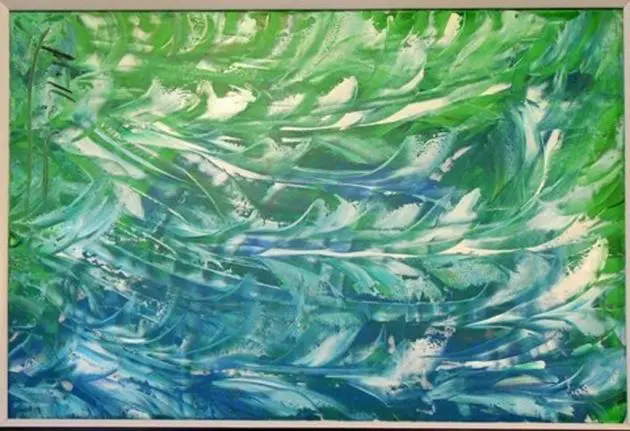
But soon into my encounter with Zen master Phap Hanh (born Nguyen Quang Thinh), I realised he was not just a gentle and peaceful person, but a genuine artist whose abstract oil paintings were far from amateurish. Colours play a more important role in the monk’s works than spiritual themes, but his devotion to art is practically religious.
“I first started painting about 13 years ago,” he says. “I realised I could use colours to describe the movements of my mind, as well as the movement of the heavens and the earth.”
Born in 1965 in Thua Thien-Hue, Phap Hanh is currently training in Thien Vien Khong forest in Vietnam’s southeast. Ordained at 14, he first practised in Myanmar and India as a member of the Tibetan Tantric sect of Buddhism before being drawn to Zen. Though Zen has a long and rich history of artistic accomplishments, Phap Hanh has never taken a single painting class.
Every painting in his collection has its own story. He deliberately avoids giving the works titles, so as to encourage each viewer to interpret the paintings in their own way.
He tells of how he once witnessed a man on a bicycle crash into a “very small child” selling lottery tickets. Both rushed to collect the tickets from the road. But the child suddenly said: “You should go to work. I will pick up the tickets as I’m only slightly bruised.”
The monk thought that a picture could illustrate this message of tolerance better than a thousand pages. At that moment, the sun broke through the clouds – so sunshine made its way into his painting. The monk attributes many of his artworks to such moments and often gives more credit to the subjects than to himself. Looking at the painting in question, he says he sometimes feels that the child who inspired him was the artist, rather than he himself.
“The more people create art filled with kindness, whether it’s drawing, poetry or music, the easier it will be for society to triumph over evil,” he says.
“In the teachings of the Buddha, there is one thing that I always fully agree with: love the country despite its flaws, like how you love your parents even when they make mistakes. I think all religions have the same ultimate meaning.”
True to his description of painting as a selfless act, Phap Hanh has donated all his paintings to raise funds for charity.
“I have never thought about selling my works,” he says. “I just want to give them to people who are passionate about art and who want to use my paintings for charitable purposes.”
His most recent donation was of 200 paintings, which he gave to the Vietnam Union of Science and Technology Associations (VUSTA) community development fund.
“I met Do Thi Van, vice chairman of VUSTA, last June. She was impressed with my work and asked for a picture to boost the morale of VUSTA members. But when I heard about the foundation’s mission – to contribute to the community and support disadvantaged children – I decided to donate 200 paintings,” the monk says.
The Buddhist community also supports Phap Hanh in his charity work.
“The Buddhist ideal is to educate people to do good things, but your actions are also very important. To be a true Buddhist, you should both practise and help people in real life,” he explains.
Listening to him speak, I feel slightly ashamed by his generous heart. His feeling of responsibility for others is much greater than mine. He willingly seeks out solitude so as to meditate on compassion. I don’t have nearly that much faith. But I can’t help but be inspired by his words.
“I do not define my paintings as abstract or realistic,” he says. “I found peace in my painting and hope to bring peace to everyone who looks at them.”
