
Explorers behaving badly


Play
Vasco da Gama's atrocious actions in the Far East five centuries ago explains Muslim wrath today
“The Last Crusade” is a textbook example of history that’s too hair-raising to be included in school textbooks. Its revelations about the celebrated Portuguese explorer Vasco da Gama are so shocking that Wikipedia ignores them – even as it cites the book among its sources.
Appallingly, Wikipedia quotes only what little praise it could find in the 2011 edition of Nigel Cliff’s book (then titled “Holy War”), thus repeating the grievous sin of omission that Western educators continue to commit.
Gama established Europe’s sea route to India in 1498, true enough. And he endured extraordinary hardships getting there. But to believe that he thus advanced the Age of Enlightenment is chauvinism of the worst kind. Gama secured a lion’s share of the spice trade for Portugal with crossbows and cannon. “Gunpowder might have taken the chivalry out of war,” Cliff writes, “but it was the agent of Portugal’s empire in the east.”
Columbus has been torn from his triumphant pedestal in recent decades. Now the detractors need to turn on Vasco da Gama. He was among the most brutal in a long line of vicious European “explorers” who thought nothing of hacking down obstacles and opponents in the name of Christ.
In fact, it is Nigel Cliff’s contention that the primary mission of Gama’s voyages was to eradicate Islam once and for all. Portugal’s kings wanted to mount another crusade to reclaim Jerusalem, and the money to finance it would come from spices and other coveted goods from the Far East, access to which the Muslims were blocking. The “Moors” would have to be dealt with in the Indian Ocean first, and then in the Holy Land.
This “last Crusade” theory is a bold assertion, placing the Christian drive to proselytise above the romantic yen for conquest and even the businessman’s lust for oriental riches. It demolishes the myth of intrepid explorers seeking out new lands to claim for the glory of – of what, exactly? What did they tell us in school – the glory of their homeland, of white men, of Jesus?
The conquered populations and the extinguished tribes attest to no such glory, and Cliff draws an undeniable connection between the marauding Christianity of the 15th century and the Islamic jihad of 9/11. With history’s lessons suppressed, to this day the West pays for its arrogance in the East.
“Prior to the emergence of the Portuguese, control of maritime trade in the Indian Ocean was established peacefully,” researchers at the University of Calgary in Canada say in an online essay that’s far more measured than Cliff’s criticism.
“Over the centuries, a mutually beneficial relationship developed between Muslim traders and Hindu merchants and the Portuguese could offer little in the way of goods or services to supplant the established network ... [They] quickly surmised that they could only change the status quo by resorting to brute force.”
Arriving in Calicut (Kozhikode), the Portuguese were the first Europeans to reach India, having never heard of Hinduism. They looked around and presumed that everything not obviously Muslim had to be Christian (though a man with an elephant’s head pictured in the “churches” was surely a strange saint). They negotiated with the ruling Zamorin (the Samoothiri), but the paltry tribute sent by Portugal’s king only served to insult him.
Matters deteriorated from there, Gama playing the bull in the china shop and ultimately demanding that the Zamorin expel every Muslim from Calicut. When this was refused, Gama bombarded the city, just as he’d done in Mozambique earlier in the voyage, just as his successor at Calicut would do again in 1500, and just as Gama himself would do yet again on his return in 1502.
By now the Portuguese, with huge cargoes of spices and treasure regularly dispatched home, had also discovered the merits of piracy at sea and bureaucratic corruption on land. The men heading east were not the finest of the species, and Portugal’s empire was rotten to the core. Wanderlust was fed by a lust for earthly pleasures. They amassed and tortured their African and Indian slaves, each beating counted out on rosary beads.
Gama, serving God and his monarch, captured a ship with 400 pilgrims returning from Mecca, locked them in the hold, and torched the vessel. He cut off the ears of the Zamorin’s high priest and sewed a dog’s ears in their place.
Gama and his successors slashed their way across the Spice Islands all the way to Canton (Guangdong), Macau and, by accident, Nagasaki. Siam was spared Portuguese brutality because it backed their claim to rival Malacca, but the European settlement at Ayutthaya soon became a cesspool. The king was vicious in turn when dealing with “Western miscreants”, roasting some alive, having others trampled by elephants.
“The Last Crusade”, however, is much more than a litany of cruelty. It is an invigorating education in the politics of a bygone world that continues to reverberate today. Before Gama, Europeans thought there was a race of people in Asia with no mouths who survived on the scent of apples. They found plenty of wonders, of course, and then did their best to spoil them.
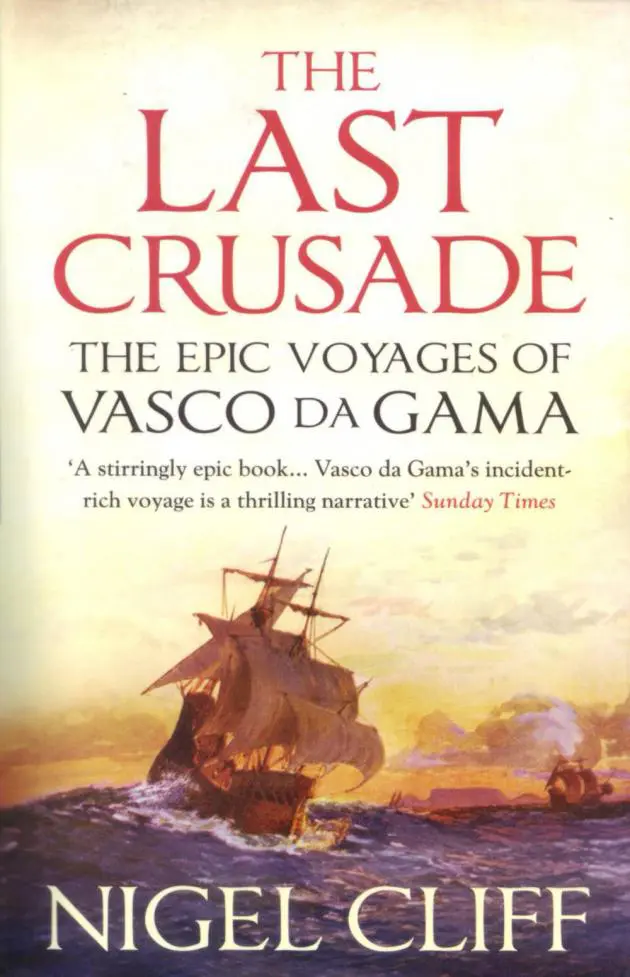
The Last Crusade: The Epic Voyages of Vasco da Gama
By Nigel Cliff
Published by Atlantic, 2012
Available at Asia Books, Bt445
