
The art of the islands


Play
The Ando Museum is launched as part of the Setouchi Triennale 2013
The Ando Museum, designed by renowned architect Tadao Ando, opened last month on Naoshima island in Kagawa Prefecture. The museum complements the ongoing Setouchi Triennale 2013 art festival by presenting a stimulating space with various contrasting elements.
The festival runs until today but will reopen from July 20 to September 1 and again from October 5 to November 4 in coastal areas and on more than 10 small islets in the Seto Inland Sea.
Ando’s museum, which was inaugurated a few days before the festival opened, features contrasting elements of past and present, wood and concrete, and light and darkness.
Many traditional wooden houses that were built more than 100 years ago still remain on Naoshima to this day. The Art House Project under way in the Honmura district on the island has received critical acclaim for transforming some of the unoccupied homes into works of art.
As an extension of the project, Ando’s new museum, also located in the district, makes effective use of an old two-story wooden house.
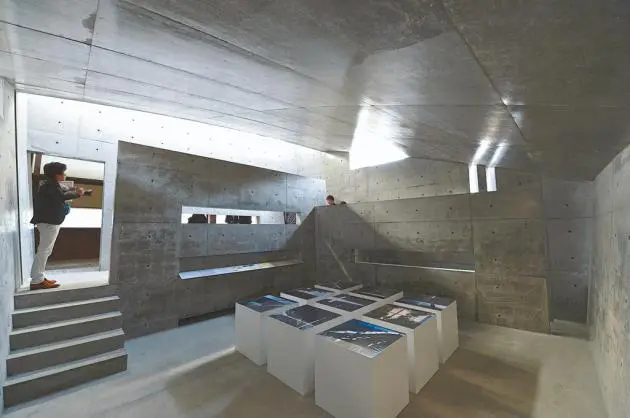
Despite its old-fashioned exterior, once visitors step inside, a large, tilting concrete wall immediately catches their attention. The wall is seemingly supported by conventional wooden pillars near the entrance.
In line with Ando’s vision, the older wooden house was disassembled. An exhibition facility was built on the site using Ando’s signature material – concrete – and the wooden house was then reassembled to wrap around the structure.
The building has no special lighting fixtures and is instead illuminated with gentle natural light pouring through glass panels on the roof. The natural light reflects off the concrete wall, which is slanted at an about 7.5-degree angle. As the reflection changes throughout the day, the atmosphere in the facility also morphs.
In the garden, a vertical cylindrical chamber made of concrete was built underground. The chamber, the interior of which measures about 2.7 meters in diameter, is intended as a meditation space for visitors. It was built to be sparsely illuminated with natural light seeping in from above.
The museum is meant to serve as a showcase of Ando’s architectural career. Among the exhibits in the building are photographs, sketches and models of Ando’s buildings that have similar characteristics to those of the new museum. These architectural works include the Row House in Sumiyoshi in Osaka and the Church of the Light in Ibaraki, Osaka Prefecture.
Visitors can also observe panels bearing photos taken by local people illustrating Naoshima’s history. The images include a copper smelter symbolising a key industry in the past, scenes from autumn festivals, and mountains where trees were killed by fumes from local factories.
Ando said at a preview of the museum: “I’ve suggested using old things for worthwhile purposes for a long time. I want the museum to be another landmark rooted in history that represents the face of a new world in this region, free from Tokyo’s dominance.”
To help revitalise the island, which is suffering from depopulation, Ando has eight designed art-related buildings there over a quarter of century. These include the Benesse House Museum; Minamidera, one of the Art House Project facilities, the Chichu Art Museum; and the Lee Ufan Museum.
All these buildings have distinct appearances and characteristics but are designed to sync with the natural surroundings and time-honoured, classic landscapes in their neighbourhoods.
This represents the core of Ando’s architectural philosophy.
