
Bamboo's big future


Play
The traditional material is leading the way towards stylish and sustainable homes
Fate is a funny thing – you never know when it will take you in a full circle in life.
When she was five, Elora Hardy used to create fairytale houses amidst Bali’s verdant fields and forests. Today, the former print designer for Donna Karan New York is back in her childhood playground and building bamboo houses of fantastical proportions.
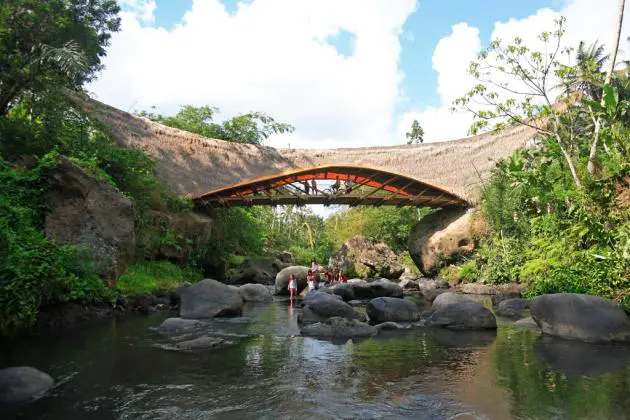
Spherical roofs float over coconut palms, shading open-plan spaces that look like tropical Robinson Crusoe island hideaways. Propped up by sturdy bamboo poles and connected by rope and bamboo bridges, these homes, however, are far from rustic or makeshift. They are in fact luxurious dwellings that are sustainable, environmentally-friendly and very comfortable.
They provide the feeling of tree-house living that children dream of, yet are complete with conveniences such as water heaters, toilets, electricity and swimming pools perched on dramatic cliffs overlooking the Ayung River.
“We build very lightly on the land, redefining the meaning of luxury with a clear conscience,” explains 31-year-old Hardy, who leads the creative design team at Ibuku, an award-winning firm specialising in eco-friendly bamboo buildings.
“Bamboo is a strong, beautiful, flexible and highly versatile material that is sustainable as it has a short, four-year growth cycle. It grows in bountiful clumps that will sprout a new generation of shoots yearly.
“Left on its own, a bamboo pole degenerates after 10 years to make room for younger bamboos, releasing the sequestered carbon back into the atmosphere. Hence, it is a highly efficient resource.”
Each bamboo building in Green Village is unique, tailor-made for each homeowner.
Since 2010, her father John has been experimenting with bamboo buildings, inspired by another long-time Bali resident, Linda Garland, a pioneer and vocal proponent of using bamboo for construction.
The Hardys took the idea of sustainable living outside the box by creating the Green Village, 15 handcrafted bamboo houses located in a stunningly beautiful landscape in Sibang, near Bali’s artistic and cultural heart of Ubud.
Seven homes have been completed, with an eighth on its way.
The intriguing buildings are literally handcrafted and custom-tailored homes for buyers who value the structures’ gentle footprints enough to pay between US$300,000 and $600,000 (Bt8.6 million-Bt17.2 million) for them.
Taking pride of place is the renowned Green School, which caters to pre-schoolers to the 12th grade with an innovative curriculum slanted towards environmental education that is sorely missing from most schools.
Among the topics taught are sustainable environmental practices, renewable energy and organic farming.
Each of these structures is designed and built by hand by teams of skilled traditional Balinese bamboo craftsmen and takes about six to eight months to build. The bamboos are secured by bamboo pins and pegs on concrete foundations but otherwise each structure is 90-per-cent bamboo.
Hardy says she grew up in a beautiful world and wants to keep it that way, hence her interest in green-friendly construction.
From the initial chaotic clutter of bamboo emerges a raw, structured beauty where every room opens out to reveal the verdant landscape Bali is blessed with. Instead of yet another concrete villa, the bamboos are lashed, propped and woven into wondrous structures to create dramatic spaces that do their beautiful location justice.
Sunlight casts seductive shadows everywhere. Banisters are built with bamboo poles split length-wise to reveal its intricate core patterns while basket-like designs are woven to create walls or doorways. Every inch speaks of the human touch in its construction.
Cut stone slabs form kitchen counters while hand-hammered brass are used for baths and shower fixtures. “We innovate to the point of madness,” says Hardy.
“Working with bamboo forms a dramatic departure from conventional ways of building so, initially, everything was a challenge. Architecture as we know it today is based on straight lines, grids, rectangles. Even the components that make up structures are rectangular and linear.
“But bamboo is exactly the opposite, it’s round, hollow and curved. Our team of 10 architects is young and not stuck in conventional ways of working, they haven’t become ‘safe’ in the way they think.”
Bamboo has strengths aplenty – it has the tensile strength of steel, and it is lightweight and earthquake resistant, which is especially crucial in earthquake-prone Indonesia.
Bamboo’s weakness is the lack of big, flat surfaces and a difficulty of enclosing spaces.
But if you can create a design that does that, bamboo can now create long-term structures as the wood can be permanently protected from insects with a natural salt solution treatment. All that’s needed is a polish and coating every three years with aqua-based wood varnish or lanolin.
Hardy is especially proud that each structure is unique.
“I spend much time with clients to understand their family movements first and foremost, as every occupant’s lifestyle is different. We take them through our existing houses so we can better understand the kind of features that they like. Our current client has asked for something that’s super innovative, that hasn’t been done, so we created a new type of roof, beam and design for them.
“But what’s absolutely central is that our team designs on the land itself where a natural alchemy emerges.”
Bamboo can be used to create all sorts of shapes and sizes, from grandiose buildings supported by 2,500 poles to this simple little pergola-like structure.
Hardy acknowledges that bamboo houses are very expensive in the early stages.
“We are lucky we have amazing, forward thinking clients who are willing to invest in what’s considered a luxury product. We hope in future bamboo dwellings will become affordable as they make ideal low-cost housing in earthquake-prone areas.”
For more information on Ibuku’s bamboo buildings, visit ibuku.com and greenvillagebali.com.
