
A homecoming for Red Bull
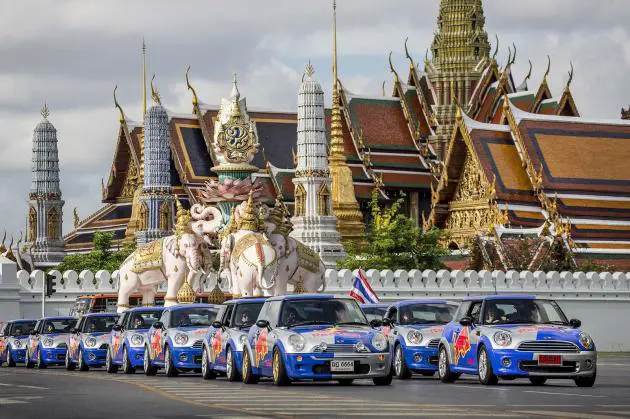


Krating Daeng's European cousin arrives in Thailand with a spectacular party
Thirty years after its creation, Red Bull – the European version of Thailand’s favourite energetic drink, Krating Daeng – has an official home in Bangkok.
European Red Bull celebrated its arrival in Thailand last week with appearances around the capital by world-champion athletes, a Formula One race car and 40 European and Thai “Wings girls”. The “homecoming” of sorts culminated on Thursday with a party at Rajamangala Stadium jammed by race fans, dancers, DJs and bartenders.
The guests were invited to explore four “World of Red Bull” boxes – enclosed rooms set out on the stadium field.
The first box was pitch black, the better to experience the deafening roar of a Formula One engine up close. The second found a connection between summery Thailand and European winter with snowboarding footage shown on wall-to-wall screens.
In the third box, guests mounted virtual wakeboards to fly over rushing water, and in the fourth hung from a virtual cliff before diving into the sea far below.
Beyond the boxes, BMX flatlander Viki Gomez of Spain put on the same jaw-dropping performance he’d earlier displayed amid dense traffic at Bangkok’s Asoke intersection. French football freestyler Sean Garnier, world champion trial biker Petr Kraus and urban dance troupe the Flying Steps from Germany all put on spectacular shows before DJ Julian Smith capped off the night with groovy beats.
Packing the kick of sugar and caffeine, Krating Daeng was first marketed in Thailand in 1976 by self-made billionaire Chaleo Yoovidhya and instantly became a hit among truck drivers and labourers who needed a quick and affordable pick-me-up during the day. Almost 10 years later the drink became a global phenomenon – especially among the younger crowd – when Red Bull was launched in Europe.
It was the adaptation of Austrian entrepreneur Dietrich Mateschitz, who modified Krating Daeng to better match Western tastes. In 1988 he founded Red Bull and put his energy drink on shelves in Austria. It was Europe’s first energy drink, and today Red Bull is available in 164 countries. More than 4.6 billion cans were sold in 2011.
While Krating Daeng is seriously sweet and potent, Red Bull is a milder, fizzy version that doesn’t have the same heart-jumping-out-of-your-chest jolt.
“Red Bull is a great mixer with vodka,” a fan said at the party. “It’s very fragrant and not too sweet and it has this fizz that really lifts a vodka drink. And it keeps you energetic all night.
“It’s nice on its own, too – chilled or poured over ice. I know it’s just sugar and caffeine, but it’s refreshing and cooling. It’s not like coffee, where you have to heat the water, brew the mix, froth the milk and go through so much trouble.”
Krating Daeng, however, maintains its legions of fans.
“Krating Daeng is cheaper and more effective,” a security guard at The Nation insists. “If you just need to stay alert and awake, why pay Bt60 [for Red Bull] instead of a little of over Bt10? And besides, I don’t like fizzy drinks – they make me gassy.
“But I do agree that Red Bull is more pleasant as a mixer because it doesn’t smell as strong, so it doesn’t overpower the booze you’re drinking. But still, it’s a pricey mixer!”
Red Bull contains caffeine, taurine, glucuronolactone, B-group vitamins, sucrose and glucose.
The European Food Safety Authority found no health risk in the taurine and glucuronolactone at the levels used. The caffeine and sugar levels are comparable to those of coffee and fruit juices, respectively. Nevertheless, it’s recommended that you shouldn’t drink more than two cans a day.
