
The story behind the masks


Play
Ralf Tooten's photos of densely clothed labourers are arrayed around Ratchaburi for all to see
Westerners’ fascination with the way labourers in Thailand toil under the hot sun with faces and bodies completely covered finds fresh expression in a photo exhibition that’s spread around Ratchaburi.
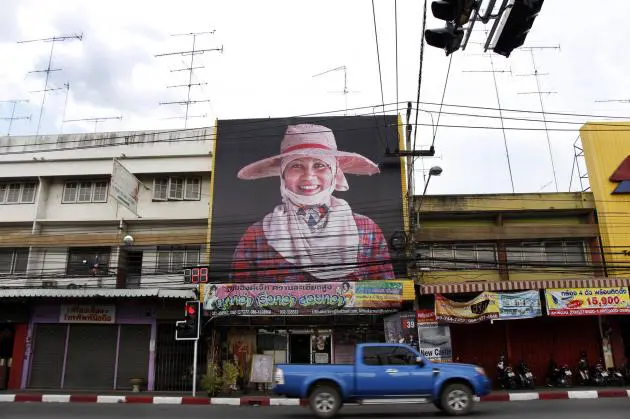
German photographer Ralf Tooten has picked up where he left off with “AWC” (“Asian Workers Covered”), displaying more than 30 stunning portraits of workers at 14 venues around the city in a show called “RCA” (“Ratchaburi Construction Workers”), continuing through July.
The show, which opened on May Day, is a collaboration with ceramics factory Tao Hong Tai and the DKunst Gallery founded by Wasinburee Suphanichvoraparch, from the family that runs the factory.
Tooten took the pictures for the original exhibition at construction sites around Southeast Asia from 2007 to 2010, but the images in “RCA” all originated in Ratchaburi. Tooten aims to boost public appreciation for both art and the city itself, which he praises for its charm and character. It’s a place that warrant more acclaim, he believes.
His photos – shot with a Hasselblad to capture every detail – emerge from an inkjet printer and are then screened on large vinyl backdrops at the factory, a bridge over the river, water towers and the walls of school and shophouses.
“I started the ‘AWC’ series in 2006 and we had the exhibition in 2008,” Tooten says. “My inspiration comes from the workers’ colourful attire and the shapes created by their facial coverings. It’s a kind of fashion!
“In fact all of this is a follow-up my very first idea, the ‘Eyes of Wisdom’ project, where I shot portraits of many people around the world. I travelled to many big cities in China, Tibet, Nepal, Romania, Rome, Japan, Austria, Germany, Israel, the US, Switzerland, India and more. That’s when I came to Thailand, in 2003 and 2004.”
Tooten says Wasinburi proposed the Ratchaburi project last year. “It’s fascinating that I can show portraits in public spaces all around the city and people can see them on their way to work, from the train or just walking by. They see pictures that reflect themselves.”
Ratchaburi native Wasinburee marked out a guided tour of the 14 locations with asterisks on a map. It starts at his ceramics with a photo of a man in a black T-shirt and a black mask. Next is a photo on a roll-up door showing an older labourer in a checked red shirt.
Another man wears a covering over his face of two-toned cloth with holes cut for the eyes. Still another wears sunglasses atop a facemask adapted from an old denim shirt, standing by an old zinc warehouse.
“A year after the gallery opened, we’re finding new ways to link the arts and the community,” Wasinburee explains.
“There’s a coffee corner at the gallery where anybody can just sit and appreciate the artwork while they’re sipping, but I realised that the gallery was still too much of an ivory tower, patronised only by the artists and their friends. So we wanted to stimulate interest in the community beyond the gallery, and with this project we’re using public spaces to display our art. We hope people will appreciate what they see and feel more comfortable with art as part of their lives.
“Ralf is a good friend,” Wasinburee says. “He’s a photographer who’s concerned not so much about the quality of his photos as the concept behind them. And this is a good chance for people to see his creativity.
“We set up studios at three construction sites run by a friend of mine who loves art and was happy to support us. He allowed us to use his workers as models.”
On a water tower, images of workers in various poses include one of a cheerful woman in a red checked shirt and big hat ushering cars through an intersection, and another of a man in a vivid orange shirt baring his face for Tooten’s camera.
On the wall of a shophouse opposite the bus station, more used to graffiti than the fine arts – four men show off their own practical fashion innovations. There are more pictures in a traffic tunnel, among the ruins of a jail and at the ferryboat dock.
Tooten had asked that his completed portraits be displayed without captions so that viewers could discuss what they saw and draw their own conclusions. It proved too daring an approach, though, when, on a fence at one of the schools, they mounted his picture of a beaming young woman in a solid-red shirt.
“She’s not a supporter of the red-shirt movement,” he says, “just a working woman in a red shirt who shows how happy she is with a lovely smile!”
“But people thought it suggested that the school supports the reds,” adds Wasinburee, “so, to avoid any political conflict, we had to add some words of description here.”
The idea is to have “an impact on the community”, he says – just not that kind of impact. “We want to people look at what they have in this town and conserve it. After we’d installed the art we had a lot of comments on our Facebook page. Some people like the exhibition and some feel unhappy, but it doesn’t matter – it’s all good feedback!”
EYES HAVE IT
<< The “RCA” exhibition continues until July 30.
<< It's based at the DKunst Gallery on Woradej Road in urban Ratchaburi, which is open daily except Monday from 10am to 7pm.
<< Find out more at (081) 880 3600 or (087) 708 9991 or the “THT.dKunst” page on Facebook.
