
The art of acceptance
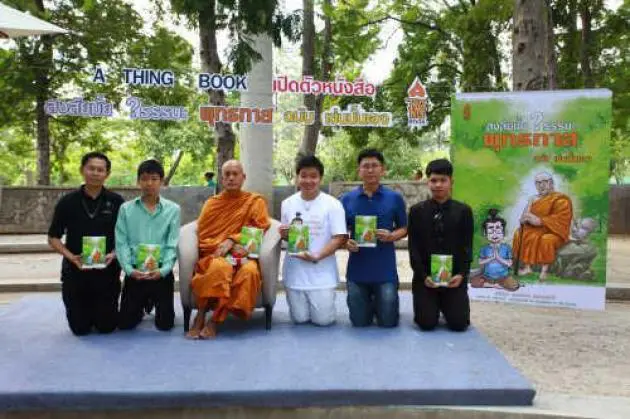


Bhikku Buddhadasa's dharma concept of 'suchness' is richly illustrated in a comic book
One of the central concepts of Buddhism is an acceptance of the true reality of any given moment, so why do we, as Buddhists, frequently complain when things are not going our way? Rather than enjoy and appreciate the present, we seem to always mumble about the past being better while also worrying about the future.
The well-respected monk and philosopher Bhikku Buddhadasa often reminded us to practise tathata, meaning suchness - in other words, to learn to accept things just as they are.
It is a concept that children can find hard to understand. Teaching them might now be a little simpler thanks to the launch earlier this week of a new dharma comic entitled “Songsai Mai? Dharma Buddhadasa ‘Chen Nan Ang’” (“Curious? Dharma Buddhadasa’s Reality of Suchness”).
Produced by A Thing Books, the new comic is penned by Chaiyapat Tongkumbanjong, who owns the publishing company, and illustrated by Verachai Duangpla, popularly known as “The Duang”, winner of the Manga Silver Award winner, and his cartoonist dad Ruangsak.
“Dharma Buddhadasa ‘Chen Nan Ang’” is the third publication in A Thing’s dharma series for teens. Two earlier releases, “Songsai Mai? Dharma” and “Songsai Mai? Dharma – Cognisant Suffering”, have proved a major success with young readers, going through 22 and 14 reprints respectively. The series’ central character is Khob Fa, a teenage boy curious about Buddhist teachings.
Chaiyapat says his writing highlights such common questions as “Why do people believe in amulets? Does they really help relieve suffering? and “how can one stop suffering?’
“The answers to these questions will come from the hearts of our readers. The more critical questions we ask, the clearer dharma will get,” says the 33 year-old. “Reading a dharma book requires serious concentration even for an adult. Cartoons, on the other hand, don’t require so much effort. The simplified messages and attractive illustrations help teens learn dharma.”
The key massage in the new “Songsai Mai?” dharma book makes the point that nobody likes to suffer and stresses that suffering is all in the mind. It cites easy examples of how suffering is stimulated by greed, such as the desire to make enormous profits, depression, say following a loss of profit and even a car accident. By understanding the uncontrollable wheel of nature and realising the reality of non-duality, which is at the core of Buddhist teaching, suffering can be stopped and enlightenment attained.
Speaking at the book launch at Suan Mokkh Bangkok in Chatuchak district, Phra Kru Baideekamontien Munthiro Bhikku, the deputy abbot of Than Nam Lhai Temple at Suan Mokkh in Surat Thani province, pointed to the many levels Buddhists have to cross in achieving the behaviours that constitute dharma, so it’s only natural that youngsters need time to learn and understand.
“There are lots of dharma comics on the market these days but explaining ‘chen nan ang’ or ‘suchness’ is not easy. Buddhadasa Bhikku took 10 years to explain the term. It is best defined as the state to free oneself from suffering, leading to peace of mind,” he says.
The comic ends with Khob Fa being content with his life despite the problems he faces because he is wearing an imaginary chen nan ang necklace, which helps him a peaceful and positive mind.
Ruangsak and Verachai, who worked together for the first time in illustrating the comic, say they didn’t find conjuring up a Buddhist ambience difficult, because the book reads like a normal cartoon with characters and frames that lead readers into the story.
Rather, the challenge lay in the dharma interpretation. “We have to keep the ambience and emotions as serene as possible while still bringing humour to the cartoon,” says Ruangsak. “The comic-style brings lightness to difficult dharma thoughts allowing young people and children to read with enjoyment even though they may not understand everything. I don’t think dharma is necessarily hard to teach but how well it is assimilated depends on how we can adapt the teachings to our own lives.”
Verachai, who also worked on the earlier series, adds that before drawing Khob Fa, he reflects on the content of the dharma teachings then tries to transfer the messages to paper through the character’s expressions. “The feedback from the past two series has been overwhelming. Readers say they like them and don’t find dharma boring. I feel as blessed as if I had made merit.”
Chaiyapat compares Buddhists to candles. “These can be beautifully decorated like the ones especially carved for the rainy season retreat or plain, with no enhancement. But no matter what they look like, they will eventually be extinguished,” he says
“Suffering derives from cause and result. If you plant a mango tree, you cannot expect an orange. The fruit are just as they are – chen nan ang”.
TURN THE PAGE
- “Songsai Mai? Dhamma Buddhadasa ‘Chen Nan Ang’” is available in bookstores for Bt150.
