
Friendship and a road


Play
Songs-for-life pioneer Nga Caravan celebrates 40 years of bringing his music to the people
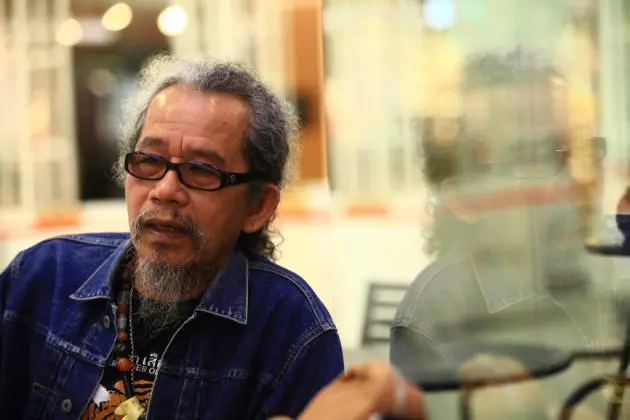
One of Thailand’s most steadfast supporters of democracy and a champion of poor rural folk, Surachai “Nga” Chanthimathorn is celebrating four decades of singing and songwriting next month by returning to the stage.
“The starting point of this concert is my song, ‘Thanon Mittraphap’,” says Surachai, the front man of songs-for-life band Caravan, whose last concert, five years ago, marked his 60th birthday anniversary.
The Surin-born political activist penned the song in 1984 and named it after Mittraphap Road – the Friendship Highway – that runs from Saraburi to Nong Khai and was built with financial assistance from the US. It received its name in 1957.
“Many of the events in the Indochinese region are related to this road. Its name means friendship, but it was the road to war. The authorities all made a big fuss about how it was linked to the beauty of friendship and freedom but in fact it was just a convenient way to transport firearms for the American military camps based in our country during the Vietnam War,” Surachai says.
“I guess you can call it the road full of good meanings. I grew up in an era when thousands of people the world over were objecting to the wars in Vietnam, Cambodia and Laos. But music fans shouldn’t worry – there’s nothing serious about this concert.”
Indeed the concert is being designed around Surachai’s 40-year musical career rather than the 39 years since Caravan was launched. That career started in 1973, when Surachai and two friends worked together under the pennames Thor Sen and Sanjorn. Caravan was formed the following year.
“It was part of our political movement, and most of the audience were students. Back then, there was a very clear separation of the left and right. Many of those to the left were young people, some of them members of non-government organisations, who opposed the government and reacted against its policies. It was nothing like today’s red and yellow shirt groupings. They are not clearly to the left or right, and both groups contain government officials as well as ordinary people,” he says.
Surachai’s first two songs were “Khon Kap Khwai” (“People and Buffalos”) and “Khao Khoi Fon”. The former, written by violinist Somkhid Singsong and sung by Surachai, was first recorded at the Kings Sound Studio in 1975 and later banned. It was inspired by Bob Dylan’s “Masters of War”.
“Our songs may have been banned but we still performed live. ‘Khon Kap Khwai’ reflected the thoughts of the young people of that time and their defence of the farmers. In fact, nothing has changed – the farmers are still a popular cause. But it’s important to remember that while the farmers are regarded as lower-class or grassroots people, they are also the most useful to the country. Back then, the farmers were selling their land and becoming labourers instead. So, many songs at that time were related to the farmers. ‘Khao Khoi Fon’ draws on Khmer folk music and we gave it Thai lyrics,” he says.
After the bloody crackdown on student activists in October 1976, Surachai and several other songs-for-life musicians fled to the jungle and hid in the forests of Udon Thani, Nong Khai and Loei where they stayed for six years.
“Up there, I was responsible for entertaining a troop of 50 people, all of them toting firearms. Although we were musicians, we had to carry guns. I had so many near-death experiences because I had to travel from one district to another. More than 10 songs, including [bandmate] Mongkol Uthok’s ‘Nor Mai’ [‘Bamboo Shoot’] were written in the forest and are still performed today,” says Surachai.
The musician returned to Bangkok in 1982 performing for the first time at the “Caravan in Concert for Unicef” at Thammasat University, with a set of songs that included “Khuen Rang” (“Back Home:).
“Politics change all the time depending on who’s in power but some things have always remained the same – corruption, bad politicians, dirty businessmen, capitalists, influential people and ex-officers,” he comments.
Songs-for-life compositions have also changed to reflect the changes in the political situation.
“The songs are slower and less violent,” he says. “Songs-for-life music never dies and even though its popularity has decreased, many songs-for-life artists are still able to make a living these days. The term ‘songs-for-life’ was used by philosopher and revolutionary Jitra Phumisak to describe the words of musicians and poets.”
The 65-year-old songs-for-lifer is a long-time fan of Bob Dylan and also admires Neil Young, Carlos Santana, the Beatles, Crosby, Stills, Nash and Young, Bruce Springsteen and U2.
“Western music is the standard by which we learned rhythms and styles like blues or jazz,” says Surachai, who boasts a collection of 500 LPs at home.
He’s prepared a song list of more than 30 numbers for the upcoming concert, among them “Thanon Mittraphap”, “Dok Mai Hai Khun”, “Noom Panejorn”, “Khuen Rang”, and “Jaak Phoopha Thueng Thalay”. Guests include his band mate Mongkol Uthok as well as fellow songs-for-lifers Keetanchalee and Keetakawee.
“The three-hour concert will showcase the different feelings of songs written and performed at various times in the past, and will also include a narration about their backgrounds and stories,” Surachai concludes.
Singing the songs
_ “40 Years: Mittraphap Bon Thanon Dontri” (“40 Years: Music on the Road with Surachai Chantimathorn”) is at 7pm on July 13 at the Thailand Cultural Centre.
_ Tickets are Bt500 to Bt1,500. Call (02) 262 3456 or visit www.thaiticketmajor.com.
