
Orwell's turning point


Play
On duty as a colonial policeman in Burma, Eric Blair had a sudden revelation of his own freedom being destroyed
Walking down a narrow stairway from a traffic-congested street in Myanmar’s largest city, I come across Hpaya Lan Station.
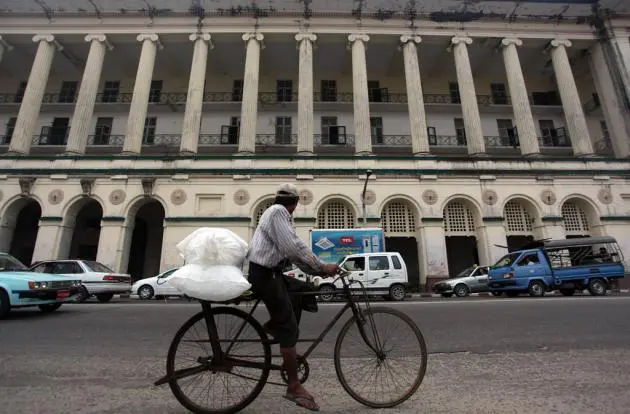
Inside, the arrival of rundown coaches takes visitors back to the old British-colonial days when the station had an English name, Pagoda Road, and the city was called Rangoon, the capital of a country then known as Burma.
One day here in 1924, a group of students waiting in the station were teasing each other when one bumped into a tall British man. The Briton burst into a fit of anger and was about to swing his cane at the student’s head, but relented and poked his back instead.
One of the students, Tin Aung, who later became the president of Rangoon University, wrote about the incident before he died in 1978.
After the encounter, the students followed him onto a train as they continued to protest the man’s actions. But as Tin Aung recalled in his writings, witnessing the man trying to patiently speak to the outraged students instilled in him a sense of sympathy and understanding.
Tin Aung was told by a Burmese police officer that the man’s name was Eric Blair, who later adopted the pen-name George Orwell.
In his essay “Shooting an Elephant”, about his life as a police officer in Burma, Orwell wrote that the longer he stayed in the country, the more strongly he felt that imperialism was evil. His sympathy toward the Burmese people had deepened, he wrote.
The essay tells of the day he received a report that an elephant had gone on the rampage in a village. He arrived carrying a weapon, and found himself surrounded by a crowd of curious villagers. He did not want to kill the creature, but he reckoned the locals would regard him – and all Britons – as cowardly if he failed to do so. The colonial masters’ reputation was at stake.
He raised his rifle and fired, but his anguish was increased by the slow and painful death of the elephant.
For Orwell it was a metaphor for British imperialism.
“When the white man turns tyrant it is his own freedom that he destroys,” he wrote.
Khin Maung Nyunt, 84, professor emeritus of Mandalay University, says the writer sensed the emptiness behind the feelings of superiority that many Britons harboured toward Asians. He says the period Orwell spent in Burma was a turning point for him.
After rejecting the illusions of imperialism, Orwell denounced totalitarianism for its accumulated lies and repression of truth and conscience in such works as “Animal Farm” and “1984”.
Orwell left the country in 1927, and Burma gained its independence in 1948. But a military coup in 1962 brought five decades of tyrannical rule that saw tens of thousands incarcerated as political prisoners.
“Because nationalistic education continued for many years, works of foreign literature, including Orwell’s, were not widely read,” Khin Maung Nyunt laments.
In central Yangon, the Independence Monument stands tall near the Supreme Court building constructed by the former colonial masters. Carved on the monument is a slogan declaring that the rights of citizens must be shared by all.
On my visit I witness a Muslim man, a member of a religious minority in Myanmar, lean forward and examine the words closely.
Recent reforms here have brought the lifting of sanctions by the international community and expectations of rapid economic development. However, concerns remain over the ingrained prejudice and inequality practised against the country’s religious and ethnic minorities. The Muslim man’s presence prompted me to recall an ironic quote from “Animal Farm”: “All animals are equal. But some animals are more equal than others.”
From Eric to George
George Orwell was born as Eric Blair in British India. After graduating from Eton College in England, he worked in Burma, now Myanmar, from 1922 to 1927. In 1934, Orwell published a novel, “Burmese Days”. He fought against the fascist dicatorship of Franco in the Spanish Civil War, which began in 1936. His novels “Animal Farm” and “1984” were published in 1945 and 1949, respectively. The latter depicts a nightmarish totalitarian nation. Even today, closed societies such as North Korea are described as “Orwellian”. Orwell died of tuberculosis at 46.
