
The crocodile wrestler
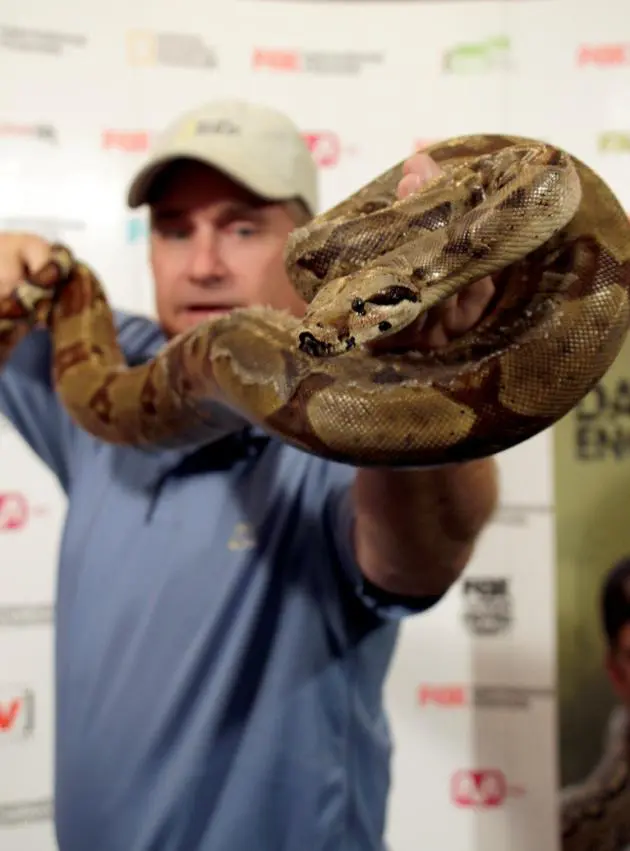


Southeast Asia has the world's biggest reptiles - Brady Barr loves it here
Meet Dr Brady Barr, whose passion for reptiles gives him a great deal of courage to do hands-on research among the most dangerous animals in the wild. Unfortunately for Barr, the knowledge he gains comes at the cost of bruises, broken bones and too many near-death experiences. Fortunately for us, we get to watch it all from the comfort of our living room – on “Dangerous Encounters with Brady Barr”.
The 50-year-old former high-school teacher from Texas found international fame 20 years ago on a Nation Geographic Channel show that’s “all reptiles all the time”. During his career he’s captured more than 5,000 crocodiles – he’s the only one person to have captured all 23 croc species in their natural habitats.
“It’s dangerous,” Barr told The Nation on a recent promotional visit to Bangkok.
“The show focuses on animals that are dangerous but also, more importantly, on the science, and the conservation message that goes along with it. One of the things I’m proud of is that I always work with local scientists and local experts. And we’re not laying hands on the animals just for TV. I might work with a Thai biologist on a monitor lizard, and highlight the conservation elements around it.
“I’m proud to call National Geographic my home. They don’t demonise or sensationalise these animals. You know that what you’re watching is real and accurate.”
So no stunts, then?
I get too many bites, bruises and broken bones as it is! Doing stunts with the animals is too dangerous for me and for them. TV’s not worth dying
for, and neither is science. There’s got to be a good reason involved in what we do.
But there does seem to be a lot of crocodile-wrestling on the show.
The thing is, unlike mammals like lions and tigers, you can’t dart crocodiles to capture them. If reptiles forget to breathe, they die. If you dart them and they go into the water, they’ll drown. It’s got to be muscle on muscle, man against beast. You have to put a rope on them and hold on tight. It’s a matter of who tires out the quickest.
What we do is what people did hundreds of years ago. And when you get a one-tonne animal that’s not happy, bad things can happen.
Why do reptiles interest you most?
When I was a kid I was really into dinosaurs, like a lot of kids are, and as I got older I moved into the world of the living, present-day reptile.
And there’s the science to it. You’d think we scientists would know everything about them, but it’s just the opposite. We know very, very little about these animals because they are big, dangerous animals to work with, and there are not many people who do it.
The average person might think these are cold-blooded beasts that operate only on instinct, but they’re not. They’re complex and intelligent and they don’t get nearly the credit they deserve. That’s why I’m here – I’m the ambassador of the cold and scaly.
Which part of the world fascinates you most?
It’s probably Southeast Asia. In this part of the world you’ve got the world’s largest lizard – the Komodo dragon – and the python, the world’s longest snake, the king cobra, the longest venomous snake, as well as the largest crocodile and saltwater crocodile, the largest turtle. The list just goes on.
For whatever reason, the biggest and best and the record-setting reptile families are here. My focus will on be Southeast Asia for the next two years, because it’s a very special place for me, both on a professional and a personal level.
Anything special about Thailand?
You have two types of crocodiles here – the Siamese and the saltwater. Thais should rally around these animals, making them iconic, but, sadly, the Siamese is not just an endangered croc, it’s one of the most endangered animals on the planet. They’ll probably go extinct in our lifetime unless we get the word out.
So not enough conservation is being done?
There are a lot of people raising conservation awareness about mammals – the cute and cuddly, warm and fuzzy animals. But there aren’t a lot of people talking about the cold and scaly. In many places I talk about snakes and people start heading for the exit. If I talk about koalas they’ll start throwing money at me. And a wild koala can tear you apart!
Everything is important. We know that everything is involved in a web of life, and is connected in the local and global ecosystems. Some of these animals are called “keystone” species, like crocodiles. If you remove the keystone from a building, it collapses.
Catastrophic changes in the ecosystem are inevitable. It might be good or bad. No one knows, but I think it’s not an experiment we as human want to take.
Does crocodile farms help?
In this day and age there is no reason for anyone to wear real animal skin on our feet or handbags. Fake is fine – almost a compliment to the animals.
As for the meat, it’s a question of where the meat comes from, because there are lot of problems in terms of the bush-meat trade and illegal poaching.
But crocodiles are in a weird situation, particularly here in Thailand where they’re farmed, which actually helps protect the crocodiles in the wild. Would I prefer that it didn’t happen? Yes, absolutely, but as long as the farms are highly regulated and the money made on the skin and the meat goes back into crocodile conservation.
Crocodile meat is a no-no for you?
I’ve got a deal with animals. I don’t eat them and they don’t eat me.
BITE DOWN
Watch “Dangerous Encounters with Brady Barr” on the National Geographic Channel on TrueVisions, and on Nat Geo Wild on GMMZ, CTH and MeTV.
