
Worshipping at Japan's highest shrine


Play
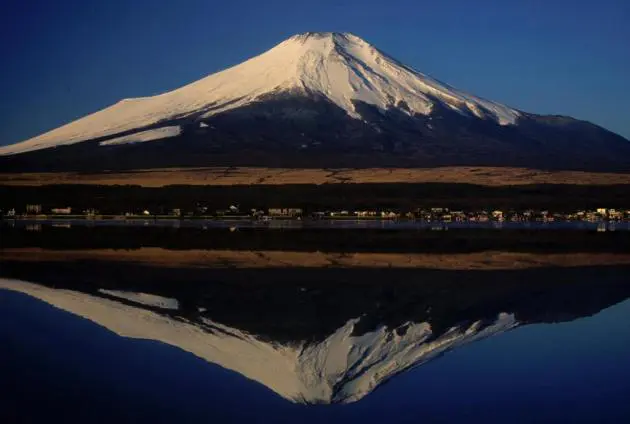
Surrounded by forest, lakes and mysterious caves, Mount Fuji has long been revered as sacred
Wearing the white robes of ascetics, they gather at a shrine beneath the north face of Mount Fuji.
Each gently places a wooden board into the sacred flames of a small fire.
The rite is being held by a Fujiko group – religious sects that worship the mountain. The wooden boards, called saiboku, are inscribed with wishes for good health and success in business.
The saiboku catch fire and warp in the heat instantly, sending their smoke-wreathed prayers soaring towards the summit.
Yoshitsugu Saito begins to chant the special mantras of the group, as the flames lick close to his face.
Saito, 82, tells me he joined the group 60 years ago after an accident left him with serious injuries. He attributes his recovery and long life to the healing powers of the mountain, as well as his ascetic lifestyle as a member of the Fujiko sect. He reckons he has climbed to its summit nearly 50 times.
Surrounded by forest, lakes and mysterious caves, Mt Fuji has long been revered as sacred.
In the early Heian Period (9th century), a Shinto shrine to the goddess of volcanoes rose at the foot of its northern slopes in order to quell eruptions. More than 300 years have passed since lava last flowed from the peak, in 1708, so the shrine seems to be doing its job.
In the Muromachi Period (1337 to 1573) two trails to the summit were opened – the Murayama and the Yoshida – and Fuji became widely known as a site of pilgrimage. The mountain trails are punctuated with lodges known as bo, where pilgrims can rest and perform rituals before continuing on their journey.
The Zuzuya lodge is more than 400 years old and generations of pilgrims have set off from here for the summit. Now owned by Emiko Ozawa, 68, Zuzuya is an “Oshi-no Ie” lodge, where ascetic devotees learn the principles of Fujiko and receive instruction on safe climbing.
During the Edo period (1603-1867), there were more than 80 such lodges hereabouts, catering to a steady flow of devotees. Now only a handful remain.
Ozawa’s son Terunobu, 38, is the latest in a family line of Fujikas at Zuzuya lodge that stretches back 20 generations. “I’m resolved to maintain the culture [of Oshi-no Ie] as long as pilgrims visit our lodge,” he tells me.
I follow the path to the first stop on many pilgrims’ trail – Yoshida Tainai Jukei, a cave created by a large eruption in 864. Ever since, devout visitors have crouched down to pass through the narrow low entrance and into the purifying atmosphere. Inside, they kneel at the small shrine at the back of the cave, cleansing their souls ahead of the climb.
Attempting to do the same, I breathe deeply, then follow in the footsteps of the thousands before me who have made the ascent to the sacred summit.
