
Talent and instinct
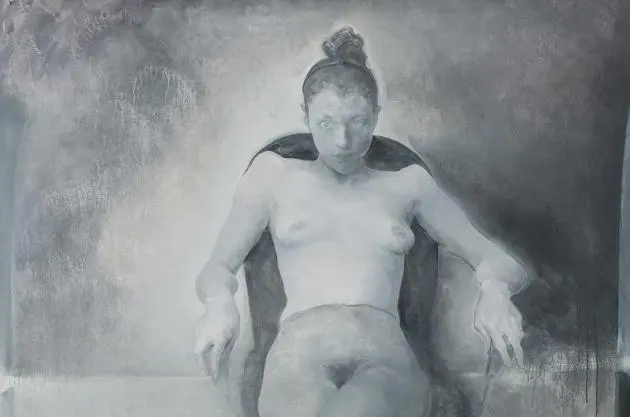


China's Mao Yan says his work reflects his own state of mind
With centre-parted short hair and baggy old jeans, 45-year-old Mao Yan looks more like a rebellious youth with the bearing of a sharp and sensitive artist. The vanguard painter is said to be the most difficult to define among today’s Chinese art icons. His works are extremely contemporary, though the artist claims to have a serious classicism complex.
He has stayed in Nanjing for years, while other artists proceeded northward, flocking to the capital.
Despite the multifaceted symbols and concepts emerging in the endless stream of contemporary Chinese art, he sticks to portraits, the most traditional subject of easel painting that has gradually been pushed aside by newer art forms.
“Painting to me is an instinct,” Mao says. “I don’t like doing things ‘on purpose’ and I have no need to prove myself just for a trend or an idea.”
At Pace Gallery in Beijing, Mao is presenting his first solo exhibition after signing with the gallery.
Featured works include several pieces from his best-known Thomas Series from the late 1990s and a few unconventional portraits of animals. Two large-scale portraits of naked women painted this year are the artist’s first-ever showing of this kind.
Mao was named the most influential oil painter of 2012 at the Seventh Award of Art China in May. He along with three others were also named the Martell Artists of the Year last month.
“I heard many fellow artists highly praise Mao’s superb technique, but what is most precious is his earnestness in work, which is like a mirror that shames those pretenders,” comments artist Li Xiaoshan.
Studying painting with his father since the age of three, Mao quickly showed his precocious ability and was labelled a genius even before he entered the Central Academy of Fine Arts in 1988. In 1992 the then-24-year-old achieved national fame at the 1990s Art Biennale held in Guangzhou for his work “Portrait of Xiaoshan”.
He continued to portray his friends until the late 1990s, when he met Thomas, an overseas student from Luxembourg. For the next decade Thomas was the only subject on Mao’s canvas.
“Subjects depicted during Mao’s ‘pre-Thomas period’ had faint social identities, age characters and completed postures. Later these elements were simplified yet the personality became stronger,” comments writer Han Dong.
“Thomas is only a cover – it could be anybody, including myself,” says Mao, who intended to escape from the booming cluster of Chinese symbols at that time by portraying a foreigner.
These finished portraits are therefore a far cry from the original model. “There is surely resemblance in appearance and character, but I endow the figures with extra features through the eyes and facial expression, and through the tone,” Mao says.
Mao also likes to infuse instant feelings into every stroke of the brush. For example, if he is obsessed with Song Dynasty (960-1279) poetry during a certain period
of time, his inspired sentiment will be reflected in the following works.
Since the mid-1990s, colours of flame and warm brown in his works have gradually been covered and replaced by a much calmer tone of grey, which has lasted till today.
He brushes each canvas with multiple thin layers, which creates a progressive visual that prints fail to capture. But such a method of painting slows down the process and limits him to a few pieces per year. “Every piece deserves years of efforts,” Mao believes, stressing that even this must be after “good communication with the model” – otherwise the process “is very likely to continue infinitely”.
The market has corroborated his pursuit of perfection. In 2007 Mao entered the million-dollar club when his oil painting “Memory or Dancing Black Rose” nearly twice that at the Beijing Poly Spring Auction. And in 2011 Mao’s “Portrait of Xiaoka” set his highest record at an auction house.
Aside from the Thomas series, which will continue, Mao says, he is preparing a new portrait project studying the images of Chinese people. That, he says, “will be a lifetime project”.
“I enjoy spending a long time doing one thing without giving much thought to its meaning or result,” he says. “It is my painting principle as well as my attitude toward life.”
OFF YOU GO
Mao Yan’s solo exhibition continues at the Pace Beijing Gallery until July 20. It’s in the 798 Art Zone on Jiu Xian Qiao Road.
Learn more at www.PaceGallery.com.
