
The forgotten Free Thai hero
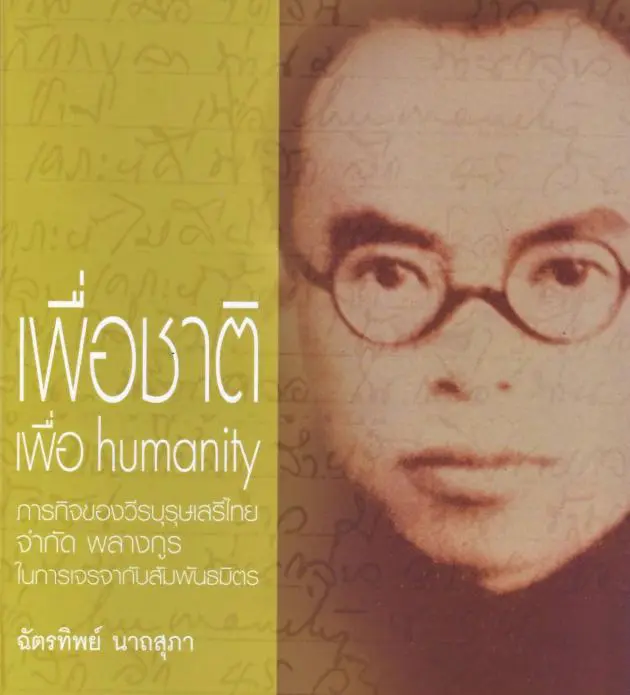


The bravery of Chamkad Balangkura shines onstage next month
Despite a book being written about him, the story of Chamkad Balangkura has remained one of the least-known aspects of the Free Thai movement that rose against Japanese occupation in World War II. Now the author of the book has penned a stage play in the hope of wider recognition for the man who risked his life to take Thailand’s case to China.
Historian and economist Chatthip Nartsupha revealed the depth of Chamkad’s heroism in his 2006 book “Pheu Chart Pheu Humanity” (“For Nation, For Humanity”). It is a striking tale of a young man’s clandestine mission to sneak across borders and secure from China’s Nationalist leader Chiang Kai-shek a promise that Thailand’s independence would be recognised after the war. Chiang in turn pleaded Siam’s case to US President Franklin Roosevelt. By that time Chamkad was dead, a victim of cancer doubtless fed by the enormous stress of his undertaking.
Professor Chatthip’s book earned praise, but he feels the story demands a wider audience, so on August 30 and 31, his political-economy students at Chulalongkorn University will present a play about Chamkad at the school’s Sodsai Pantoomkomol Centre for Dramatic Arts. The production happily coincides with the professor’s 72nd birthday, an auspicious one in Thailand.
Chatthip wants more people to be aware that Chamkad was one of the most important heroes of the National Liberation Movement, initially code-named the XO Group, led by future prime minister Pridi Banomyong. Better known to history as the Free Thai movement, this was the local effort to expel the Japanese occupiers by force. The support of the Allies was crucial – along with their readiness to recognise Thailand’s post-war sovereignty.
MR Seni Pramoj secured the backing of the United States, and in 1943 Pridi decided to send 28-year-old Oxford University scholar Chamkad to Chongqing to seek help from the ruling Nationalist Party. He would also communi
cate with British and American forces helping Chiang in the fight to oust the Japanese Imperial Army from China.
What Chamkad accomplished “was magnificent for the country”, Chatthip says, but, because he died soon after his mission, still young, and his work was done in secret, his name “almost vanished in Thai history”. Only a 1,000-page diary remained, chronicling his journey, preserved by his wife Chalopchalai. A copy is now available at the National Library, but Chatthip heard the story earlier while on a Pridi Banomyong scholarship for Thurakit Bandit University.
Chamkad was the eldest son of Phraya Padungwittayaserm, the scholar who wrote the well-known Thai textbook “20 Mai Muan Poem”. Chamkad earned a scholarship to study philosophy, politics and economics at Oxford in England, where he wrote “New Siamese Philosophy”, a book that characterised the revolution of 1932 as a “renaissance” that transformed Thailand into a civil society and sowed the seeds of people power.
The title of Chatthip’s book, “For Nation, For Humanity”, are the words Pridi spoke to Chamkad as he left for China. Chamkad would repeat the phrase to himself during his mission – and again as gastritis and liver cancer seized him.
The meaning of “for nation” is clear enough, but Chatthip believes “for humanity” refers to victory in a battle for the compassion of all humanity. “I think there are three important lessons about Chamkad’s act of bravery that younger generations should acknowledge.
“The first is simply that no one today realises how crucial it was to get China’s support.” That’s forgotten because the US and British roles have always been emphasised.
Chiang Kai-shek was not expected to be easily appeased. Thailand had not been a good friend to China in recent decades, and the Thai government had been increasingly hostile to Chinese immigrants. But the movement’s leaders were delighted to learn that Chiang was not only ready to recognise their aims but also to promote them among the Western Allies.
“In his diary,” Chatthip says, “Chamkad wrote that Chiang told him, no matter what the situation was, the Chinese government was willing to help Thailand regain its sovereignty. And the Chinese kept his promise.”
The second revelation behind the mission, he says, was the compromise struck between Thai royalty and the Khana Ratsadon (People’s Party) that had usurped its power. He discovered that Mom Chao Suphasawat Wongsanit Sawatdiwat, representing the Thai royal interests in Britain, travelled to China and talked to Chamkad for seven days and nights to forge an agreement, based on democracy, that best met the homeland’s interests.
And the third message from Chamkad’s story is the important role that ordinary civilians played in the Free Thai movement, which ensured the Japanese ouster. “In the Thai historical records, much of the emphasis has instead gone to the heroic leaders and those who operated in foreign countries,” Chatthip says.
These lessons aren’t lost on Pornsilp Patcharintanakul, deputy secretary-general of the Board of Trade and Thai Chamber of Commerce, who will play Chiang Kai-shek in the Chula production. The story, he says, is full of “vital collective values that have been neglected. That spirit has gone today, everybody is interested in his or her own benefit, and corruption is common.”
SEATS LIMITED
n The August 31 performance of “For Nation, For Humanity” is by invitation only.
n Admission to the August 30 show is free, but seating is limited and you must book in advance. Call Khun Pailin at the Chulalongkorn University Political Economy Centre at (02) 218 6294 and (02) 218 6299.
