
Hues for the home


Play
Give a home look to your pad with a colour makeover
CHOOSING THE PERFECT colours for your home can sometimes be an overwhelming experience. With an infinite number of shades and hues available, picking a scheme or finding suitable combinations for your rooms requires good planning and strategising. Jeremy Rowe, the managing director of AkzoNobel Decorative Paints, provides some tips and inspirations on how to jazz up your pad with for a trendy look that exudes your personality.
>> Define your preferences
Before you begin, take a look at your favourite colour inspirations, such as your dressing style and the colours of objects you’re drawn to. Do you prefer bold shades or muted tones, bright hues or light pastels? Is there a particular feature in the room you’d like to highlight, such as a sofa or a painting? By creating a portfolio of ideas on what appeals to you, you will better understand your preferences with regard to colour denominators.
>> Expressing your moods
Colours have a huge influence on the ambience of a space. Bold tints can be dramatic and used to evoke visual interest – warm hues like reds, oranges and yellows can bring energy into a room and make it feel brighter and cheerier, whilst cool tones like blues and purples can offer a sense of calm and serenity, as well as elegance and grandeur. Aa versatile, robust blue is at once regal and peaceful, yet instils a sense of wonder.
Likewise, greens are associated with nature, bringing a refreshing yet relaxing vibe to the room. Whites and neutrals, such as creams and tans, are subtle and understated and can be used as a platform for bold colours or other features of your home to stand out.
>> Mixing and matching
Base colours are defined as the overall dominant colour of the space, while accent and trim colours are secondary colours and patterns. Starting with a base hue before matching complementary or contrasting shades will help create your colour palette. By using one or two bases throughout the house, and mixing in other accents, the place will have a continuing theme while allowing individual rooms to have their own personality.
Home decorators can also use a colour wheel to help envision how the paints will come together. This is a helpful guide for determining a colour scheme for the room or home;
- Single/Monochromatic scheme – using only one colour, select lighter and darker shades of the same family to distinguish various sections in the room. A good tip is to pick alternate hues in the same colour segment.
- Harmonious scheme – when matched together, a colour from the family segment on either side of your base hue creates a pleasant scheme that is easy on the eyes.
- Contrasting scheme – two colours sitting opposite each other on the colour wheel can contrast or complement each other.
- Dynamic scheme – any three colours that form a triangle on the colour wheel provides a striking and bold theme
>> Play with your space
Colours can be used to generate visual weight and balance. Light, cool shades recede away, softening a room and making it feel more spacious; while dark, warm tones advance towards us, bringing the walls in and evoking a cosy atmosphere. To heighten a ceiling, produce a vertical colour ascent. For instance, the floor can be painted a dark foundation, followed by a medium hue for walls, and finally a light tone for the ceiling so that it appears higher.
Take into consideration factors such as the location, lighting, furnishings and decoration, which will influence the shades of colours used and the overall composition.
>> Highlight or hide
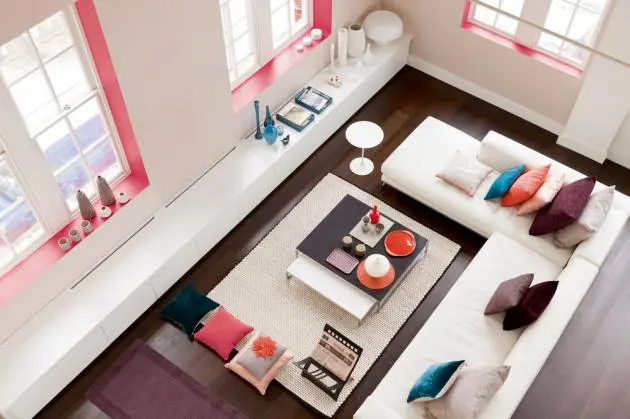
Accent colours can help to draw attention to well-designed features such as prominent walls, panels and frames. Use stronger colours to showcase architecture or furniture in the room, such as painting a wall a perky vermillion to transform it into a vivid backdrop for big screen television or a bed. Conversely, lighter tones of the same colour or other neutral colours can help play down unsightly design elements, such as poorly placed windows or rooflines. To highlight an area of the wall, paint it in a hue that contrasts against the base colour.
If you’re adopting bold colours for the first time, use it on smaller features in the room – this will give you the confidence to try out these shades on larger areas in future. Even used in small ways, these colours can help reflect your style and make a statement too.
>> Create your own original effects
Experiment with textures or patterns to add fun touches or striking statements to the space.
Ombre gradients are fast gaining popularity, where walls or furnishes begin with a single colour, before blending in a chromatic spectrum from dark to light. Simply portion walls into three sections and paint colours in dark, medium and light shades from the same colour family. Working with small sections of the wall, paint the darkest shade around the base, followed by the medium then the light shade around the ceiling. Use a large, dry paintbrush to blend the hues into each other quickly, making sure that the lines are blurred. Work quickly as paints blend easier when wet, and ensure that your brush is dry when using it to meld the colours together.
Another way to add definition to the room is by printing patterns on walls, such as by painting stripes or using trendy stencils which a readily available in DIY stores.
>> Don’t worry, be happy
One of the great things about paint is that it is easy to change, update and modify as a wall colouring and covering. So you can let your imagination run riot and experiment, knowing that if it isn’t quite right the first time, then it is easy to have a second go.
For more information, visit www.Dulux.co.th.
