
Colours made for drinking


Play
Japan's ryukyu glass grows in popularity during the hot summer months
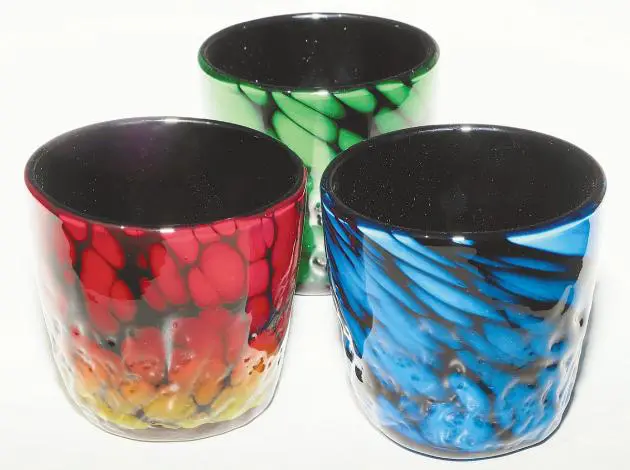
RYUKYU GLASS, with its colourful simplicity, is coveted around the country, not just in Okinawa Prefecture where it originated.
With the onset of summer, Ryukyu glass can be a cool gift and a receptacle for your favourite shochu.
“The colourful tones and air bubbles in the glass represent a beauty that occurs by chance,” notes Masaki Enomoto, store manager of Tokyo-based Ryukyu Glass Awaniko. “Craftspeople put their whole feeling into each product. This is why each piece has individuality."
Born in Shimoda, Shizuoka Prefecture, the 25-year-old Enomoto has been manager of the store since 2010. The store, which sells to individuals and restaurants through the Internet, also provides items used in TV shows and films.
Ryukyu glass is generally made using the glassblowing technique in which melted glass is rolled at the tip of a hollow iron rod, and then moulded when the craftsperson blows into the glass through the rod.
The production of Ryukyu glass began after World War II when local people made glasswork after melting Coca-Cola and soft-drink bottles discarded by US troops.
As the colour of a bottle is reflected in the product, the finished piece could be rainbow-hued.
“Due to impurities, such as bottle labels, minute air bubbles appeared in the glass. That made the glasswork popular,” Enomoto says.
New glass is used most of the time nowadays, with colouring agents added to make them more attractive. Baking soda is used to produce air bubbles.
“When the weather becomes hot, serving cool green tea in a Ryukyu glass cup is the thing to do,” Enomoto says.
One of the most popular products is a barrel-shaped glass for drinking liquor on the rocks. The glass is about eight centimetres tall and about eight cm in diameter.
“As the regional shochu liquor awamori is popular in Okinawa, a glass with a wide mouth is preferred,” Enomoto says.
He adds that the glass is great as a gift because many people like to drink shochu with a little bit of atmosphere.
Besides red, blue, light blue, green and purple, Ryukyu glass products can be found in black.
“Okinawa presents an image of the sea and summer. So, blue and sky blue are popular,” Enomoto says. This offers a sense of coolness, which is needed when it gets hot.
Red offers a good deal of presence and reminds us of the sun in tropical countries. Since creating red glass needs a special heat treatment, it takes longer to form the colour. “It costs a little more, but it is popular among people who want something special,” Enomoto says.
But what has attracted most attention recently is a black-based glass made by some producers.
Ryukyu Glass Awaniko offers black glass with the surface painted with other colours and designs. So far, this kind of glass has been mainly for exhibit, but craftspeople are now producing it for practical purposes.
“It has a sense of depth and looks modern. As it is preferred by men, it makes a perfect gift for husbands, friends and lovers.”
One drawback is that Ryukyu glass cannot be placed in a microwave oven and pouring extremely hot water into a glass is not advisable. “Wash it gently by hand and treat it with care,” Enomoto says.
Meanwhile, there is a move to recycle cullet, broken or refuse glass, to make Ryukyu glass products. Ryukyu Glass Awaniko processes it in such a way so it does not present a danger to customers.
The store sells two kinds of cullet glass – one about one cm in size and the other about two to three cm.
It is very decorative when scattered in aquariums and other water tanks. It also is used as a material for mosaic paintings or processed into accessories.
