
Cleaning up after the headhunt


Play
A visitor witnesses a gory rite in Borneo's jungle - and lives to tell the tale
Borneo, famous for rainforests teeming with wildlife, also hides a wealth of human mysteries.
Perhaps the strangest is nyobeng, a ritual in which human skulls taken during headhunting are removed from storage and ritually cleansed to restore their magic power.
Visitors are discouraged at such rites, but through a mixture of persistence and luck I found myself in Sebujit Village, Bengkayang Regency, at just the right time of year.
Proceedings began with a blast, as men of the Dayak Bidayuh tribe, in traditional dress adorned with beads and animal bones, fired their ram guns skywards to salute their ancestors.
What happened next was a gruesome, shocking reminder of nyobeng’s bloodthirsty roots.
A headman threw chickens into the air, and members of a visiting tribe slashed at them with swords as they fell, repeating the process when the animal dropped to the ground alive.
The welcoming ceremony for other tribes continued with white and yellow rice being scattered and mantras chanted by village elders. Local girls served tuak (palm wine) before the guests were taken to the Rumah Balug, a shrine-like wooden building in the middle of the village.
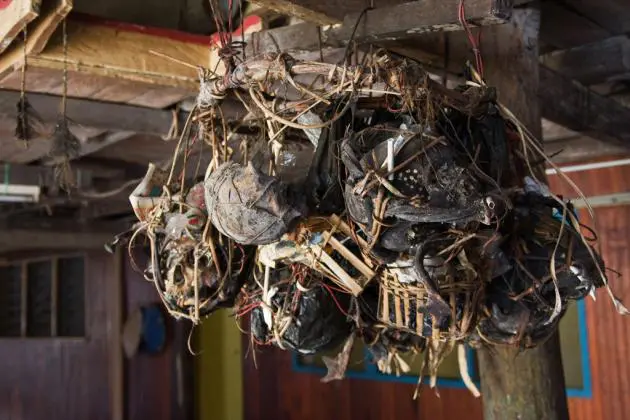
This is where the most sacred part of nyobeng begins – the bathing of headhunted skulls.
The Dayak Bidayuh believe that the head contains the soul of a person, whose power lingers on after death. Dried human skulls are thus thought to emit the strongest magic powers on Earth. A freshly taken head, say the Dayak Bidayuh, has the power to rescue a village from the grip of deadly disease.
Their potency does not stop there, though. Headhunted skulls are also considered effective for inviting rain, increasing harvests and warding off evil spirits. The greater the number of dried skulls gathered, the greater their supernatural powers will be.
Such beliefs led to the special bathing rite, aimed at restoring the protective potency that emanates from the heads of their former enemies.
The practice of headhunting among the Dayak officially came to an end in 1894 at a general meeting of community elders in Tumbang Anoi, Central Kalimantan.
However, the elders’ agreement failed to reach some ears. Headhunting was still being practised in West Kalimantan during the late 1940s, says Waliman, 45, the former head of Sebujit Village. “Headhunting in my village ceased when Christian missionaries arrived,” Waliman said.
Local headman Amin said that the nyobeng tradition’s roots had been maintained by keeping the skulls in the Balug house and bathing them once a year.
According to tradition, the heads would guarantee the safety and welfare of the village only if stored in a high place. Eventually the circular Balug house was built on tall stilts to house the gory trophies.
The Balug is about 20 metres high, and soars above the rest of the village. The tall structure is supported by over a dozen solid wooden piles and equipped with a flight of stairs.
Sebujit villager Gunawan says that the Balug here has been used for at least seven generations.
The villagers are hospitable, and visitors can spend a night or two.
The 15-or-so holiday huts available are basic, as Gunawan admits, but they give visitors a chance to get better acquainted with daily life here.
“In spite of the improvements still needed, the facilities will certainly appeal to anyone wishing to stay a while,” said Gunawan.
The holiday huts, with rates that range between 25,000 and 100,000 rupiah (Bt75-Bt300), are reached from the road via bridges.
Just outside the huts is the Balug, whose steps visitors can climb to take a look at its interior and the several animal skulls hanging from the walls and rafters.
The human skulls, which are considered sacred and off-limits to outsiders, are stored in a special chamber within the Balug.
