
Nature on the brush


Play
Sandstone artist Li Junsheng wants to bring his painting techniques to the world
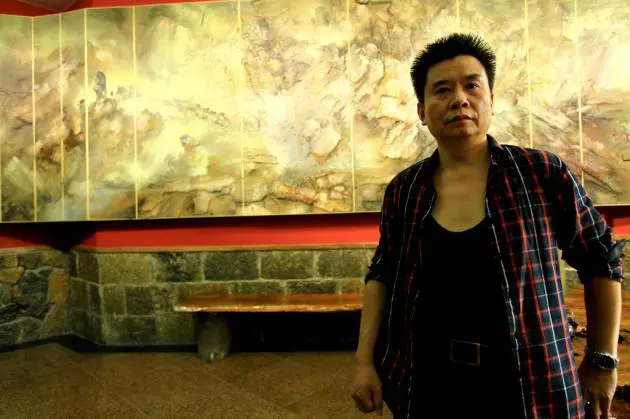
One of Hunan province’s most respected artists, Li Junsheng relates the essence of his native Zhangjiajie through paintings created with only the most natural of materials – sand, fragmented stone and portions of plants like tree bark and bamboo sticks.
Li’s works, which are on permanent show at the Junsheng Sand and Stone Painting Institute in Zhangjiajie, have an intriguing three-dimensional effect that’s coupled with a strong sense of reality. Most are inspired by the gorgeous natural scenery in this part of northwest Hunan, though some portray the ancient and plain ethnic dwellings and the people of the minority Tujia group, of which he is a member.
“It’s a kind of environmental art,” says Li, chatting with our group on the third floor of the institute. “If raw materials from nature were all gone, then our lives would come to an end.
“To me sandstone painting involves two important factors. The first is internal and has its roots in my fight for a better life, the second is external and is about the raw materials like stones and bark.”
Li grew up in a very poor peasant family in this town which, until 1994, was known as Dayong. He recalls being passionate about art as a child and began instinctively to depict his picturesque hometown through various media.
In 1984, he headed to the provincial capital Changsha to attend art school but was forced to drop out because of the expense involved. His painting with sandstone came later and was inspired by the way the local people spread coloured cobblestones on walls while repairing their houses.
“I started working with oils when I was in my early 20s but switched to sandstone in 1986,” says the 50-year-old.
“I’ve always liked trying new things and try to incorporate different techniques and materials in my paintings. But a sand and stone painting is sand and stone, with perhaps some bark too,” says the artist who integrates other styles such as Chinese landscape painting in his works. “And because the materials are simple, the inspiration shines through.”
Junsheng has found fame both nationally and internationally. In 1994, he held an individual sandstone painting exhibition at the China Art Gallery in Beijing and his sandstone painting, “Wuling Landscape Is Best” was acquired for the Kunming World Expo China Archive Treasures in 1999.
In 2000, another work titled “Ancient City”, won the gold prize in the 3rd Arts and Crafts Essence Exhibition and in 2003, his entire collection was showcased in a publication of the China Literature Association Press.
International recognition came in the early part of the 21st century with his “Scenery Recurrence” chosen for the 2004 Paris-China Calligraphy and Painting” exhibition in France and “Soul of Wuling-Tiamen Mountain” selected for the Chinese Pavilion at the Japan Aizhi World Expo the following year.
He’s also exhibited in Macao and elsewhere and his paintings now form part of the private collections of world leaders and art lovers around the globe.
Li set up the four-storey institute in 1997 and opened an exhibition hall for this type of painting in 2001. The Fine Arts Academy of Jishou University has used it as a teaching and practice site and it has served as the first demonstration base for Hunan’s culture industry. He has more than 100 students in China and overseas, including in America and Canada.
The first floor of the institute is home to a painting in which he traces the relationship between man and nature while the second features his materials along with a remarkable depiction of the famed Heaven Gate, through which the world’s best wingsuiters flew last year. Other paintings in this space include a Tujia village reputed for dyeing cloth, hay for the cattle, Zhangjiajie in winter, and Junsheng’s own house with a double door that opens out to the best Mother Nature has to offer.
“When he opens the door to his home, he sees the natural scenery of Zhangjiajie. There are small sheets of red paper pasted on both sides of the door: the one on the left depicts the Communists while Mao Zedong is on the right side,” explains a local guide.
The third floor features an installation of 10 different pieces of wood covered in Chinese script telling the story of the artist’s life.
The fourth floor is more like a conventional gallery with small paintings lining the walls and benches where visitors can sit as they appreciate the art. The collection includes a portrait of Tienzi Mountain and four pieces about the seasons in Zhangjiajie titled “chun tian” (spring), “xia tian” (summer), “qiu tian” (autumn) and “dong tian” (winter).
“For me, art has no boundaries,” Li says. “Sandstone painting isn’t easy but nor is it hard. The subjects are just different and the emotions that come across in my work vary accordingly.
With museums already up and running in Zhangjiajie and in Wulingyuan, Li says he is planning a third. “It will still be in Zhangjiajie,” he says, “but much bigger than this institute.
“But my most important goal for the future is to establish a sandstone art school so I can popularise this splendid art form and make Zhangjiajie known around the world.”
On the Web:
www.JunShengHuaYuan.com
