
Literature's fish out of water


Play
Jerry Hopkins surveys a century and a half of western writers who preceded him to Asia, the proverbial blind men groping the elephant
LIKE OTHER foreign authors who arrive in Thailand with heads full of writings about the Orient by fellow “outsiders”, Jerry Hopkins must have wondered exactly how many had preceded him. Their keen readers wonder too, for that matter. One website he found listed 5,000 titles in English.
Hopkins – an American who had not yet written about the East when he moved here in 1993 but has since published “Bangkok Babylon” and “Thailand Confidential” – is probably alone in taking the logical next step of authoring a whole book about his predecessors. It’s an informative survey, not least for establishing that most of the Western observers denigrated the East in their books, and still do.
“Romancing the East” narrows the field down to three dozen scribes, although many more are mentioned in the concise chapters that fit fewer than 300 pages. Almost all the names are famous, from Conrad and Kipling to Amy Tan and VS Naipaul, but there are also several lesser lights, like John Masters (“Bhowani Junction”), Marguerite Duras (“The Lover”) and – dare I say it? – John Burdett, one of Thailand’s most successful purveyors of girls-a-go-go.
These synopses are author reviews, not book reviews, quick biographies culled from the Internet and doubtless a few old-fashioned sources as well. In some instances Hopkins retraces his subjects’ footsteps in spots around Asia and reports what’s left to see. But he offers scant personal insight or opinion, which is a shame given that his most famous book, a biography of Jim Morrison, provided a real sense of what the prematurely dead rock star was like.
It’s admittedly harder to say what Rudyard Kipling was like, so Hopkins settles for acknowledging the very different views of the “Gunga Din” poet that persist today. Whether he was the champion of oppressed colonials or patriotically duty-bound to wield the whip remains in question, and Hopkins for the most part prefers to err on the side of neutrality.
Generally there is little to quibble about regarding the names and titles on which Hopkins has focused. He casts endearing looks at Lafcadio Hearn, who “went native” in Japan, and Orwell with his “Burmese Days”. He has a bit of fun with Richard Mason of “Suzie Wong” fame and Anthony Burgess, the scourge of old Malaya. Pearl Buck and Graham Greene are given due respect for knowing their subjects well, less so the tourists Somerset Maugham and Paul Theroux.
Not that Hopkins wants to criticise anyone, even if he doesn’t hide his winces when it comes to the creators of stereotypical Asian characters like Charlie Chan (American Earl Der Biggers) and Fu Manchu (Sax Rohmer, a Briton). Western apprehension of “the Yellow Peril” remains deeply ingrained and is thus a key subject in any examination of the literature. Hopkins also joins in the universal seething over Anna Leonowens’ graceless fibs about Siam.
On occasion, though, Hopkins seems more impressed by sales figures than writing quality, cultural acuity or literary significance. Thus we have the blockbuster authors – James Michener, Ian Fleming, Michael Crichton – who really didn’t know Asia well at all, instead colonising it from afar in their imaginations.
And, when it comes to Thailand’s peculiar glut of farang authors, Hopkins puts his spotlight on the two biggest money-makers, Michel Houellebecq (“Plateforme”) and John Burdett (“Bangkok 8”, etc), both purveyors of sordid violence and mindless sex, while skimming past Jack Reynolds’ “A Woman of Bangkok”, the best-crafted book any foreigner has ever written about the Kingdom.
Reynolds’ 1957 novel does get praised in a “Three worth reading” sidebar – along with Stephen Leather’s lamentable but hugely popular “Private Dancer” and Timothy Halliman’s relatively obscure “The Queen of Patpong”. Beyond the sidebar, Christopher G Moore is hailed as “the bar scene’s authorial top gun”. Meanwhile Alex Garland gets a chapter of his own for “The Beach”, a feast of backpacker malarkey hyped as a classic tale of societal breakdown.
Hopkins gives the majority of bargirl chroniclers a poke for books “badly written, poorly produced and seldom proofread”, but he could do with more proofreading himself. The most glaring of several (assuredly minor) slip-ups is the title “XXX” for the chapter about Andre Malraux. My guess is it’s a placeholder for a Malraux book title that someone forgot to insert.
Sometimes it’s hard to see the trees when the forest is so big. But, collectively, Hopkins’ chapters paint an absorbing mural of displaced foreigners struggling to understand and explain “the exotic East” in the context of their own damaged lives and forsaken homelands.
“Like what happened when blind men examined an elephant and described its various parts,” he writes, “these authors visited or lived in Asia in far different ways and places over a period of 150 years, yet their divergent dispatches and stories joined like the parts of an outsized pachyderm, forming a fantastic ‘one’, a weird and woolly place with scary tusks and a tough skin but knowing eyes, a good place for adventure and romance.”
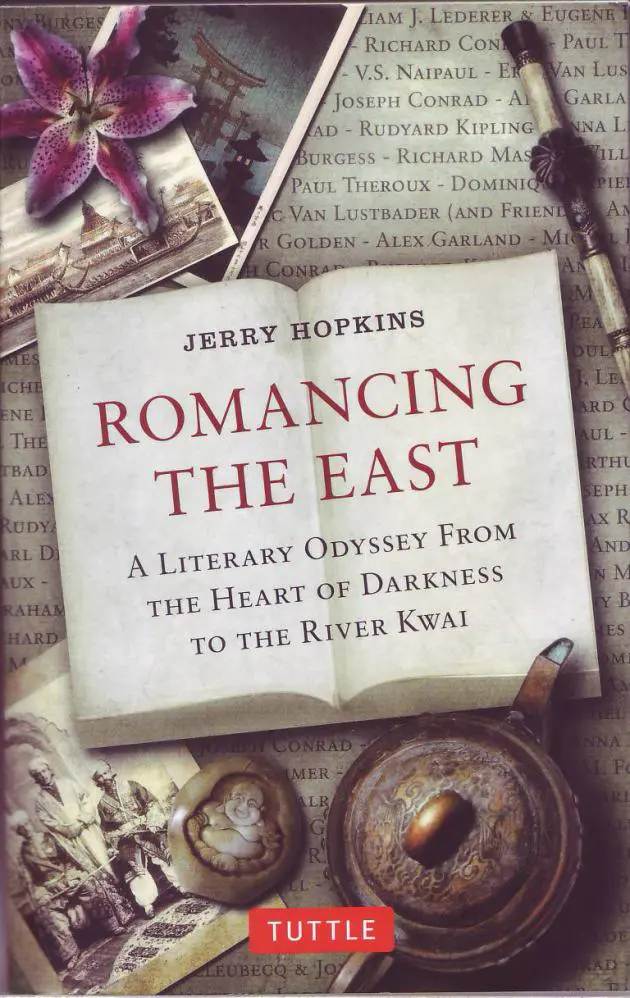
Romancing the East: A Literary Odyssey from the Heart of Darkness to the River Kwai
By Jerry Hopkins
Published by Tuttle, 2013
Available at Amazon.com, US$12
WELL SAID
>>“You know, you shouldn’t understand. It’s much too big, much too complicated for one book to clarify any situation.” – John Masters, on India, if not anywhere in Asia
>>“To Bangkok! Magic name, blessed name. Mesopotamia wasn’t a patch on it.” – Somerset Maugham in “Youth”
