
A spirit that transcended borders


Eighth-century Chinese monk Jianzhen endured shipwreck and more to answer Japan's call
Yangzhou in China's Jiangsu province is located on the north bank of the lower reaches of the Yangtze River. Its abundant water and greenery creates a feeling of peace. It’s the hometown of Jianzhen, an eighth-century Chinese monk who helped propagate Buddhism in Japan. After many failed attempts to reach Japan, Jianzhen finally made it on his sixth try. The name of the noted master of Buddhism remains engraved in Chinese people’s minds.
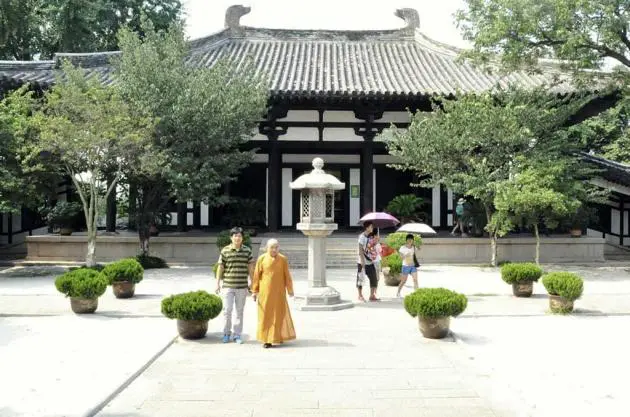
Daming Temple, where Jianzhen served as a master, sits on a hill in the northen area of the city. To reach it I climbed about 100 stone steps amid the buzzing of cicadas. Many people visit the famous temple from early in the morning.
The temple includes a main hall and the Jianzhen Commemoration Hall. The latter looked somewhat familiar to me. That was natural because the hall was modelled after the kondo or Golden Hall of Toshodaiji Temple in Nara. Large ornamental tiles are set at both ends of the roof, and the hall houses a wooden statue of a seated Jianzhen, modelled after the famous Japanese national treasure in Toshodaiji Temple. Zhang Maorong, 34, a clerk at the temple, said with a smile, “Jianzhen was a symbol of Japan-China friendship.”
“The Roof Tile of Tempyo”, an historical novel by Yasushi Inoue (1907-1991) that depicted Jianzhen, contributed greatly to Japan-China friendship.
During China’s Cultural Revolution (1966-76), temples in various places were destroyed as part of a rejection of religion. However, Daming Temple survived. “Then-premier Zhou Enlai instructed that the temple should be protected, as it was important for the Japan-China relationship,” said Zhang.
Yangzhou’s location at key junctions of a large canal connecting northern and southern China made it an international city during the Tang Dynasty, the era in which Jianzhen lived. It attracted visitors from India and the Arab world. Envoys from Japan, on missions to Changan, capital of the dynasty in the province, also passed through Yangzhou.
Neng Xiu, 48, chief priest of Daming Temple, said, “Jianzhen’s international orientation was cultivated in the environment of Yangzhou.”
Jianzhen, who was trained in Changan, returned to his hometown around the age of 26 and was involved in the construction of many temples and Buddha statues. Eventually Jianzhen became a highly accomplished master, qualified to hand down precepts to believers.
When Jianzhen was 55, two Japanese monks studying Buddhism in China visited Yangzhou and told him they wished to invite a high-ranking priest to Japan, as the nation then had no priests qualified to hand down precepts to believers. “Todai Wajo Toseiden”, a biography of Jianzhen written in Japan after his death in 763 but before the end of the Nara period (710-784), portrayed the situation in those days.
It says Jianzhen asked monks around him whether any of them would volunteer to visit Japan and propagate Buddhism. Most of his brethren kept silent rather than answer. Some of the monks hinted at the dangers of travelling to Japan. Jianzhen immediately declared he would go, saying, “This is for Buddhism. Why are you reluctant to stake your lives? If no one wants to go, I’ll go myself.”
This must be a remark that Jianzhen made on the spur of the moment. However, Jianzhen resolutely carried out his stated intention, despite shipwrecks and taking 11 years to reach Japan.
In addition to Buddhism, he was an expert on medicine and was considered a founding father of medicine in Japan.
The Daming Temple master said, “Difference of races and national borders have nothing to do with helping people.”
Daming Temple established Jianzhen Buddhist University in 2003 to spread the master’s spirit, and about 40 monks are studying Buddhism there currently. Following Jianzhen, who spread Buddhism to the world, the school focuses on foreign languages such as Japanese and English and frequently holds exchange events with people related to Buddhism in foreign countries.
When I returned to the commemoration hall after making a circuit of the temple site, I saw a man, 29, bowing deeply to the statue of Jianzhen. I spoke with him, bringing up the topics of Jianzhen and Japan-China relations. He said with a smile, “Relations were better in the Tang era when Jianzhen, who bet his life on Japan, was alive.”
Jianzhen taught people how important it is to help each other beyond borders by his own example. There is much we can learn from Jianzhen even today.
