
This faithful cloth


The Queen Sirikit Textiles Museum weaves new plans
“TEXTILES RELATE to everything,” says Dale Carolyn Gluckman, insisting that this is far more than cloth you’re looking at.
“Consider the many aspects of textiles,” the consultant at the Queen Sirikit Museum of Textiles enthuses. “There’s technology, art and art history, craftsmanship, economics development, sociology, culture, anthropology ...”
They are parachutes, the upholstery on trains – everywhere you look, textiles are adapting to some compelling necessity. “A lot of textile development comes out of other fields, and vice versa,” Gluckman says. “The world has been trading in textiles for thousands of years.”
She and Melissa Leventon are overseeing the museum’s promotional activities centred on Her Majesty the Queen’s birthday last week.
“One of the special things about this museum is it that, as far as I know, it’s the only one that really focuses just on textiles,” Leventon says. “The mission is to show and interpret the textiles connected to the royal family, and particularly Her Majesty, but it also looks at the broader picture, across Southeast Asia.
“I’m prejudiced, but I think this is the most beautiful museum in Thailand!”
Americans Gluckman and Melissa – experts in arts museums and textile museums in particular – have been working for this one at the Grand Palace since 2004.
“Visitors not only develop a greater appreciation for Thai history and a better understanding of Thai culture,” says Gluckman, “but they also marvel at how beautiful these textiles are – whether they’re Her Majesty’s gorgeous dresses or the beautiful textiles made by rural weavers for her Support Foundation. They are inspiring. Textiles are not only a great art form in general but the truly great art form of Thailand and Southeast Asia.”
Sirikit Museum chief Piyavara Teekara last week unveiled the new exhibition “Fashioning Tradition: Queen Sirikit Creates a National Dress for Thailand”. The book “In Royal Fashion: The Style of Queen Sirikit of Thailand” now has an English-language edition. And coming up in November is the museum’s first international symposium, “Weaving Royal Traditions through Time: Textiles and Dress at the Thai Court and Beyond”.
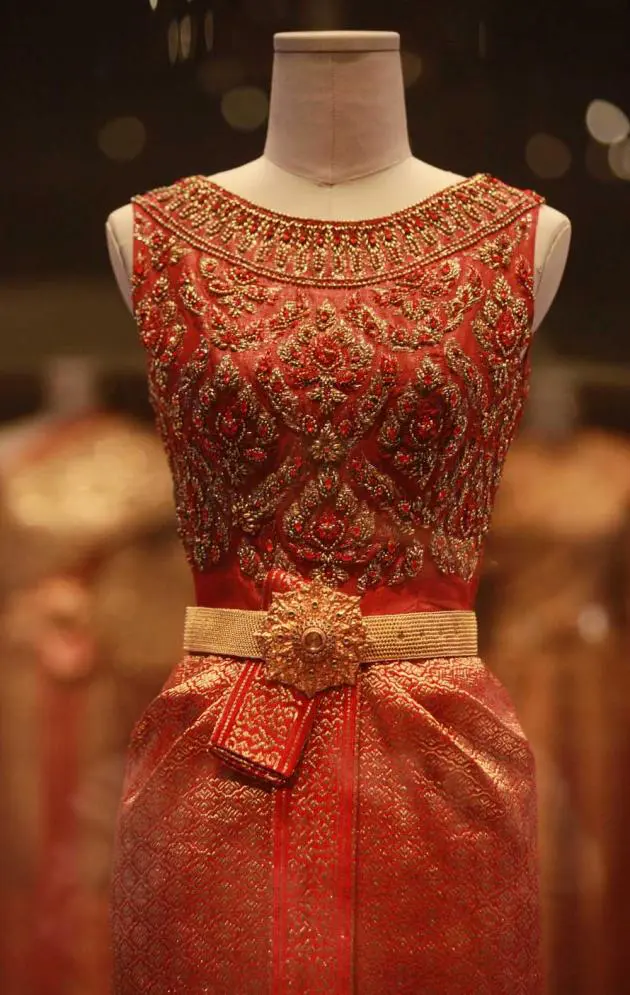
Nine more gorgeous outfits made for the Queen are on view in Gallery 2 while those previously displayed undergo conservation in accordance with international standards.
You can see the Thai Dusit dress that famed French designer Pierre Balmain created for her sometime between 1962 and 1967. He formed metal-thread brocade in the phumkhao bin (heads of rice) pattern, adding sequins and beads.
Balmain’s Thai Sivalai dress is also here, tailored with metal-thread ivory brocade in the same sequinned pattern. This is the gown the Queen wore for the royal naming ceremony for Crown Prince Maha Vajiralongkorn in the Anantasamakom Throne Hall at Dusit Palace on December 28, 1972.
And Balmain made the Thai Chakri dress too, in 1982, with an attached shoulder cloth of silk and
gold brocade. The House of Lesage in Paris did the bead and sequin embroidery.
There are two Thai Boromphiman costumes in the style of the 1960s, one from an unknown Thai designer with a bodice of metallic thread, an attached skirt of silk and metallic brocade. The second is by Nai Nok, with a silk bodice and attached skirt of silk brocade.
A Thai Ruean Ton dress is on show, of the kind Her Majesty often wore for the annual kathin ton distribution of robes to monks, as is a Thai Chakraphat – a formal evening gown with a brocade skirt and separate embroidered shoulder cloth (sabai).
Leventon keeps a close eye on the clothing’s condition. “Preserving textiles in a tropical climate can be quite challenging,” she says. “Textiles like the humidity about the same as humans, around 55 per cent, and the temperature between 12 and 15 degrees.
“We have great climate control in the museum, but textiles are organic and they gradually degrade, just like humans. We’re fortunate Her Majesty didn’t wear these dresses a lot. These were for special occasions like state dinners and tours abroad, so for the most part they’re in good condition.”
Her Majesty’s wardrobe was of course well taken care even before it reached the museum, yet Gluckman points out that some of the pieces are quite old, dating from the 1950s and ’60s.
“The museum has a large dedicated laboratory for preservation and state-of-the-art storage facilities,” she says. “Another mission of the museum is to train people to take care of the fabrics.”
The book “In Royal Fashion” examines women’s attire during the Rattanakosin Era, as well as Her Majesty’s initiatives in conserving traditional fabrics, skills and styles, which led to the designation of eight national costumes.
The museum has also commissioned children’s books, paper dolls and jigsaw puzzles through which youngsters can learn about silkworm farming, weaving, Thai patterns and the different costumes.
The international symposium “Weaving Royal Traditions through Time” takes place at the Dusit Thani Hotel from November 6 to 9. Her Royal Highness Princess Maha Chakri Sirindhorn will open the event and make a speech.
Participants will be treated to the sight of distinguished experts from around the world dressed in royal Thai costume, and also travel to locales related to weaving.
SILK
AND MORE
- The Queen Sirikit Museum of Textiles is open daily from 9 to 4.30. Admission is Bt150 (Bt80 for seniors, Bt50 for students, free for children under 12). Admission is free with a ticket to the Grand Palace.
- Find out more at (02) 225 9420, [email protected].
- For information about the symposium, see www.QSMTSymposium2013.com.
- The museum’s library can be visited by appointment. Call (02) 225 9430, extension 151, or e-mail [email protected].
