
The man who moved the Hmong
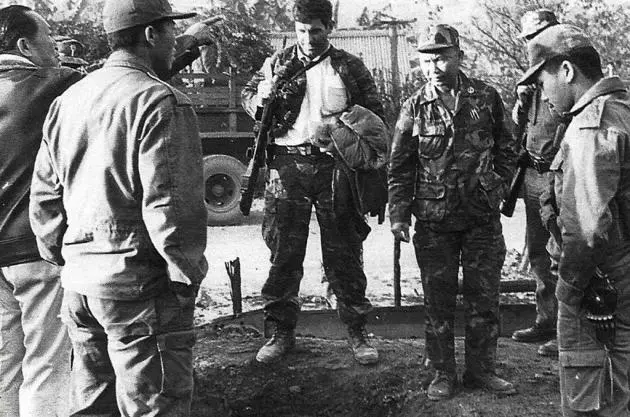


A new biography examines the life and death of a celebrated CIA agent who died in Bangkok 31 years ago
The extraordinary life – and mysterious death in Bangkok – of a famous CIA officer from the “secret war” in Laos is the subject of a new book that has won high praise from military analysts and experts on the American spy agency.
“Hog’s Exit” by American academic Gayle L Morrison tells the story of Jerry Daniels and the key role he played in the covert war in Laos. He was the agent assigned to General Vang Pao, head of the Hmong force armed and encouraged to resist communist troops with the aid of massive air support.
Daniels was a rugged outdoorsman who formed a deep and enduring bond with the Hmong. They revered him for fighting at their side for months on end north of the Plain of Jars, and for his ability to speak their language. They admired his honesty and, after the war, his years of work to help resettle thousands of Hmong from Ban Vinai and other camps to the US.
Daniels was initially a “smokejumper” in Montana, parachuting into forest fires. Joining the Central Intelligence Agency, his expertise in parachutes and air-cargo rigging made him perfect for a job as a “kicker”, men who crewed the planes and helicopters, dropping weapons and supplies to CIA forces fighting the communists in the 1950s and ’60s. The kickers were used to support US-backed units in Korea, Taiwan, Tibet and then, in 1961, the hilltribe warriors in Laos.
“Hog” Daniels is hailed as one of the shining lights following the US military’s dramatic retreat from Indochina. He opened the door to a new life for faithful allies – mountain people with little formal education who’d been left to face the wrath of communist troops after the US base at Long Cheng was abandoned.
He was a straight-talker, intelligent and respected by his peers, but the discipline and focus he summoned to support the Hmong were matched by wild excess in his private life. He had a passion for women and boozing, drowning the tension of the war and anguish over lost comrades in week-long binges – on R&R in Bangkok and on his returns home, where he undertook long hunting trips with friends in the hills of Montana.
In “Hog’s Exit”, friends and Hmong associates discuss the death of Daniels in Bangkok and his funeral back in Missoula in May 1982, which drew hundreds of Hmong, plus top government officials. It was a three-day traditional Hmong ceremony – a rare honour – enacted amid an undercurrent of speculation on whether the CIA man really was inside the sealed casket flown back from Thailand.
Doubt lingers over his death under unusual circumstances – carbon monoxide poisoning from a leaking gas outlet in his flat in Soi Lang Suan, after another big drinking session. The threats he received in his final years when approving or rejecting refugees in the camps adds to the speculation.
Author Morrison was a counsellor hired in the late ’70s to help Hmong and Lao refugees who arrived in California learn English and adapt to their new life.
Her first book, “Sky is Falling”, was about the CIA’s evacuation of the Hmong from Laos in 1975. This book is another oral history, told through the words of friends, family and colleagues, a style that lends great authenticity and closeness. But it was also a huge labour of love for the author, who spent more than a decade researching and editing the book.
In an email exchange, Morrison said getting people to talk about Daniels required finesse. “Many Hmong and all CIA [operatives] had to be approached in the Asian way – indirectly, relying on personal introductions, recommendations, and their own ‘back channel’ checks – before I could make contact.”
She made three research trips, but was careful not to put people at risk in Laos, where the brutal treatment of political dissidents continues. “I made up my mind that I wouldn’t interview anyone still living in Laos,” Morrison said. “[But] I have interviewed a number of American expats who worked in Laos during the war years and who live in Bangkok.”
Morrison said the war stories she heard from the Hmong about Daniels were serious, while the tales from his friends in Montana were often hilarious. But his greatest legacy was his impact on the Hmong in the US – who now number more than 250,000.
“I don’t think the significance of what he did for the Hmong who left Laos can be overstated,” Morrison said. “In 1975 there was no plan to resettle Hmong and Lao refugees to the US. The massive Hmong exodus out of Laos to Thailand took everyone by surprise, even Jerry. But what are you going to do? You can’t pretend it’s not happening. Someone has to deal with it. Jerry believed Hmong resettlement in Thailand was the least traumatic solution, but when that wasn’t an option, he stepped up to try to ensure the Hmong refugees were dealt with fairly by the US government, not just ignored.
“The bottom line is, without Jerry Daniels there wouldn’t be a Hmong-American community in the US today – not without his personal commitment and effort. Now there are so many younger Hmong-Americans named Jerry! Jerry Yang, Jerry Moua, Jerry Vang, Jerry Thao, on and on. What a tribute to a man who changed the course of Hmong and US history.”
READ ALL ABOUT IT
“Hog’s Exit: Jerry Daniels, the Hmong and the CIA” by Gayle Morrison is published by Texas Tech University Press. It’s available at Asia Books, Kinokuniya and elsewhere for Bt1,400.
