
Crying out for peace


Play
Thailand's Got Talent winner Somchai Ninsee conveys the hopes of the deep South through his songs
Pattani native Somchai Ninsee had barely been named as the winner of this year’s season of “Thailand’s Got Talent” when the social networks started buzzing with criticism.
“Somchai is just a songs-for-life style musician who plays guitar and sings about the insurgency in Thailand’s South,” read one comment.
“The first runner-up Thai Gym represents our country by showcasing Thai style gymnastics while the second runner-up Sornsilapa showcases Thai martial arts through muay thai moves,” pointed out another.
Somchai, however, is not troubled by the unkind rants.
“Thank you so much,” says the 30-year-old musician when I congratulate him on his win.
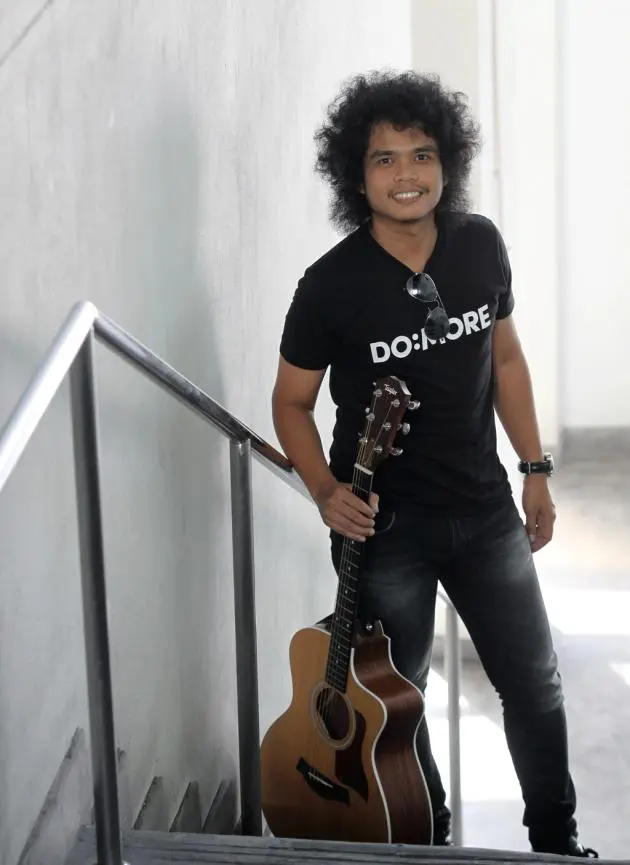
Dressed in his trademark faded black jeans, a black T-shirt sporting the slogan “Do: More” and black sneakers, the musician, who sports unruly curls and a small moustache, adds that he hasn’t actually read any of the comment though he’s heard about them from friends.
“I haven’t harmed anyone by winning,” he says quietly. “All I wanted to do was to sing the songs I wrote from my heart and at the same time tell people from all over the country that the thing that all of us in the three Southernmost provinces want is peace.
“Every contestant has a different ability. Mine happens to be songwriting and singing. It’s totally impossible to satisfy all of the people but it was Thai viewers who made the decision to vote for me.”
Somchai insists that he doesn’t feel hurt by the negative comments but is constantly saddened by the never-ending violence in Pattani, Yala and Narithawat.
“There’s nothing an ordinary guy like me can do to get rid of violence and bring peace. All I can do is make people aware of what’s going on by telling true stories through song.”
Somchai didn’t have a privileged childhood – his dad was a janitor and his mum a street vendor – and money was often scarce. It was, however, happy. His love of music, he says, comes for his father, who played for a nang talung (Southern shadow puppet play) troupe in his spare time.
He enjoyed singing at primary school and played music with friends at high school. Rocker Seksan Sookpimai, better known as Sek Loso, is his favourite artist and he also admires songs-for-lifer Pongsit “Poo” Khampi.
“When I was a high school student, I used to dream of meeting Sek Loso and maybe carry his guitar. I knew that if I wanted to see him, I had to come to Bangkok,” he says with an easy smile. “I like Sek because he’s an easy-going guy with a laid-back attitude who has a talent for producing songs with a catchy melody.”
He did make it to Bangkok, not to carry Sek’s guitar but to study at Phranakhon Rajabhat University’s Faculty of Industrial Technology. Between classes, he started to write songs and was soon producing melodies that he mixed with the klong khaek (a two-faced drum used in Islamic music), the phee menorah (flute used in Norah music), and the rong ngeng (Thai-Muslim folk dance).
He posted his songs on YouTube and Facebook and borrowed from his relatives to produce music videos of his numbers “Rai Leela” (“Good-for-nothing”) and “Dek Tai Woy” (“Southern Boy”) on cable TV.
After graduation, Somchai tried to find work in the music business but was quickly disillusioned. He worked for a while as a street vendor selling clothes and junk jewellery and eventually winded up going home.
“I didn’t have the money to pay for time at a recording studio,” he says.
A few months after the 2004 violent incident at Pattani’s Krue Sae Mosque, he wrote his first hymn to peace, “Nok Phirab See Khao” (“White Pigeon”).
“I was just about to leave Pattani for Nakhon Si Thammarat to serve with the 16th tank battalion at Thep Satree Sri Sunthorn Camp. By then, there were killings every day. Many of them were people from Pattani –a motorbike mechanic, a senior executive, a friend of my dad’s. People from all over the country were asked to fold paper cranes and a million of them were released over the south in a plea for peace. I thought a lot about what I could do for my hometown.
“When I was growing up, we lived a happy life and people were always smiling,” he continues. “Muslims went out to sea to catch fish and distributed them to Thai Buddhists, who returned the favour with rice or palm sugar. It was the way we lived. Now all that has changed. We have to be back home before 5 or 6pm and lock the doors. Every night, we hear armoured cars on the road. It’s so bad that farmers carry guns to work in the fields.”
Somchai saw “Thailand’s Got Talent” as a channel to present his songs to the country if not the world and lost no time in applying for this third season. In the audition, he played “Nok Phirab See Khao”. He sang “Yala Pattani and Narathiwat” in the semi final and “Yak Hai Ban Rao Klub Ma Muean Derm” (“Let It Be Back to the Same”) in the final.
“In ‘Nok Phirab See Khao’, I talk about the need for peace to return to my hometown and ask the birds to protect our home. ‘Yala Pattani and Narathiwat’ is about the different feelings of the people in these three provinces.
“The lyrics say, ‘People in Pattani realise how much pain they feel. People in Yala feel hurt by the way Thai people kill each other. People in Narathiwat are faced with the outrageous events every day. Why don’t we turn to love each other?’
“The last song is like a conclusion of the first two, and makes the point that we want a return to the peace we knew before.”
Somchai touched viewers with his cries for peace and was easily voted the winner of this third edition of the talent show. He takes home Bt10 million, a condominium and a car.
“I think Thai people know that I wrote my songs from my heart. They didn’t vote for me but for the people in the three Southern border provinces. I’m only a messenger,” says Somchai.
