
New life for a pillar of faith
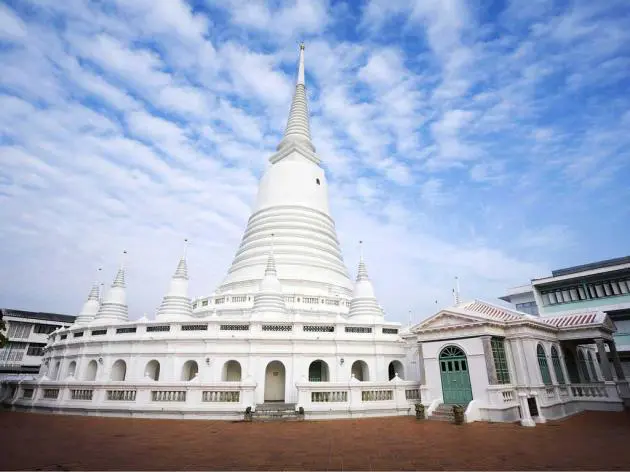


Unesco praises the successful restoration of the "leaning chedi"of Wat Prayoon
The United Nations Educational, Scientific and Cultural Organisation has chosen the restoration of the main chedi at Wat Prayoon in Thonburi over 46 other such works around the region for its 2013 Asia-Pacific Heritage Award for Cultural Heritage Conservation.
The 186-year-old reliquary stupa known as the Phra Borommathat Maha Chedi was restored along with the adjacent Pharin Pariyattithammasala hall that now houses the Prayoon Bhandakharn Museum at the temple formally known as Wat Prayurawongsawas Worawihan.
In announcing the award last week, Unesco’s Bangkok office cited the “technical achievement” and “outstanding social impact” involved.
“We were particularly encouraged to see our broadest-ever geographical range this year, from the Cook Islands to the Islamic Republic of Iran,” jury chairperson Tim Curtis said of this year’s award choices. Curtis heads the Bangkok office’s culture unit.
Built in 1823, during in the early Rattanakosin Period, the bell-shaped Phra Borommathat Maha Chedi contains relics of the Buddha. It is the largest such structure built at that time, rising 60.5 metres and with a circumference of 162 metres. It is surrounded by five-metre-wide porches, along which devotees circle the stupa in prayer.
There are 54 dents facing inside the basement with another 55 dents facing out. On the second terrace are 18 miniature pagodas, also bell-shaped.
The chedi was struck by lightning in 1918, causing substantial damage, and over the years thieves have scaled it to steal statuary and amulets.
It wasn’t until 1991 that serious repairs were considered. It was found that the 10-metre-tall brick pillar at the centre of the chedi was leaning toward the external brickwork. Restoration began in earnest in 2005, led by the temple’s abbot, Phra Brahmapundit, also known as Prayoon Dhammacitto, and Associate Professor Somsak Thammavatevittee of King Mongkut’s Institute of Technology at Lat Khrabang.
Over the course of three years, the senior architect and his team used traditional techniques to move the main pillar, preserving the original brickwork with stucco made from a time-tested mix of sugar cane and rice.
“The most difficult thing was figuring out how to bring the huge pillar back upright,” Somsak tells The Nation. “After that we built metal supports to preserve the structure and keep it in place, keeping as much of the original material as possible.”
After climbing the temple’s two-century-old granite steps, we enter the remarkable sacred monastery, its breathtaking
architecture carrying on the influences of old Ayutthaya.
“Unlike most chedis, which are circular, this one at Wat Prayoon is octagonal and has unique eight-column ribs. After preserving the brick walls, Phra Brahmapundit asked us to display Buddha statues in each of the eight alcoves,” says Somsak, 57.
They cleaned fungal growth from the exterior and painted it white. Spotlights were arranged to dramatically set off the spire’s beauty at night. Like other Bangkok temples that remain open into the evening, Wat Prayoon has become an after-hours tourist destination as well as drawing the Buddhist faithful to see the museum and pay respects before statues of the Buddha that date to the 17th century.
Unesco noted that the restoration has “preserved one of Bangkok’s most iconic religious monuments, combining an act of faith with a major engineering feat”.
“The project has catalysed extensive social impact in the multicultural historic district of Kadeejeen,” it commented in its report. “In strengthening the interior structure while maintaining the external shell of the dramatically leaning stupa, the project demonstrated a sophisticated understanding of a unique architectural typology from the early Rattanakosin era.
“The technical interventions, combining the latest in scientific advances with traditional construction techniques, help to convey a sense of antiquity and feeling of age. The exemplary cooperation between the monks, specialists and locals has given a 21st-century meaning to the age-old symbiosis between Buddhist monasteries and the lay community in sustaining a sacred complex as the centrepiece of neighbourhood life.”
Unesco’s Asia-Pacific Awards for Cultural Heritage Conservation recognise the efforts of individuals and organisations in taking care of such structures. “By recognising private efforts to restore and adapt historic properties, the awards aim to encourage other property owners to undertake conservation projects within their communities, either independently or by seeking public-private partnerships.
“The winners were selected based on how the projects reflected a clear understanding and application of various criteria, such as the articulation of the spirit of place, technical achievement, appropriate use or adaptation, and the project’s contribution to the surrounding environment and the local community’s cultural and historical continuity.
“Eligible projects must be more than 50 years old and the restoration must have been completed within the past 10 years. Buildings with a new use must have also been in viable use for at least one year from the date of the awards announcement.”
Legacy of honours
Thailand's Asia-Pacific Award winners for Cultural Heritage Conservation:
2011 – Scripture Hall. Wat Thepthidaram, Bangkok (Award of Merit)
2011 – Salarian Pavilion, Wat Kutao, Songkhla (Honourable Mention)
2011 – Na Phra Lan historic shophouses, Bangkok (Honourable Mention)
2009 – Samchuk community and old market district, Suphan Buri (Award of Merit)
2008 – Wat Pongsanuk, Lampang (Award of Merit)
2008 – Amphawa canal community, Samut Songkram (Honourable Mention)
2008 – Crown Property Bureau Building, Chachoengsao (Honourable Mention)
2005 – Tamnak Yai, Devavesm Palace, Bangkok (Honourable Mention)
2004 – Phra Racha Wang Derm, Thonburi (Award of Merit)
2002 – Wat Sratong, Ban Bua, Khon Kaen (Award of Merit)
FOR THE FUTURE
Nominations open next month for Unesco’s 2014 Heritage Awards. Find out more at www.UnescoBkk.org/culture/wh/asia-pacific-heritage-awards.
