
Welcome to the pleasure dome


Play
The party is long over but the glory still lingers at Kublai Khan's fabled palace of Xanadu
The Rutted track leading to the site of Xanadu in Zhenglan, Inner Mongolia, bounces our heads against the van’s ceiling as we peer into the endless grasslands outside the window.
But no amount of spine-cracking can shatter the feeling of excitement as we approach this summer capital of the Yuan Dynasty (1271-1368) – the only Unesco World Heritage site in Inner Mongolia.
Built in 1259, Xanadu shaped Westerners’ perception of an exotic Oriental land paved with gold after Marco Polo described the city in lavish terms in his “Travels of Marco Polo”.
As soon as we step onto the path (mud – no gold in sight) leading to the old city gate it begins to rain heavily. Despite it being high summer, a chilly wind bites at our legs.
“There is a gorgeous marble palace, which is wholly painted golden with various elegant designs of animals and flowers. You can feel both visually and heartily pleasant when facing it,” wrote Marco Polo in 1275.
The Mongol emperors of the Yuan Dynasty spent half the year in Dadu, predecessor of today’s Beijing, before moving to Xanadu during the summer.
Merchants, missionaries and travellers from the Middle East and Europe were drawn to this world hub by its lucrative business and internationally famed pleasures.
At its peak in the 14th century, the population had swelled to 14,000 and the city boasted riches – both material and cultural – that have led modern-day historians to describe Xanadu as the capital of world culture during that epoch.
At its heart was the royal palace immortalised by the Romantic poet Samuel Taylor Coleridge:
In Xanadu did Kublai Khan
A stately Pleasure-Dome decree,
Where Alph, the sacred river ran
Through caverns measureless to man
Down to a sunless sea.
Many of the marvellous buildings in Xanadu were burned down in the wars at the end of the Yuan Dynasty and the only remaining evidence above ground of the palace are its ruined walls.
Still, the glory of times past lingers.
In the 4.2sq km ruins of the ancient city, the foundations of more than 1,000 buildings have been unearthed since archaeological digs began in 1996.
However, a lack of records means the history and past purpose of many of the buildings remains a mystery.
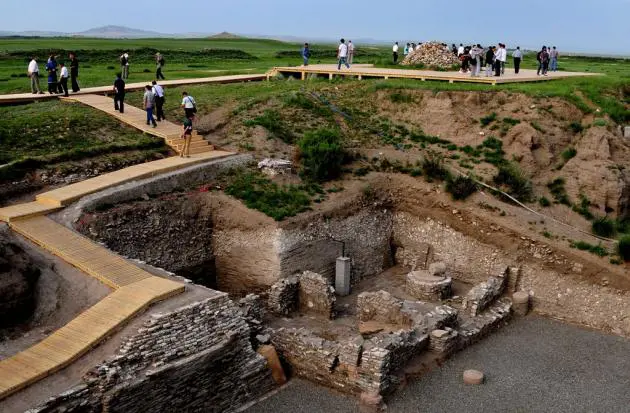
Wall lines of the Palace City, Imperial City and Outer City which together display the traditional urban planning of central China mixed with courtyards for Mongolian tribal meetings, can still be clearly perceived, as can mounds indicating palace and temple buildings, some of which have been excavated, recorded and reburied.
The piles of black bricks forming the city walls still look solid, thanks to their ancient mortar of eggs, sticky rice and lime. An elm tree struggling to grow from a crack in the wall is said to have stood here for 500 years. Tied to its branches are khatag, long ribbons of silk left by locals to mark the rebirth of the city’s spirits.
Casting our eyes up to the surrounding mountains, we see the beacon towers that once acted as the city’s communication link to the outside world. News of an attack on Xanadu would reach Dadu within 20 minutes via the beacon relay.
The ruins of the Da’an Pavilion, where six of the 11 Yuan Dynasty emperors ascended to their thrones, are also still here. The pavilion is where Marco Polo first met Kublai Khan, in 1275.
The surrounding palace, which was said to be 70 metres high, is now reduced to its square foundations and scattered stone pillars. One pillar carved with delicate images of dragons was stolen in 2007, but then recovered by police, and now stands as one of the most precious remaining pieces at the site.
The rain has started to pour now, preventing further exploration of the ruined city. The grasslands in this area will be dotted with golden troll flowers from mid-July. It’s a pity we have come too early to see this stunning scene.
We take shelter at the nearby Xanadu Museum amid the antiques and architecture discovered at the site.
The pieces reflect the many aspects of life during the Yuan Dynasty’s boom times.
As we finish our museum tour, the rain stops. We grab the opportunity to return to the ancient city with our new-found knowledge, recreating its glory days in our mind’s eye.
