
Talking Tagalog


Play
The British entry to the oscars for foreign language film zooms in on Manila's slums
For next year's Oscars race in the Best Foreign Language Film category, the United Kingdom has selected “Metro Manila”, and it is in Tagalog.
Written and directed by British filmmaker Sean Ellis and filmed in the Philippines capital, it was selected by a Bafta committee to enter the race for films that are primarily not in the English language. The rules allow films in languages not indigenous to the submitting country.
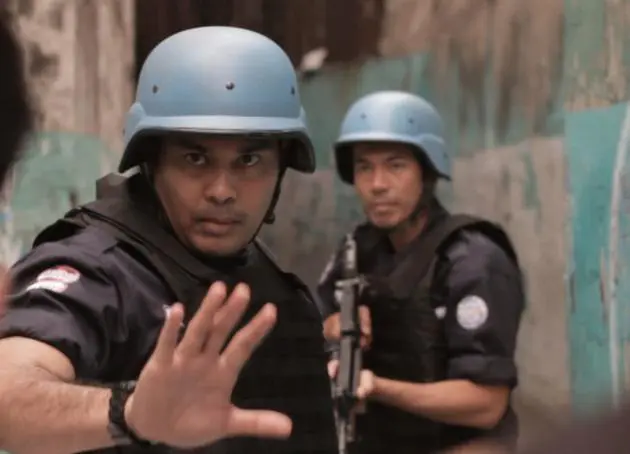
The crime thriller, which opened in Singapore on Thursday, was sparked by a sight Ellis, 43, saw while he was on holiday in Manila in 2007: two armed security guards arguing in the street, near an armoured car.
“One of them was kicking the truck, then they got in and drove off. They had M16 rifles, so there wasn’t much funny about it. It looked like they were going to shoot each other,” he says by telephone from London.
Eighteen months later, that scene had grown into a script about a rice farmer who becomes trapped in a plot to rob an armoured car.
In an industry where story locales, languages and even the race of characters are swapped freely to suit budgets and win audiences, Ellis says he was not willing to compromise; the story needed to be set in Manila and in Tagalog, he says.
“The idea was given to me in the Philippines and I felt I should return and make it there. It had to be made on a very small budget because this film was never going to be a blockbuster.
“The Philippines wasn’t a place I saw on the cinema screen very often, and it felt vibrant and exotic and dangerous to me. This was a place I wanted to visit in the cinema and I hope audiences come out of it feeling they have been there,” he says.
It helped that production costs are low in the Manila compared with the UK and that the Philippines boasts a wealth of well-trained English-speaking talent available.
Ellis' career kicked off when his short film “Cashback” (2004), about a supermarket worker with the ability to freeze time, won an Oscar nomination. A feature-length version followed in 2007, which received critical acclaim as well as winning several awards on the festival circuit.
He stumbled with his next feature, the psychological thriller “The Broken” (2008), which he also wrote and directed.
It was “a bit of a miss” with critics and at the box office, he told The Guardian newspaper earlier this month, so funding for personal projects dried up. He re-mortgaged his home to raise the US$400,000 (Bt12.3 million) he needed to make “Metro Manila”.
The film had its international premiere at the Sundance Film Festival in January this year, where it won the audience award for world cinema, in addition to
garnering praise from British critics.
His crew in Manila was local, as were all the lead actors. Oscar, the rice farmer-turned-security guard, is played by thespian Jake Macapagal who, along with other actors, translated the English script into Tagalog.
Ellis directed them without knowing if they had deviated from the original text, but says that was never a problem.
“You trust the actors to tell you if they’ve fluffed a word or made a mistake. Apart from that, I was watching the performance and not the words. It’s not how you deliver a word; it's how you act. They don’t call it the Best Line Delivery Award, they call it the Best Actor Award. That I don’t understand what they are saying in fact liberates me. I can concentrate purely on the acting,” he says.
The film opens in the Philippines next month and he is eager for Filipinos to watch it, he says. While he is sure that locals will understand that the depictions of the poor and desperate are germane to the story, he is aware that a few Western critics have dismissed the film as poverty tourism without watching it.
“There seems to be some question about the showing of poverty and whether it is exploitative. The poverty creates a dramatic story of the plight of these people. If they weren't in a desperate situation, there would be no drama.”
Filming took place in Manila’s Tondo district, one of the most densely populated zones on the planet, which is known for its poverty and gang activity.
“I had concerns going in, for the safety of myself, my wife and my crew. But the crew assured me that the locals would be more excited than aggressive and they were right. We drew large crowds. They were fascinated, but they were respectful and quiet and we didn’t need security guards or assistants shouting at them with megaphones. They were very generous in allowing us into their homes to make a film.”
