
Sacred ground for Somdej Ya


Play
The Hall of Inspiration in northern Doi Tung cherishes the Princess Mother's wisdom and beneficence
DOI TUNG, an hour’s drive from downtown Chiang Rai, is offering a chance to commemorate the birthday this month of the late Princess Mother in the area where she succeeded in eliminating opium cultivation as well as covering denuded hills with forest.
His Majesty the King’s mother, revered across the nation as Somdej Ya, was already 87 in 1988 when she resolved to help the people around Doi Tung find another means of sustenance besides growing and selling a narcotic. She initiated the Doi Tung Development Project to guide the struggling and vulnerable communities toward self-sufficiency and independence.
“No one wants to be a bad person,” she said, “but not everyone has the opportunity to be good.”
Today the 30-rai Mae Fah Luang Garden on Doi Tung is a popular tourist spot with its dozens of varieties of flowers in dazzling colours amid the stunning scenery. Most visitors, however, tend to overlook the Hall of Inspiration right next to the garden, rendering it a hidden historical gem.
And yet this dramatically building brings home all the humbleness that Somdej Ya and her family chose as their way of life – and how they inspired one another to serve the country.
“People don’t realise that this property was once all bare hills, unfertile soil and parched streams,” says Pimpan Diskul Na Ayudhaya, director of the site’s Knowledge and Learning Centre. “People under 30 might know Somdej Ya was the mother of His Majesty the King, but they don’t know how much she contributed to the country.
“The exhibition in the Hall of Inspiration explains that she wasn’t beyond the reach of the average citizen. It’s the story of a common mother who did her duty well, of one family constantly learning and gaining inspiration from each other, whose works have inspired and aided the less fortunate in the Kingdom.”
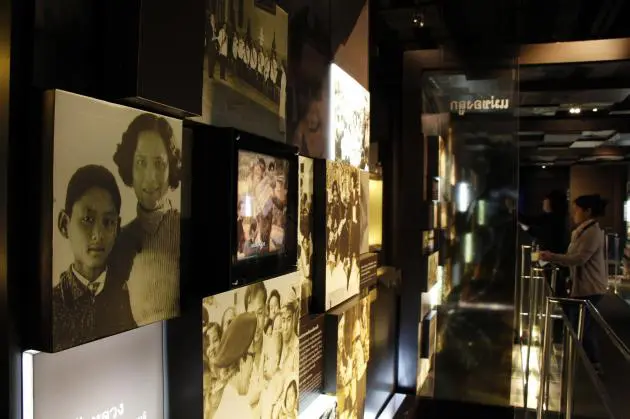
The Princess Mother’s Commemorative Hall was completely renovated and renamed in 2008 after hosting an exhibition for the 84th birthday of the King’s sister, Her Royal Highness the late Princess Galyani Vadhana. The show’s organisers and the Mae Fah Luang Foundation agreed that part of it should remain permanently in the hall, amended to cover all five members of Mahidol family, led by His Majesty and his elder brother Ananda, King Rama VIII.
Beyond an entrance illuminated in blue is a well into which single drops of water fall between long pauses, creating ripples that serve as a metaphor for the lives and work of the family an the inspiration they carry to others.
In seven rooms, the King’s father, His Royal Highness Prince Mahidol, is portrayed as a pioneer and supporter for Thai medicine; the Princess Mother as a woman of strong conviction; Princess Galyani as a commendable teacher; Ananda as a cheerful prince; and His Majesty, named Bhumibol Adulyadej, as a diligent monarch.
Somdej Ya is of course doubly honoured as the commoner Sangwan who became Princess Srinagarindra and the mother of two kings. Her personal belongings are on view amid many photographs as her life is retold, the daughter of a goldsmith who died when she was still quite young, her own devoted mother, who died not long after, and her precocity as a bookworm.
“A book-rental shop was her favourite place,” says Pimpan. “The owner liked her and waived the rental fee so she could read as many books as she liked. It opened her mind to the vast world of knowledge. Not even an orphan needs to be a problem child.”
There is a letter on display, dated February 24, 1918, in which Prince Mahidol tells his mother, Her Majesty Queen Savang Vadhana, that he has decided to marry Sangwan. “Sangwan is all alone in the world,” he wrote. “When we marry she will use my surname. I did not choose a wife according to her surname or whether she was born into this or into that family. We cannot choose our births. I looked for a good wife. For better or worse, I am responsible for my decision.”
Somdej Ya was determined to raise her children to be well educated, healthy and of good heart. She wrote to her mother-in-law the Queen on April 10, 1935, insisting that Ananda attend school with other youngsters, the better to enjoy his childhood. Otherwise, she said, the burdens of kingship would be heavier to bear.
“It is important that a king should have the experience of mixing with and learning about other people. This will be a great benefit for reigning over a democratic country. So long as they are still children, they should be allowed to live and act as children. A king who is unhealthy and unwise would be undignified for the country.”
Her principle on which she raised her
children was “Not noble by birth, yet noble by deeds”. King Bhumibol took this to heart, launching thousands of projects over the decades to assist people and improve the land. His four simple tools – a pencil, a map, a camera and a walkie-talkie – are on show in the hall.
“The camera was for documenting what he saw and helping him plan his work, and the maps were for double-checking locations with the people in the area,” Pimpan explains. “Government officials made the maps and he wanted to make sure they were correct.
“The walkie-talkie was for communicating with officials to ensure quick solutions were delivered. And, as for the pencils, Dr Sumet Tantivejkul, secretary general of the Chaipattana Foundation, says His Majesty requests 12 pencils every year – one for each month. He uses each one up completely. No one dares to throw away any of his pencils.”
A better understanding of how His Majesty approaches problems associated with water is offered in a room with interactive displays. Various methods have been tried, tested and implemented for four geographical zones – mountains, uplands, plains and coastlines. Where there is erosion or poor soil, for example, he has vetiver grass planted. Simple water wheels have proved to be the most economical way to oxygenate polluted water. His celebrated notion of “monkey cheek” reservoirs is crucial in times of flooding.
Inspired by her son, Somdej Ya developed her own model to alleviate the problems in the North of poverty, reliance on opium, deforestation, poor health and illiteracy. She conceived a practical approach that gave the people viable options that would keep them permanently self-supporting – and ensure them lives of dignity.
A LESSON IN HUMILITY
>>The Hall of Inspiration is part of the Doi Tung Development Project in Chiang Rai. It’s open daily from 8am to 5pm.
>>Admission is Bt90 (free for children under 12, students with ID cards and seniors).
>>Learn more at (053) 767 015-7 and www.DoiTung.org.
