
Posh in a po
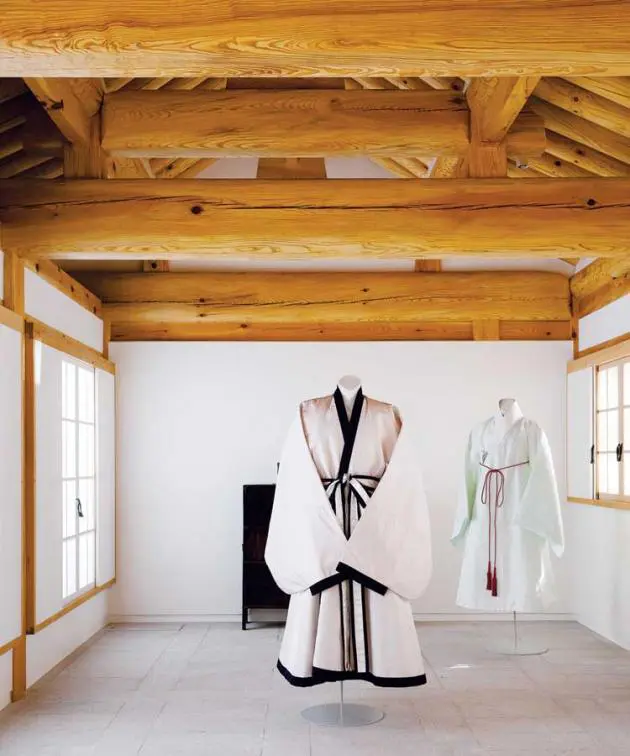


The Joseon literati's robe gets a modern makeover
Taking its cue from the way Japan’s kimono has inspired many global-leading designers, a Korean cultural non-profit organisation is hoping to introduce the Joseon literati’s outer robe as the next Oriental fashion inspiration.
Arumjigi Culture Keepers Foundation is currently presenting a triennial exhibition that sheds light on the robe and the spirit behind it. The exhibition, which runs until November 20, displays traditional robes in various colours and designs, recreated by artisans of today and three leading Korean fashion designers.
“Some of the notable features in po, as the outer robe worn by literati are known, include the understated silhouette, the simple dimensions and the balance and proportions that are in harmony with nature. We decided to study the beauty in the literati’s clothes,” says Cho Hyo-sook, a Gachon University professor, speaking at a talk held prior to the exhibition at the Arumjigi Culture Keepers Foundation in Tongui-dong, Seoul.
The first part of the exhibition shows robes remade to fit a 183-centimetre tall man of today. Five hanbok artisans reproduced outer robes in colours and designs similar to those of yore using historical documents as their base.
The display of robes brings vitality to the exhibition venue, itself a traditional Korean house known as a hanok. The robes are hung inside just as it their owner, a scholar, were living there. A robe worn by King Yeongjo of Joseon is recreated in the hands of two artisans who used sheer light-weight organza in jade green to create a robe characterised by a sharp, pointed collar and wide sleeves to show the wearer’s dignity.
Contemporary designers bring out the understated, but dignified silhouette in their modern designs. Veteran designer Jin Tae-ok, known for her romantic, simple designs, applied the elegant, streamlined V-collar of the traditional robe to her wool coat with a long V-collar in leather.
Menswear designer Kim Seo-ryong says he understood the traditional outer robe as the coat we wear today. He recreated the light feeling of the traditional outer robe in multiple layers of silk, compressed to create a soft, light texture for his clean-cut suits in ivory and black.
“I was worried these might become clothes that are not worn, but just seen. I initially felt helpless in front of the beautiful traditional robes. My focus has always been clothes that feature aesthetic features from tradition, but that are still be wearable,” Kim says.
Juun.J, one of the few Korean designers successful overseas known for his trench coats, applied the traditional inspiration to his signature relaxed, yet classical bell silhouette.
He chose the least likely fabrics – denim and leather – in his creations for the exhibition. His oversized coats feature a straight V-neckline that runs to the middle of the chest. He also incorporates a slightly curvy V-neckline to the tailored Chesterfield coat.
“The quest for extreme simplicity, expressed by fashion designers is minimal. The original appearance of po lies in the beauty of refined lines and streamlined cutting lines. Modernity has always been in the po, but we have only realised it today,” Jung says.
For more information, visit www.arumjigi.org.
