
For your tiny, perfect library


The Japanese hone the art of making miniature books
“They stir your imagination about the kinds of stories inside, don’t they?” Shiori Tanaka says as she displays an array of palm-sized books she’s made. The spine of some of them is only two centimetres long. Others look like toys.
You can buy various kinds of miniature books – known as mamehon (“bean books”) in Japanese, as miniaturised versions of ordinary books or elaborately designed artworks. And these days more people are making them as a hobby.
“They’re lovely to look at and easy to make, which is probably the reason they’re so popular,” says Tanaka, a Yokohama native who’s been making mamehon for more than 40 years. She founded the Japan Miniature Book Association in 2011, organising events and workshops throughout Japan.
Students in her classes range from kindergarteners to octogenarians. Some write original stories for their handmade books.
Making a miniature book involves folding pieces of paper, stitching one edge to form the spine, attaching a string bookmark and gluing on a cover. It sounds simple, but it’s quite time-consuming.
For the book cover, Tanaka recommends fabric from a kimono or other old clothing to give the book a personal touch.
“This is a mamehon, too,” Tanaka says of a miniature camera. When the film compartment is opened, an accordion book appears. The story it contains is about a man taking pictures while on a walk.
Tanaka shows me more books. A three-millimetre-thick book appears when a tiny piano keyboard is opened, and a book spine that looks like a ring is kept inside a jewellery box.
Enthusiasts are apt to have a palm-sized book in their pocket at any given time. “It’s fun to secretly read stories in the palm of my hand,” Tanaka says.
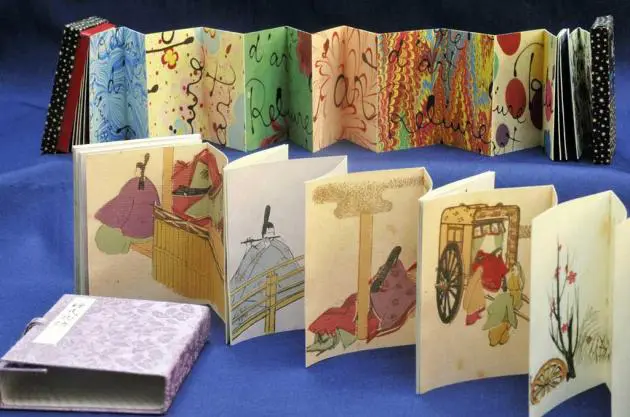
Some are artistic enough for display. An accordion book of marble-patterned pages, for example, is an artist’s original. In another, containing “The Tale of Genji”, pale yellow-green and purple pop out from the pages and reflect the elegance of the story.
“Artists put special feeling and meaning into each little character, or come up with creative designs to get readers to immerse themselves in the story,” Tanaka says. “So it’s fun to directly hear about the artists’ efforts and the meaning behind their work.”
Handmade miniature books are prone to damage if displayed on the shelf with the same page open for a long time. Tanaka says it’s important to frequently change the page or close the book for a while.
“Miniature books cannot be mass-produced, meaning there’s no restriction on the shape or material used,” she says. “They’re fun, not only to read but also to display.”
