
Moans and cries transformed


Young director courageously tackles mental illness in "Mother"
DOCUMENTARY FILMMAKERS routinely take on dangerous subjects, like grizzly bears, powerful corporations, shadowy government agencies or the volatile actor Klaus Kinski. But perhaps the bravest of all is the director who turns the camera on himself and his family.
Vorakorn Ruetaivanichkul is one of those most-courageous souls. For his debut feature, “Mother”, he films the mental breakdown of his mum, putting her suicide attempt on the screen for all the world to see.
Already suffering from various ailments, mother’s plunge from her second-storey balcony to the concrete driveway left her partially disabled.
She then turned into a compulsive shopper, wandering off in the middle of the night to a nearby grocery store, filling her trolly with whatever she put her hands on. This is one of the most electrifying segments in the film, with a camera mounted on the trolley. The troublemaking matriarch also stuffs items under her clothes, which gets her hauled in by the police for shoplifting.
The problems mount as mum refuses to take her medication or submit to treatment for her failing kidneys, and puts further strain on a family that’s already at the breaking point.
Vorakorn describes his 67-minute film as a “hybrid documentary”. Some segments – like mum face-down on the driveway – are re-enacted. A young actor stands for the camera-shy director.
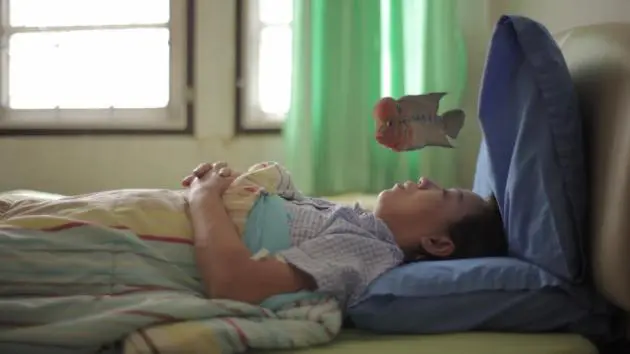
Other segments are dreamlike fantasies, such as a scene where the mother is walking in a park-like setting and the trees are super-saturated with white leaves. Another scene has an ornate goldfish floating above the bed-ridden mother’s face.
To provide more context to the delibilitating condition of depression, Kierkegaard’s “The Poet” is quoted in intertitles: “What is a poet? An unhappy man who in his heart harbours a deep anguish, but whose lips are so fashioned that the moans and cries which pass over them are transformed into ravishing music.”
Fights are common in the household, and so capturing an argument on camera was just a matter of waiting until one started. During one shouting match between the blubbering mother and her sister, the camera maintains its focus on the mother’s diaper-clad bottom, which was uncomfortable.
But discomfort faded during the question-and-answer session at the World Film Festival of Bangkok screening, where one audience member asked Vorakorn if his family had seen the movie.
“They’re right up there,” he replied, pointing to the back row, where his mother, beaming a big smile, sat with other family members.
So in spite of all the pain, it’s a happy ending.
“Mother” was on the festival circuit last year, screening at the Vancouver International Film Festival, the London fest, the Torino International in competition and ChopShots in Indonesia. Vorakorn had previously worked as a director of photography on Thunska Pansittivorakul’s controversial experimental documentary-drama “Terrorists”, and he took part in the Berlin film festival’s Tokyo Talent Campus. He’s another bright new talent to keep on eye on.
Kicking hi-so butt
Monday night’s screening of “Baan Sai Thong” at the World Film Festival of Bangkok attracted a number of die-hard Thai cinema buffs, among them academics, critics and filmmakers, who then proceeded to giggle like schoolchildren throughout the running of the 1980 drama.
A scathing indictment of the divide between the classes in Thai society, it’s an important landmark for Thai cinema. But it hasn’t aged well, being melodramatic to the point of absurdity, with laughably exaggerated acting and overly obvious exposition. But that was the style back then, and it still is, at least on TV. After all, “Baan Sai Thong” is the template upon which all Thai TV soaps are built on.
Running as part of the festival’s Lotus Award tribute to “Baan Sai Thong” star Jarunee Suksawat, it’s the story of a young woman named Pojjamon who comes from the countryside to a mansion in the city. She’s there to claim her share of an inheritance left by her father, but the mansion is inhabited by the Sawangwongs, who are distant relations of her father. You’d need a family-tree chart to map it all out, and it likely still wouldn’t make sense.
Anyway, the blue-blood Sawangwongs, particularly the mother and the younger sister, feel threatened by this upstart country girl, and they do all they can to make her keep her place.
But Pojjaman will have none of that. Ordered to scrub floors, she defiantly places a bucket of water in front of the matriarch so the snooty old woman steps right in it. And during one of the family’s frequent slapfests, Jarunee holds her own.
“Baan Sai Thong” might have been the dramatic debut for Thailand’s onetime “queen of action films”, but she still gets her licks in, so there’s plenty of fun to be had watching Jarunee in her pig-tail braids kick hi-so butt.
So popular was the film in its day, Jarunee and director Ruj Ronnapop quickly made a sequel, “Pojjamon Sawangwong”, which screens at 6 tonight at SF World Cinema at CentralWorld. And there’s one more chance to catch “Baan Sai Thong” on the big screen, at 3.30pm tomorrow.
