
Classical beauty frozen in time


Play
The Support Foundation's annual classical Thai masked dance theatre is starting to get predictable
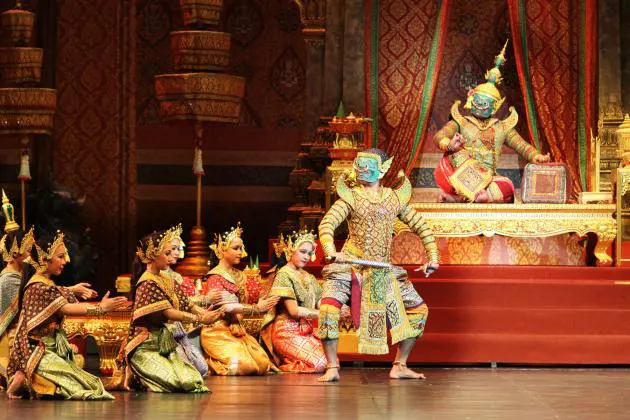
Originally scheduled to run from early November to early December, the Royal Khon Performance’s “Battle of Kumbhakan: Mokasak Episode”, produced by the Support Foundation of Her Majesty the Queen, was postponed until last Sunday following the death of His Holiness the Supreme Patriarch. The schedule of this annual classical production has also been rearranged and morning and afternoon shows added in order to fit all shows in the reduced number of dates.
Quite possibly due to this change and the current political climate, this grandest khon production of the year has received less attention and witnessed lower audience numbers than in previous years. Arriving at the Thailand Cultural Centre on Tuesday, I was very surprised to be able to find a parking space without any trouble and once in the lobby, I understood why. Hundreds of uniformed military students had been brought in by bus and they later filled the empty seats in the side sections of the main hall.
There were frequent announcements telling us by which doors we should enter and that the house lights would be dimmed once the performance started. Perhaps the producer was assuming that most of the spectators had never been to a performance before. The audience also discovered a new house rule: no one can leave their seats while the performance is in progress. That forced me to cancel my plans to bring my 74-year-old mother, a former khon performer, as its length, two acts of 90 minutes each plus one 15-minute interval, would not fit her restroom requirements.
As in most of the previous years’ royal khon performances, the play started in Thotsakan’s grand throne hall in Longka where he assigned his brother Kumbhakan to fight with Phra Ram after his nephew Maiyarap was defeated. Later on, and again as in previous years, the audience was taken up to the Heaven and to Phra Ram’s pavilion in the forest as Kumbhakan fetched Mokasak, his almighty spear, from the God Brahma, with which he later harmed Phra Lak. Here too, the great white monkey warrior performed another valiant act in finding the remedy. The script was edited in such a way that the contemporary audience – some with the help of caffeine – would neither yawn nor fall asleep, except for the scene in which Phra Lak inspected the monkey army, which lasted 10 minutes too long and didn’t move the plot forward.
While the set design and the stage technology looked more modern than the khon productions at the National Theatre, it was still very last century and full of old tricks. And with so much concentration on the spectacle, the battle scene was so overcrowded that the monkey and demon armies couldn’t really fight. Instead, they could just walk a few steps and kill one another by bumping.
Impeccable though – and again, as in the previous years – were the deftly designed and crafted costumes as well as the roof-raising performance by the musicians, the reciters and the dancers, some 200 in number, and comprising both seasoned artists and young students.
My theatre-going companion reported that a young military student seated next to her said after the intermission that he wouldn’t purchase a ticket to watch this were he given the choice.
By contrast, in her introductory speech after the prelude song and dance, the producer stressed the performance was succeeding in developing future artists. These included not only the dancers, singers and performers, but also craftsmen in various fields whose immaculate skills have contributed to this highest form of classical Thai performing arts.
We rarely discuss the development of performing arts audiences in this country. Part of the reason why that young man didn’t enjoy the performance as much as his teacher would have wanted is probably because he didn’t know how to appreciate this classical art, let alone connect it to his daily life and personal interests. For that, one can only blame his teacher.
It is also worth noting that khon performances are staged occasionally at the National Theatre and with some of the same performers. This episode is also in their repertory and yet they can’t make use of this set of specially crafted costumes, props and sets.
If this single-sided development continues, we will have many khon performances in the near future performed by highly skilled artists but in front of seriously declining audience numbers.
CATCH THIS SPEAR
- The Royal Khon Performance’s “Battle of Kumbhakan: Mokasak Episode” is at Thailand Cultural Centre’s Main Hall until December 9. Shows are at 2 and 7.30pm daily plus 10am on Saturdays and Sundays. Weekday matinees are for students only.
- It’s in Thai with English scene summary.
- Tickets are Bt120 (for students attending weekday matinees only) to Bt 1,520, available at ThaiTicketMajor.
- For more details, check out “Khon Performance” on Facebook.
