
In Vietnam, faith renewed


Thanks to the religion of len dong, once-banned mediums are more popular than ever
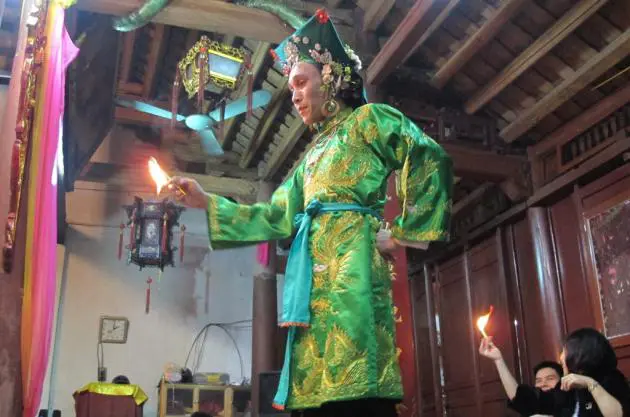
At a temple in Hanoi , Phi Viet Hung is sitting on a stage surrounded by people, his face concealed by a red silk veil, while a small band of musicians play traditional Vietnamese instruments under a cloud of incense smoke.
After a few moments the 37-year-old hotel manager raises his right hand and lifts the veil – a signal to show that a female spirit has possessed him.
Hung is conducting a len dong ceremony, involving a type of trance. It forms the main practice of the religion Dao Mau (Mother Goddess).
In the last 30 years the religion has changed from a practice deemed “superstitious” by authorities into a respected folk religion with more followers than ever.
Two years ago Hung was at the lowest point of his life. “I was ill and had to go to hospital, but the doctors didn’t know what was wrong with me,” he says. “I applied to many places for work but no one got back to me. I didn’t understand why, because I studied in Australia and I have good experience.”
At his wits’ end, Hung went to a fortune-teller. “He said my troubles were caused by bad luck and I would find the answer in len dong.”
Len dong evolved from the “generalised worship of goddesses” in Vietnamese folk history, according to scholar Ngo Duc Thinh.
A mother goddess presides over each one of the four realms or “palaces” – Heaven, Earth, Water, and Forests and Mountains. Below these is a hierarchy of spirits that includes mandarins, ladies, princes and princesses.
The religion centres on spirit possession, during which a medium will conduct a ritual at a public or private temple or shrine at an auspicious time of the year to ask the spirits for good luck, health and prosperity.
Lay people who follow the religion can have a ritual performed for personal reasons, such as the opening of a new business.
Mediums wear costumes during the rituals, in one of the colours associated with the four palaces, and perform dances and gestures associated with each spirit. The medium then sits while performers sing songs telling the history of the spirit who has descended.
At one point Hung throws bank notes into the audience, which causes a flurry of excitement. This is because one of the princes has possessed him.
During another ceremony at Ghenh pagoda, in eastern Hanoi, attendee Trang Thanh Huong, 40, goes to the stage to pray. Her grandmother introduced her to len dong by around 20 years ago.
“It’s become more popular in the last few years,” she says. “The more rituals are performed, the more people become interested.”
Dang Bich Diep is the granddaughter of the master of the pagoda. “In the past 10 years it has become so much more popular, but I can’t guess the exact figures,” she says. “The government encourages interest in len dong.”
After the end of French colonial rule in 1954, len dong was banned as part of a secularisation campaign aimed at ridding the country of “unsound customs” and “wasteful superstitions”. Over the next four decades ceremonies continued in secret.
In the late 1980s Vietnam started pursuing a market economy, and with it began a long struggle to assert its cultural identity against a growing tide of globalisation. A group of scholars fought to have len dong recognised as an important part of cultural heritage and in 1995 the government gave permission for the first len dong festival to be held.
The government continues to promote len dong as a piece of cultural identity, but official recognition has also resulted in a form of “pacification”, says ethnomusicologist Barley Norton from Goldsmiths, University of London.
“They used to pierce themselves, speak in tongues, things like that. Now it’s a vessel for the display of cultural identity and it changes its purpose.”
Some scholars question whether financial gain plays a part in len dong’s rising popularity. Ceremonies can cost from 30 million dong (Bt470,000) to 10 times that amount, and mediums commissioned to perform a ceremony can make a lot of money. Len dong master Nguyen Tien Hung, 46, says this is not a factor in the rising number of people who want to become practitioners.
“If they don’t have much money, I prepare something very simple,” he says. “In Vietnam many people pray to get more money, but in len dong only the people who really have faith can get happiness and health. If you do not have faith, you will fail.”
Hotel manager Hung says if he had heard the calling 14 years ago, he wouldn’t have been able to do anything about it because he was dependent on his parents for money. He spent 53 million dong on his last performance, conducted to honour the spirits and not commissioned by a follower. He says he has no regrets.
“When I did len dong, everything changed. I found a job and my health improved. Now I feel |better than ever. Many people who do len dong have had the same |experience.”
