
Second thoughts on gay shock therapy
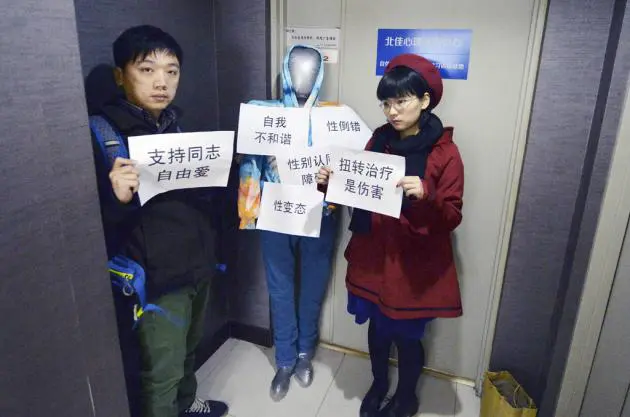


Chinese come out against painful but sanctioned reorientation treatments
A Chinese man says doctors administered repeated electric shocks through a wire connected to his genitals while he watched a pornographic film – part of treatment he hoped would eliminate his sexual attraction to men.
“I thought I’d try and see if there was a chance I could become a normal person,” says the 25-year-old, who asked to be identified only by his surname Zhang. “I didn’t want to cause my family trouble, or disappoint them.”
Zhang’s treatment shows the extreme end of a lucrative industry in China claiming to “correct” the sexual orientation of gay men and lesbians, who often face tremendous social pressures to live as heterosexuals.
“If I had a reaction to the films I would receive a shock,” says Zhang, who paid for the initial treatments himself after deciding life as a gay man would be “too tough”. “It wasn’t a massive shock, but it was painful.”
China officially classed homosexuality as a mental disorder in 2001, although some attitudes – especially in larger cities – have become more tolerant in recent years. Nonetheless, gay men and lesbians, who are often only children, still have to deal with their parents’ expectations of marriage and children.
“Conversion therapy”, as it is sometimes known, has more than a century of history around the world, but has fallen out of favour with medical authorities. It persists in countries from Singapore to Britain and the United States – where reports of electroshock use have added to momentum for a ban.
Zhang was treated three years ago, but five clinics contacted by AFP in the last month claimed to offer “sexuality adjustment” through various means, some of them including hypnosis, drugs and electric shock therapy.
The Haiming Psychological Consulting Centre in Beijing touts the use of electricity on its website, saying, “After each shock the person will quickly interrupt their thought, and separate from their fantasies.”
A staff member at the hospital says the treatment – in 30-minute sessions every few days – is used only “in extreme circumstances”.
The American Psychological Association, which judges same-sex sexual and romantic attraction to be “normal and positive”, concluded in 2009 that “efforts to change sexual orientation are unlikely to be successful and involve some risk of harm”.
The Pan American Health Organisation, the Americas office of the UN’s WHO, said in a 2012 report that conversion therapies “lack medical justification and are ethically unacceptable”.
California banned the practice – often linked to Christian groups who view homosexuality a sin – for minors last year, and other US states look set to follow its lead following an activist campaign.
Now Chinese groups are following their lead. Beijing's LGBT Centre said in a statement last month that such methods “deeply damage homosexuals’ physical and mental health, and worse infringe on their self-respect”.
Two activists connected with the centre, which is partly funded by the US and British embassies, posed with a sign reading “Homosexuality is not an illness” outside a clinic which they said offered conversion therapy, and hope to persuade health authorities to revoke such facilities’ licences.
Some clinics are moving towards counselling and prescribing anti-depressant drugs, says Wei Xiaogang, founder of the Beijing-based group Queer Comrades. “Now it’s more like therapy, like talking, because people want to make money – it’s all about business,” he says.
Officials at several clinics contacted by AFP said they saw homosexuality as changeable in people for whom it was not “innate”. But Liu Wei, 21, a salesman in the southern province of Guangdong, says, “I have a lot of friends who received the treatment and it has made some of them nervous wrecks”.
He visited a hospital last month to ask about treatment – under pressure from his father – and a doctor told him his sexuality could be changed “if I made a decision to break up with my partner, and dedicate myself to the method”.
The physician told Liu to “watch films and when I fantasised, use an elastic band wrapped around my hand to hurt myself”.
Even the doctor admitted the success rate was low, he says, but he was still considering it because his family relationships were “very tense”.
For Zhang, the treatment first killed his sex drive but went on to exact a greater toll – he became depressed, resigned from his job, went into debt to pay his medical fees, and eventually considered suicide.
“I was suffering from headaches. I couldn’t stand it. I wanted to die. I wanted to stop.”
But ultimately he accepted that his sexuality could not be changed, and came out to his father. “I thought about my whole life – I was like this from a young age,” he says. “Being gay isn’t a terrible thing.”
