
Nothing square about Hadid
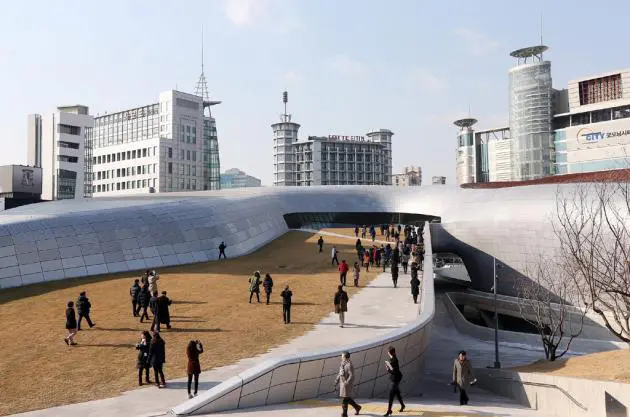


Seoul's new Dongdaemun Design Plaza adds to a futuristic cityscape
The new face of Dongdaemun, one of the largest commercial districts in South Korea, will be revealed in March with the opening of the latest masterpiece by star architect Zaha Hadid, in an ambitious Seoul Metropolitan Government project to establish a design and cultural hub in the capital.
The Dongdaemun Design Plaza and Park will be unveiled amid anticipation that the flashy building and its adjacent public park will attract citizens much like South Korea’s first sports stadium, originally located on the site, did.
The project has not progressed without snags, all the way since it kicked off in 2007. Initially planned by former Seoul Mayor Oh Se-hoon, the project faced a possible indefinite delay under the current mayor and has undergone major design changes after historical artefacts were discovered under the construction site.
The grandiose and futuristic design, unfamiliar in the Korean cityscape, has caused much debate in the architecture community. Many said the design barely reflected the history and charms of Dongdaemun.
Despite criticism, the DDP has set a good example as an innovative modern structure, using state-of-the art digital technology.
“Its design and construction sets many new standards of innovation,” Hadid says. “The DDP is the first public project in Korea to use three-dimensional digital-construction administration services that ensure design and construction quality, including 3D Building Information Modelling. It is also the first project in Korea to use an adjustable 3D moulding process for the metal cladding panels and concrete forms.”
More than 45,000 aluminium cladding-panels that don’t divide the structure at any angle create the free-flowing curves on the exterior. Inside, no pillars obstruct the view from any spot in the exhibition halls. Walls and ceilings are curved and tilted, adding dynamism to the empty white space. The building also has rooftop gardens.
A military training site of the Joseon dynasty discovered at the site is incorporated as part of the building without sacrificing the original design.
The 85,000-square-metre structure consists of five halls that will host major design events, exhibitions and conventions.
“The DDP is an important civic and cultural building that engages with the city and gives people a place to connect – creating a public park and plaza that people can use as their own and allows the city to flow,” says Hadid. “Such public spaces are a vital component of a rich urban life and cityscape. They unite the city and tie the urban fabric together.”
Some of the highlight events in March include Seoul Fashion Week and a rare show of the most prized Korean traditional art works from the Gansong Art Museum.
The museum has never in its 40-year history in the quiet neighbourhood of Seongbuk-dong loaned out its treasures for exhibition. Its regular exhibition is so popular that visitors wait in long lines to get a glimpse.
DDP will also have design shops open 24 hours a day, in line with the working cycle of Dongdaemun, where fashion wholesalers work around the clock. “I was intrigued by the energy and rhythms of Dongdaemun – the buildings and streets operate around the clock,” Hadid says.
Efforts have been made to include street vendors as part of a design-propelled commercial boom at the DDP. Six Korean architecture firms are building kiosks for vendors nearby. “This is part of an effort to extend the energy of the DDP to a broader area and help it function as a true landmark of the city,” says Kim Sun-hyun of DLIM, an architecture group in Seoul, who participated in the kiosk project.
