
Flowers in their hair


Japanese art of making hair decorations preserved
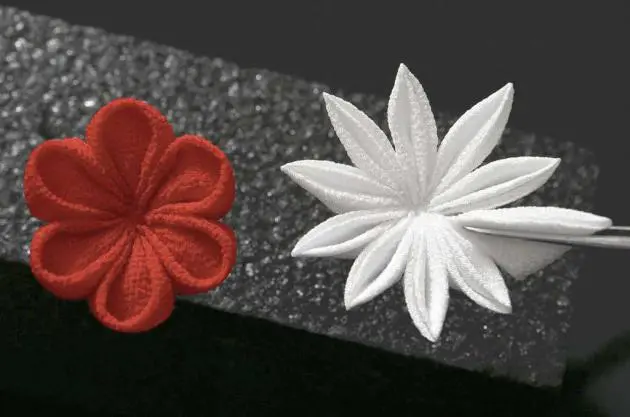
Last month a group of students gathered in the Asakusabashi district of Tokyo to learn the traditional Japanese pinching craft known as tsumami zaiku. They gasped in appreciation as designer Sanae Takeyari, 55, made red and white flowers by pinching, folding and arranging thin pieces of cloth with tweezers.
Their class was held at Tsumami-do, a shop and school dedicated to promoting tsumami zaiku, which originated in the Edo period (1603-1867) as a method for decorating |kanzashi hair accessories. Tsumami-do, which sells materials and offers lessons in tsumami zaiku, was opened in March 2012 by Masayuki Takahashi, 69, who also runs a wholesale company of tsumami zaiku products.
Takahashi joined the wholesale company founded by his father at the age of 24. However, when domestic production of the craft began dropping sharply around 2000 due to competition from China, Takahashi worried that the both technique and craftsmen would disappear if nothing was done to save them,
That sense of urgency, he says, prompted him to open Tsumami-do.
Takahashi personally visits craftsmen located in Tokyo and farther afield in Chiba and Saitama prefectures to procure products for his company. His company has had a close relationship for more than 70 years with the family of Ichiro Ishida, a 69-year-old craftsman in Tokyo, beginning in their parents’ generations.
“So many people say, ‘It’s beautiful,’ and take up an interest in the craft. We often get together to talk about ways we can bring new life [to the art],” Ishida says.
On New Year’s Day, Takahashi made his first prayers of the year at Sensoji temple in the Asakusa district of Taito Ward with his family. His 9-year-old granddaughter Kasumi, a third-grader, wore a kanzashi accessory with tsumami zaiku decorations to complement her furisode long-sleeved kimono.
“There was a time when people looked forward to New Year’s as a chance to go out wearing their brand-new kanzashi accessories. It would make me happy to see that revived,” Takahashi says. Kasumi smiled as her grandfather touched a finger to the handcrafted kanzashi in her hair.
