
When TV came to Bhutan
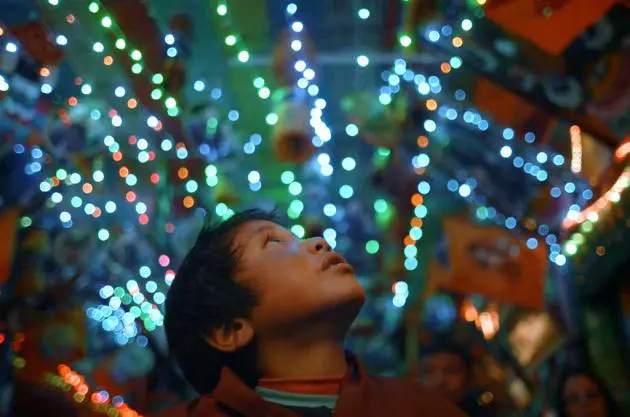


To document the screens we constantly watch, a French filmmaker went where there were none
What happens when a remote village in the Himalayan kingdom of Bhutan gets electricity and television? “Happiness”, a newdocumentary by Frenchman Thomas Balmes, shines a light on the power and risks of the small screen.
In 1999 authorities in Bhutan – which famously measures prosperity by gauging its citizens’ happiness, not GDP – decided, after much reflection, to allow television and the Internet into the tiny landlocked country sandwiched between China and India.
But the village of Laya, which is two days’ walk from the nearest road, had to wait more than a decade more before electricity arrived.
That’s when Balmes – whose work is partly financed by TV companies and who previously had a hit with a documentary called “Babies” – grasped the rare opportunity to observe the impact of television on a community that had never had it.
“The idea was to make a film about television. And I even thought for a time about coming to make it in the United States,” he said last week at the Sundance Film Festival in Park City, Utah, where the documentary had its release. The film won the cinematography award in the World Cinema Documentary category. It’ll be shown at the International Documentary Film Festival Amsterdam in November.
“I am constantly surprised by how few films there are about screens, whether smartphones, televisions or computers,” Balmes added.
“After hesitating over whether to make the film in a place where an enormous amount of television is watched, it occurred to me that obviously I should go to the opposite end of the scale. What better way to talk about television than by going somewhere where it doesn’t exist?”
The documentary tells the story through the eyes of Peyangki, an eight-year-old who is “practically the only person who had never left the village. That made him even more of a virgin in terms of experiencing electricity and television,” said Balmes.
Balmes wanted to show the transforming power in the village – both positive and negative – of a medium that’s now ubiquitous in the developed world. The filmmaker doesn’t have a television set at his own home.
“The huge problem with television, even without talking about what’s on it, is that it becomes an invasive force,” he said. “With ‘Happiness,’ I show how naturally that’s accepted. Today if you go back to Laya there isn’t a child who plays bow and arrow in the street. They’re all in front of the television, and don’t do anything else.
“It’s a complete mystery to me that we ask teachers for certain qualifications to educate our children, but we don’t have the slightest worry about who makes the six or seven hours of television watched daily on average.”
His film is visually sumptuous. “I wanted to be a photographer, so images have always been important to me,” he said.
“For 25 years my aim has been to use the specificity of the documentary medium, which is above all about images, and to talk as little as possible.”
“Babies”, which tracked a year in the lives of babies around the world, took this to extremes by having no dialogue whatsoever. “I didn’t want to do the same thing with ‘Happiness’, but there is still the idea of making a film that can be understood without any commentary at all,” Balmes said.
“In terms of the images themselves we used fixed lenses, as in cinema, which are rarely used for documentaries. They give a visual feel which is closer to fiction than documentary.”
