
Grim Thai face to the world
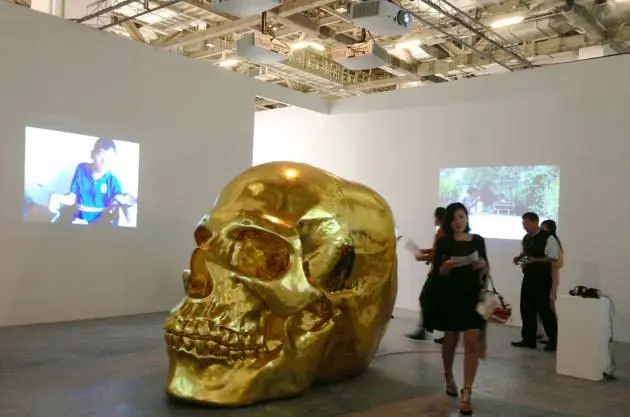


There was no hiding the bad news at Art Stage Singapore
One of the Thai contributions to this month’s Art Stage Singapore, Asia’s leading art fair, was a fibreglass sculpture of a human skull covered in gold leaf, as tall as a man, with videos about life and death playing all around it.
Another was a table covered in bloodied broken glass and a screen showing a video of a young man papering the Democracy Monument with lyrics from the Thai national anthem.
Anyone visiting the show from January 16 to 19 who didn’t already know that Thailand was in trouble certainly knew now.
Still another video had an elderly woman and her dogs watching a TV show about the political unrest. There were pictures of some of the people who died at Tak Bai in Narathiwat in 2004 after the Army stacked suspected insurgents in the back of trucks, suffocating dozens of them.
This year’s theme was “We are Asia”, a reference to the region’s increasing importance in the world market for contemporary art, but Thailand’s grim offerings were a wholly separate perspective on Asia.
Along with the usual commercial galleries’ booths – 130 firms represented in all – much of this year’s fair was laid out like a museum, the art coming from Central and Southeast Asia, China, Japan, South Korea, India, Taiwan and also Australia. But everything was for sale, and the more than 40,500 visitors spent a lot of money.
“Southeast Asia has many high-calibre artists – there’s no question about that – but few countries in the region have infrastructure equivalent to that of the long-established art capitals in the West,” said Lorenzo Rudolf, the Swiss behind the prestigious annual Art Basel event who also founded Art Stage Singapore.
Rudolf believes, though, that the lack of infrastructure needn’t “hold the region back” and chose Singapore as Southeast Asia’s art centre because of its “geography, economic and political stability and sophisticated, cosmopolitan society”.
“Art Stage Singapore, together with the Singapore Art Museum and especially the much-anticipated new National Art Gallery, will provide the commercial and academic influence and authority needed to transform Southeast Asia into the next major global art region. The ingredients are all here. All that is now required is the collective will and effort to make it a reality.”
Southeast Asia enjoyed the most active participation at this year’s event, with the less saleable conceptual installations, video art and sculpture appearing alongside readily sold paintings. Rudolf and the prominent curators he commissions take up the challenge of marketing all of the work to museums and deep-pocketed collectors around the globe. Their big selling point is the region’s highly refined contemporary art, and they’re aided by the decline in the US and European markets.
When it came to Thai art this year, Rudolf consulted curator Gridthiya Gaweewong in selecting both emerging and established artists, and they didn’t shy away from strong or controversial socio-political messages.
The installation “Non-Being by Itself” by Kamin Lertchaiprasert, who’s represented by the Numthong Gallery, earned significant attention from private collectors and art institutes. That giant gilded skull was irresistible with the vagina-like entry hole in the back. Inside you heard a gentle ping, conducive to meditation, but the price tag alone (unquotable here) might have been enough to jolt you into enlightenment.
An artwork presented by Gallery Ver had people on their knees as well. They were examining “Hocuspocus” – the table that 38-year-old newcomer Ruangsak Anuwatwimon adorned with shards of jagged glass salvaged from CentralWorld after red shirts wrecked the place in 2010.
On a nearby wall his just-completed video “Untitle” showed him sticking pieces of paper bearing words from the national anthem on the Democracy Monument while the song played one evening.
For DCA Art Consultant, Apichatpong Weerasetakul’s 2013 assemblage of prints, “Photophobia”, recalled the deaths of southern protesters at Tak Bai in 2004. The filmmaker etched the prints directly from photos of the victims found online and added drawings and lines of prose. Meanwhile three monitors screen his video “Teem”, which shows his boyfriend sleeping.
Araya Radjarmrearnsook, best known for recording her “discussions” with corpses, presented the sculpture “Conversation between Two Objects” and videos “The Treachery of the Moon” and “Village and Elsewhere: Artemisia Gentileschi’s Judit Beheading Holofernes, Jeff Koon’s Untitled and Thai Villagers”.
Chiang Rai-based Manit Kantasak, represented by the Whitespace Gallery, took on man’s isolation from nature in “Milky Way” (2013), which took the form of 194 hanging jars, each containing a piece of tree tissue. The idea was to look beyond the superficial for deeper understanding.
Photographer Dow Wasiksiri, represented by Singapore’s 2902 Gallery, examined the ways the colonial past has shaped national and personal history and memory. “Looking at the Past through Post-colonial Imagination” was a witty depiction of a bygone era, with colonial symbols appearing amid scenes of modern politics and everyday life.
“As a curator, the most important thing for me is to discover new artists from different parts of the world,” Gridthiya said. “At the same time it’s refreshing to get updated and see the progress of the many artists I worked with in the past. This kind of show helps me understand the artists’ ideas and see how their new work will develop to the next level.”
Many collectors and art museums are interested in Thai contemporary art, but only DCA Art Consultant has had any significant success, selling one piece. However, DCA declined to reveal sale prices.
The fair is not entirely commercial, regardless. Thai artists and gallery owners count on it to build connections and long-term collaborations. “Many of the fairs held in the region aim to sell gallery art directly to the market, but Art Stage Singapore focuses on the content, on the current art scene in Asia,” said Numthong Saetang of the Numthong Gallery.
“As a collector I’m always buying works,” said art consultant Disaphol Chansiri of DCA. “As a consultant I buy works but here I also find more opportunities to make contact and cooperate with galleries worldwide. We discuss how we can assist each other as an alliance.
“And we also had the opportunity to show work from Thailand and explain Thai art to foreign collectors. We get a lot of follow-ups.”
The Singapore government is known for its strict controls on artistic expression, but the organisers of Art Stage have faced only a few limitations in presenting strongly critical works. “This is a good opportunity to present controversial work,” said Ruangsak, who actually modified his “Untitle” video specifically for the fair. “I’m just happy that some art critics and curators are interested in my work.”
Many visitors found the new “platform” format – the museum-style displays – refreshing. “I enjoyed the platform section more than the booths, which aren’t that different from any other art fair around the world,” said Gridthiya. “Personally, I was excited to see the work from Laos, Cambodia and Myanmar, and especially one of the galleries presenting work by a Hmong artist, a shaman in Luang Prabang. To be able to bring these unknown artists onto the art map and into the market was really something!”
The writer travelled to the fair as a guest of the Singapore Tourism Board.
On the Web: www.ArtStageSingapore.com
