
The horse comes out fighting


Urbanites are appalled, but the Year of the Horse is a prime time to watch nags in battle
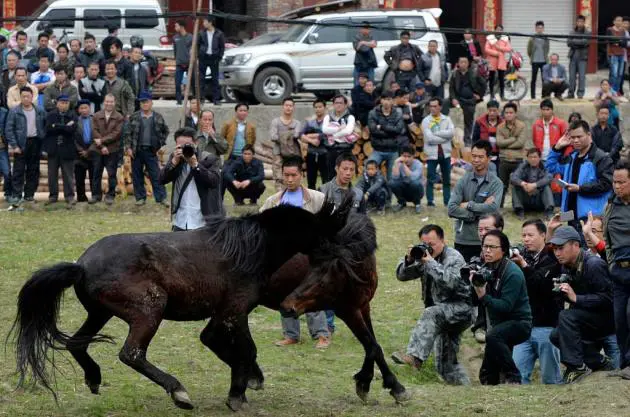
Hooves clash in mid-air, a stallion bites his opponent and delighted spectators cheer wildly. In southern China some welcomed the Year of the Horse by watching the animals fight.
For the residents of Tiantou, a remote village in the Guangxi region, the 500-year-old tradition, which pits male horses against each other in a fight over a female, was the only way to kick off the Lunar New Year.
“Without horse-fighting it wouldn’t feel like a new year,” said Pan Jianming, whose horse Little Black reared up on its hind legs and bit its opponent’s neck to scoop victory in a competition last weekend. “He stood up and hit the other horse straight away,” said Pan, a 31-year-old air-conditioner repairman.
“If he likes the female horse it doesn’t matter how much pain he’s in – he won’t run away,” he added, his black and white shirt stained with blood that dripped from a gash on his horse’s nose.
“We have medicine to treat his injuries, and he will gradually get better,” added Pan, who claimed a champion’s prize of 500 yuan (Bt2,700).
Fifteen animals fought in bouts, which saw horses jump into the air with their front hooves spinning before crashing down on their opponents and biting their head or neck, sometimes drawing hair and blood.
Horse-fighting competitions held by the Miao – an ethnic group living in mountain areas of Southern China and Southeast Asia – date back more than five centuries, according to locals.
The first battle was supposedly held to settle a dispute between two brothers who both hoped to marry the same woman. But animal-rights groups have condemned the fights, held in dozens of small mountain villages in Southern China every year with prizes of up to 10,000 yuan.
In 2010 Hong-Kong based Animals Asia called horse-fighting a “horrific spectacle”, accusing the battles of causing “abuse and suffering to animals in the name of entertainment”.
The stallions are encouraged to fight by the presence of a female horse, kept metres away from the clashing pairs by a villager armed with little more than a stick. The horse that successfully defends its position close to the female is declared the winner. Animals Asia has said the female horses are sometimes “induced into season through the injection of hormones”.
In Tiantou, hundreds of spectators gathered just metres away from the battling equines – without any barriers separating them from the action. The animals squared up to each other like boxers before unleashing a flurry of bites and backward kicks. Few appeared to sustain any visible injuries.
Onlookers scrambled to escape when pairs of bucking mares periodically galloped towards them. Others shouted: “Fight, fight!” as the animals clashed, but most insisted the contest was not cruel. “Sometimes the horses will be injured, but it won’t be very serious – they have thick skin,” said Di Zhai, a 16-year-old spectator.
Travellers from Chinese cities, which have seen a rise in concern for animal welfare in recent years alongside a growth in pet ownership, seemed more concerned. “It’s horrible to see the horses get injured. I don’t like to watch,” said 14-year-old Ma Jiasui, who had come from a nearby province as part of a tourist group.
However, she added, “It’s the Year of the Horse, and my surname means ‘horse’, so it’s special to see horse fighting this year.”
The contests are held year-round but peak following the start of the Lunar New Year, which fell on last Friday. “Now there are more horse-fighting competitions than ever,” said Jia Yingcai, head of a local equine-combat association.
“We used to hold horse fights just once a year, but now we do it more often,” said Zhou Tingyi, a 63-year-old who presided over the competition with a plastic megaphone. “Because this is the Year of the Horse, we are even more happy!
“You need a good horse for fighting. It needs to be fat. It needs to have more energy.”
Horse breeders say the ideal age for an equine pugilist was between four and eight years. Most animals do farm work when not fighting. “Horse-fighting is just for fun,” said Pan Yinghong, who held his horse with a rope as animals neighed and whinnied.
The competitions are also about “glory”, he added. “If I win, people will think of me as a horse king, and it’s also good for attracting women.”
