
The story behind the masks
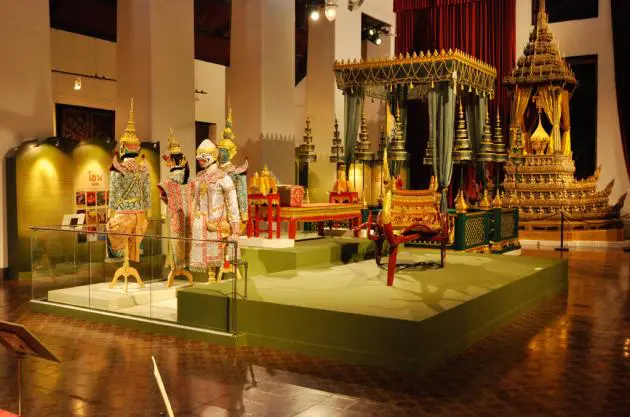


In khon, The legend of Rama is told and retold, but what of the costumes and the players?
Khon is almost always viewed from afar, on a stage that, no matter how small, creates a natural barrier to the audience. But a rare chance to see the masked dance much closer is on offer until April 6 in the National Museum Bangkok’s Issaravinitchai Throne Hall.
Organised by the Culture Ministry’s Fine Arts Department with Thai Cultural Heritage Conservation Day in mind, the exhibition “Khon: The Siamese Wisdom in Dramatic Works” includes objects dating back to the Ayutthaya Era.
There are five sections, or “acts” as they’re theatrically termed.
The first pays tribute to nine master mask-makers whose knowledge and craftsmanship have contributed so much to the success of various productions.
“In Thai ideology, every student must have a teacher and vice versa, so paying respect to one’s teacher is very important,” says Pakorn Pornpisut, director of the ministry’s Office of Performing Arts. “The ceremony in which respect is shown is truly sacred, especially in the performing arts.”
Curator Suppawan Nongnut points out, too, that the master’s permission is essential in any transfer of knowledge from one generation of teachers to the next. “Otherwise it’s considered inappropriate.”
A xylophone that Her Royal Highness Princess Maha Chakri Sirindhorn played during a khon performance is also on view, as is film footage of a performance during the reign of King Rama VII.
The second “act” is devoted to the history of khon since the days when Ayutthaya’s was Siam’s capital. This is where you can trace the traditions now so familiar. These include the human, monkey and demon characters, and the custom of masked actors performing the motions while narrators and singers at the side of the stage told the story. The central placement of Rama is explained – the Indian hero immortalised in the Hindu epic the Ramayana, known in Thailand as the Ramakien.
There have been many versions of the Ramakien, based primarily on musical scores composed by Kings Rama I and Rama II. The recitatives and dialogue have often been rewritten for the episodes selected for performance, the best known of which was written by King Rama VI.
The story chiefly concerns the war waged between Totsakan, the demon king of Longka, and Rama, righteous ruler of Ayodhya, and his brother Lakshman. Totsakan abducts Rama’s beloved consort, Sida, and the brothers ride off in pursuit, accompanied by Hanuman, the monkey warrior. A long series of battles ensues.
The performers’ masks prevent them from speaking clearly, so the story must be told through their movements, the narrator’s rhythmic recitation and the dramatic sounds of the orchestra. These elements were gradually formalised, and any diversion from “script” is highly unusual.
“The gestures are very refined to provide aesthetic pleasure,” says Pakorn.
“It’s understood that the movements of the actors’ feet and torso when they portray demons and monkeys were originally adopted from Siamese shadow plays, while those playing the parts of humans and gods draw their movements from lakhon, the classical dance-drama.
“And the movements depicting combat derive from krabi krabong, the traditional regime of physical training.”
There’s a wondrous pearl-inlay Hanuman mask on display that Rama II himself is believed to have made. One gilded Totsakan mask with a “golden complexion”, topped with a copper crown of victory and made during Rama V’s time, once belonged to Chao Phraya Mahintarasak-Thamrong (Pen Pengkul). Another of a “green complexion”, representing Totsakan’s transformation into Indra, dates to Rama VI’s day. The experts think it was worn onstage only once and never used again in the belief that no performance can end in tragedy. This is why Totsakan’s death is never portrayed. By the same token, if Rama or his brother is wounded in battle, the performance must continue until they are healed.
You can also see an ivory knife like a kris wielded by Phra Lakshman (the ivory signifying his wealth), and an arrow adorned with a three-headed naga made of coconut shell.
“Act 3” has all the components of a stage production, including the texts, costumes and sets. The key item – the mask – must reflect the characteristics of the demon, human or monkey portrayed. The costumes and props are astounding in their workmanship, testifying to the talent of the individual specialists in sculpting, lacquering, gliding, painting and embroidering.
“Here you can view khon decorations made of Swarovski crystals that were granted by King Rama VI to Chao Phraya Ramrakob. These formed the model for the present khon costume,” says Suppawan.
The fourth “act” looks at the 11 instruments of the orchestra, with samples from the reign of Rama VI that are decorated with pearls.
And Act 5 closes the show by demonstrating how khon has played a crucial role in Thai theatrical arts with the gracious patronage of the royal family.
A MATTER OF HERITAGE
The National Museum is on Na Phrathat Road in Phra Borommaharachawang sub-district, between Thammasat University and the National Theatre. The exhibition is open daily except Monday and Tuesday from 9am to 4pm. Admission is Bt50 (free for students in uniform and monks).
A seminar on “Khon: The Siamese Wisdom in Dramatic Works” is set for Thursday.
For details, call (02) 224 1333.
